Sunday, May 29, 2011

NASA's Hubble Finds Rare 'Blue Straggler' Stars in Milky Way's Hub


The Hubble Telescope captures blue straggler stars in the Milky Way bulge Credit: NASA, ESA, W. Clarkson (Indiana University and UCLA), and K. Sahu (STScl)

By: STScl
Published: 05.25.11

NASA's Hubble Space Telescope has found a rare class of oddball stars called blue stragglers in the hub of our Milky Way, the first detected within our galaxy's bulge.

Blue stragglers are so named because they seemingly lag behind in the aging process, appearing younger than the population from which they formed. While they have been detected in many distant star clusters, and among nearby stars, they never have been seen inside the core of our galaxy.

It is not clear how blue stragglers form. A common theory is that they emerge from binary pairs. As the more massive star evolves and expands, the smaller star gains material from its companion. This stirs up hydrogen fuel and causes the growing star to undergo nuclear fusion at a faster rate. It burns hotter and bluer, like a massive young star.

The findings support the idea that the Milky Way's central bulge stopped making stars billions of years ago. It now is home to aging sun-like stars and cooler red dwarfs. Giant blue stars that once lived there have long since exploded as supernovae.

The results have been accepted for publication in an upcoming issue of The Astrophysical Journal. Lead author Will Clarkson of Indiana University in Bloomington, will discuss them today at the American Astronomical Society meeting in Boston.

"Although the Milky Way bulge is by far the closest galaxy bulge, several key aspects of its formation and subsequent evolution remain poorly understood," Clarkson said. "Many details of its star-formation history remain controversial. The extent of the blue straggler population detected provides two new constraints for models of the star-formation history of the bulge."

The discovery followed a seven-day survey in 2006 called the Sagittarius Window Eclipsing Extrasolar Planet Search (SWEEPS). Hubble peered at 180,000 stars in the crowded central bulge of our galaxy, 26,000 light-years away. The survey was intended to find hot Jupiter-class planets that orbit very close to their stars. In doing so, the SWEEPS team also uncovered 42 oddball blue stars with brightness and temperatures typical for stars much younger than ordinary bulge stars.

The observations clearly indicate that if there is a young star population in the bulge, it is very small. It was not detected in the SWEEPS program. Blue stragglers long have been suspected to be living in the bulge, but had not been observed because younger stars in the disk of our galaxy lie along the line-of-sight to the core, confusing and contaminating the view.

Astronomers used Hubble to distinguish the motion of the core population from foreground stars in the Milky Way. Bulge stars orbit the galactic center at a different speed than foreground stars. Plotting their motion required returning to the SWEEPS target region with Hubble two years after the first observations were made. The blue stragglers were identified as moving along with the other stars in the bulge.

"The size of the field of view on the sky is roughly that of the thickness of a human fingernail held at arm's length, and within this region, Hubble sees about a quarter million stars toward the bulge," Clarkson said. "Only the superb image quality and stability of Hubble allowed us to make this measurement in such a crowded field."

From the 42 candidate blue stragglers, the investigators estimate 18 to 37 are likely genuine. The remainder could be a mix of foreground objects and, at most, a small population of genuinely young bulge stars.

"The SWEEPS program was designed to detect transiting planets through small light variations" said Kailash Sahu, the principal investigator of the SWEEPS program. "Therefore the program could easily detect the variability of binary pairs, which was crucial in confirming these are indeed blue stragglers."

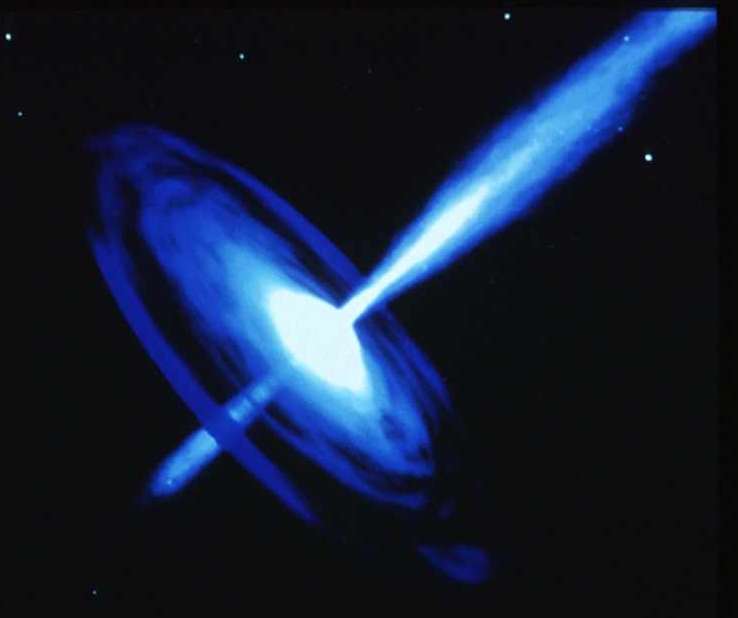
Black holes spin faster and faster


An artist’s impression of the jets emerging from a supermassive black hole at the center of the galaxy PKS 0521-36. Dana Berry/STScI

By Royal Astronomical Society, United Kingdom
Published: May 24, 2011

Two United Kingdom astronomers have found that the giant black holes in the center of galaxies are on average spinning faster than at any time in the history of the universe. Alejo Martinez-Sansigre from the University of Portsmouth and Steve Rawlings from the University of Oxford made the new discovery by using radio, optical, and X-ray data.

There is strong evidence that every galaxy has a black hole in its center. These black holes have masses between a million and a billion Suns and so are referred to as “supermassive.” They are not visible directly, but material swirls around the black hole in an accretion disk before its final demise. That material can become hot and emit radiation, including X-rays that can be detected by space-based telescopes while associated radio emission can be detected by telescopes on the ground.

As well as radiation, twin jets are often associated with black holes and their accretion disks. There are many factors that can cause these jets to form, but scientists believe the spin of the supermassive black hole is important. However, there are conflicting predictions about how the spins of the black holes should be evolving, and until now this evolution was not well understood.

Martinez-Sansigre and Rawlings compared theoretical models of spinning black holes with radio, optical, and X-ray observations made using a variety of instruments and found that the theories can explain very well the population of supermassive black holes with jets.

Using the radio observations, the two astronomers were able to sample the population of black holes, deducing the spread of the jets’ power. By estimating how they acquire material (the accretion process), the two scientists could then infer how quickly these objects are spinning.

The observations also give information on how the spins of supermassive black holes have evolved. In the past, when the universe was half its present size, practically all of the supermassive black holes had low spins, whereas today a fraction of them have high spins. So on average, supermassive black holes are spinning faster than ever before.

This is the first time that the evolution of the spin of the supermassive black holes has been constrained, and it suggests that those supermassive black holes that grow by swallowing matter will barely spin, while those that merge with other black holes will be left spinning rapidly.

“The spin of black holes can tell you a lot about how they formed,” said Martinez-Sansigre. “Our results suggest that in recent times a large fraction of the most massive black holes have somehow spun up. A likely explanation is that they have merged with other black holes of similar mass, which is a truly spectacular event, and the end product of this merger is a faster spinning black hole.”

“Later this decade, we hope to test our idea that these supermassive black holes have been set spinning relatively recently,” said Rawlings. “Black hole mergers cause predictable distortions in space and time — called gravitational waves. With so many collisions, we expect there to be a cosmic background of gravitational waves, something that will change the timing of the pulses of radio waves that we detect from the remnants of massive stars known as pulsars.

“If we are right, this timing change should be picked up by the Square Kilometer Array, the giant radio observatory due to start operating in 2019.”

Promising new method to measure star age


Artist's conception of a hypothetical exoplanet. Gyrochronology is a promising new method to learn the ages of isolated stars, including all stars known to have planets. David A. Aguilar (CfA)

By Harvard-Smithsonian Center for Astrophysics, Cambridge, Massachusetts
Published: May 23, 2011

How can we tell if a star is 1 billion or 10 billion years old? Astronomers may have found a solution — measuring the star's spin. "A star's rotation slows down steadily with time, like a top spinning on a table, and can be used as a clock to determine its age," said astronomer Soren Meibom from the Harvard-Smithsonian Center for Astrophysics in Cambridge, Massachusetts.

Knowing a star's age is important for many astronomical studies and, in particular, for planet hunters. With the bountiful harvest from NASA's Kepler spacecraft (launched in 2009) adding to previous discoveries, astronomers have found nearly 2,000 planets orbiting distant stars. Now, they want to use this new zoo of planets to understand how planetary systems form and evolve and why they are so different from each other.

"Ultimately, we need to know the ages of the stars and their planets to assess whether alien life might have evolved on these distant worlds," said Meibom. "The older the planet, the more time life has had to get started. Since stars and planets form together at the same time, if we know a star's age, we know the age of its planets, too."

Learning a star's age is relatively easy when it's in a cluster of hundreds of stars that all formed at the same time. Astronomers have known for decades that if they plot the colors and brightnesses of the stars in a cluster, the pattern they see can be used to tell the cluster's age. But this technique only works on clusters. For stars not in clusters (including all stars known to have planets), determining the age is more difficult.

Using the unique capabilities of the Kepler space telescope, Meibom and his collaborators measured the rotation rates for stars in a 1-billion-year-old cluster called NGC 6811. This new work nearly doubles the age covered by previous studies of younger clusters. It also significantly adds to our knowledge of how a star's spin rate and age are related.

If a relationship between stellar rotation and age can be established by studying stars in clusters, then measuring the rotation period of any star can be used to derive its age — a technique called gyrochronology. For gyrochronology to work, astronomers first must calibrate their new "clock."

They begin with stars in clusters with known ages. By measuring the spins of cluster stars, they can learn what spin rate to expect for that age. Measuring the rotation of stars in clusters with different ages tells them exactly how spin and age are related. Then by extension, they can measure the spin of a single isolated star and calculate its age.

To measure a star's spin, astronomers look for changes in its brightness caused by dark spots on its surface — the stellar equivalent of sunspots. Any time a spot crosses the star's face, it dims slightly. Once the spot rotates out of view, the star's light brightens again. By watching how long it takes for a spot to rotate into view, travel across the star, and then disappear out of view again, scientists learn how fast the star is spinning.

The changes in a star's brightness due to spots are very small, typically a few percent or less, and become smaller the older the star. Therefore, the rotation periods of stars older than about half a billion years can't be measured from the ground where Earth's atmosphere interferes. Fortunately, this is not a problem for the Kepler spacecraft. Kepler was designed specifically to measure stellar brightnesses very precisely in order to detect planets, which block a star's light ever so slightly if they cross the star's face from our point of view.

To extend the age-rotation relationship to NGC 6811, Meibom and his colleagues faced a herculean task. They spent 4 years painstakingly sorting out stars in the cluster from unrelated stars that just happened to be seen in the same direction. This preparatory work was done using a specially designed instrument, called the Hectochelle, mounted on the MMT telescope on Mt. Hopkins in southern Arizona. Hectochelle can observe 240 stars at the same time, allowing the researcher to observe nearly 7,000 stars over 4 years. Once they knew which stars were the real cluster stars, they used Kepler data to determine how fast those stars were spinning.

They found rotation periods ranging from 1 to 11 days (with hotter, more-massive stars spinning faster), compared to the 30-day spin rate of our Sun. More importantly, they found a strong relationship between stellar mass and rotation rate, with little scatter. This result confirms that gyrochronology is a promising new method to learn the ages of isolated stars.

The team now plans to study other, older star clusters to continue calibrating their stellar "clocks." Those measurements will be more challenging because older stars spin slower and have fewer and smaller spots, meaning that the brightness changes will be even smaller and more drawn out. Nevertheless, they feel up to the challenge.

"This work is a leap in our understanding of how stars like our Sun work. It also may have an important impact on our understanding of planets found outside our solar system," said Meibom.

Saturday, May 21, 2011

Free-Floating Planets May Be More Common Than Stars


This artist's conception illustrates a Jupiter-like planet alone in the dark of space, floating freely without a parent star.
Image credit: NASA/JPL-Caltech

By Jet Propulsion Laboratory, Pasadena, Calif.
Published: 05.18.11

Astronomers, including a NASA-funded team member, have discovered a new class of Jupiter-sized planets floating alone in the dark of space, away from the light of a star. The team believes these lone worlds were probably ejected from developing planetary systems.

The discovery is based on a joint Japan-New Zealand survey that scanned the center of the Milky Way galaxy during 2006 and 2007, revealing evidence for up to 10 free-floating planets roughly the mass of Jupiter. The isolated orbs, also known as orphan planets, are difficult to spot, and had gone undetected until now. The newfound planets are located at an average approximate distance of 10,000 to 20,000 light-years from Earth.

"Although free-floating planets have been predicted, they finally have been detected, holding major implications for planetary formation and evolution models," said Mario Perez, exoplanet program scientist at NASA Headquarters in Washington.

The discovery indicates there are many more free-floating Jupiter-mass planets that can't be seen. The team estimates there are about twice as many of them as stars. In addition, these worlds are thought to be at least as common as planets that orbit stars. This would add up to hundreds of billions of lone planets in our Milky Way galaxy alone.

"Our survey is like a population census," said David Bennett, a NASA and National Science Foundation-funded co-author of the study from the University of Notre Dame in South Bend, Ind. "We sampled a portion of the galaxy, and based on these data, can estimate overall numbers in the galaxy."

The study, led by Takahiro Sumi from Osaka University in Japan, appears in the May 19 issue of the journal Nature.

The survey is not sensitive to planets smaller than Jupiter and Saturn, but theories suggest lower-mass planets like Earth should be ejected from their stars more often. As a result, they are thought to be more common than free-floating Jupiters.

Previous observations spotted a handful of free-floating, planet-like objects within star-forming clusters, with masses three times that of Jupiter. But scientists suspect the gaseous bodies form more like stars than planets. These small, dim orbs, called brown dwarfs, grow from collapsing balls of gas and dust, but lack the mass to ignite their nuclear fuel and shine with starlight. It is thought the smallest brown dwarfs are approximately the size of large planets.

On the other hand, it is likely that some planets are ejected from their early, turbulent solar systems, due to close gravitational encounters with other planets or stars. Without a star to circle, these planets would move through the galaxy as our sun and other stars do, in stable orbits around the galaxy's center. The discovery of 10 free-floating Jupiters supports the ejection scenario, though it's possible both mechanisms are at play.

"If free-floating planets formed like stars, then we would have expected to see only one or two of them in our survey instead of 10," Bennett said. "Our results suggest that planetary systems often become unstable, with planets being kicked out from their places of birth."

The observations cannot rule out the possibility that some of these planets may have very distant orbits around stars, but other research indicates Jupiter-mass planets in such distant orbits are rare.

The survey, the Microlensing Observations in Astrophysics (MOA), is named in part after a giant wingless, extinct bird family from New Zealand called the moa. A 5.9-foot (1.8-meter) telescope at Mount John University Observatory in New Zealand is used to regularly scan the copious stars at the center of our galaxy for gravitational microlensing events. These occur when something, such as a star or planet, passes in front of another, more distant star. The passing body's gravity warps the light of the background star, causing it to magnify and brighten. Heftier passing bodies, like massive stars, will warp the light of the background star to a greater extent, resulting in brightening events that can last weeks. Small planet-size bodies will cause less of a distortion, and brighten a star for only a few days or less.

A second microlensing survey group, the Optical Gravitational Lensing Experiment (OGLE), contributed to this discovery using a 4.2-foot (1.3 meter) telescope in Chile. The OGLE group also observed many of the same events, and their observations independently confirmed the analysis of the MOA group.

A Timeline to Launch for the Alpha Magnetic Spectrometer


Fig: AMS, foreground, on the International Space Station National Laboratory

International Space Station Program Science Office
NASA's Johnson Space Center
Published: 05.19.11

The Alpha Magnetic Spectrometer, or AMS, was carried into orbit on STS-134 on a mission to the International Space Station. While it may sound like just another instrument, in actuality it is the largest scientific collaboration to use the laboratory! This investigation is sponsored by the United States Department of Energy and made possible by funding from 16 different nations. Led by Nobel Laureate Professor Samuel Ting, more than 600 physicists from around the globe will be able to participate in the data generated from this particle physics detector.

According to Trent Martin, AMS project manager for NASA, "This type of collaboration is starting to become more common in the space science community, but AMS is by far the most diversely funded space based science detector ever built. This is the type of collaboration that NASA hopes the ISS National Laboratory will help foster in the space scientific community."

The mission, to seek out answers to the mysteries of antimatter, dark matter, and cosmic ray propagation in the universe, is only part of the story. To fully understand where the science is going, you have to look at where it came from. NASA efforts with AMS began in 1994, when NASA's Johnson Space Center in Houston, Texas, conducted a feasibility study to see if such a delicate instrument could even fly in space and still produce usable data.

Ken Bollweg, AMS deputy project manager for NASA, mentions the challenges that needed to be overcome for the hazardous environment of space. "The detectors used in these types of experiments are typically used in an underground environment where the temperature doesn’t change more than two degrees from winter to summer and the bedrock hasn't moved in millennia," comments Bollweg. "Reviews of the detectors and their operating requirements indicated that it would be very challenging to adapt this technology to space -- but possible nonetheless."

Work on AMS integration and interface hardware began in earnest upon approval in 1995. One of the first understandings NASA needed to reach with the AMS Collaboration was the limitations of mass, size and power. For instance, the AMS Collaboration considered the AMS permanent magnet lightweight at approximately 2 tons, given that similar electromagnets on Earth weigh about 10,000 tons.

Working together, NASA and the AMS Collaboration developed a two-part plan to enable the mass requirements. The Unique Support Structure or USS-01 completed in 1997 and was launched with STS-91 in June of 1998. It carried a 9,197 lb engineering evaluation version of AMS. With the successful STS-91 mission and some extra time, since it was clear that the station would not be ready to host AMS in 2001, the scientists decided to make a few improvements. Plans for the AMS grew to be more complex, including the upgrade to a more powerful cryogenic superconducting superfluid helium-cooled magnet. These changes increased the projected weight for AMS to 15,251 lb, making it necessary to test a second support structure, called USS-02.

Determining a way to communicate the data from AMS to the ground was another important element of the undertaking. A digital data recorder system was developed and used during the STS-91 mission to capture data for the AMS Collaboration. Even though this was a preliminary effort to the overall AMS goal, the resulting data led to improved measurement sensitivity.

Several years passed as engineers continued working on procedures, certification requirements, and entered into the testing phases of development. In December 2001 NASA flew a prototype synchrotron radiation detector with STS-108. This flight test clarified performance of the detector for the AMS. The enhanced complexity of the AMS also meant an increase in data channels from close to 70,000 to over 300,000. In response, NASA developed a new digital data recorder system, which launched on STS-133 in February 2011. This enabled a trial run of the recorder system in preparation for the actual launch of AMS with STS-134.

With the announcement that the space station would continue to operate through 2020, the AMS Collaboration swapped out the current cryogenic magnet with a permanent magnet, which would have an infinite life. The entire AMS was taken apart, the magnets exchanged, and put back together for testing. From concept to implementation, this only took seven months to extend the potential life of the AMS investigation.

Martin commends the efforts of the many NASA and contractor personnel who made significant contributions to the completion of the AMS investigation. These individuals will continue to support AMS while it is on its mission in orbit to gather valuable data. Martin notes in particular the support of NASA's Bill Gerstenmaier, associate administrator for space operations. "[He was] critical to AMS's success, especially while AMS was off the space shuttle and space station manifests after the Columbia accident," says Martin. "He saw to it that Advanced Projects Office personnel were able to continue with the integration and certification tasks and personally visited AMS at various stages of development and testing."

The AMS will be the most advanced charge particle detector flown in space, increasing global knowledge of antimatter and dark matter and providing a powerful tool to physicists. The investigation will enable the discipline of modern physics to grow as scientists seek answers to the origins of our universe.

The Einstein Telescope (Underground Observatory)


By Astroparticle European Research Area Press Office, Geneva, Switzerland
Published: May 19, 2011

A new era in astronomy will come a step closer when scientists from across Europe present their design study today, May 19, for an advanced observatory capable of making precision measurements of gravitational waves — minute ripples in the fabric of space-time — predicted to emanate from cosmic catastrophes such as merging black holes and collapsing stars and supernovae. It also offers the potential to probe the earliest moments of the universe just after the Big Bang, which is currently inaccessible.

The Einstein Observatory (ET) is a third-generation gravitational-wave (GW) detector, which will be 100 times more sensitive than current instruments. Like the first two generations of GW detectors, it is based on the measurement of tiny changes (far less than the size of an atomic nucleus) in the lengths of two connected arms several kilometers long, caused by a passing gravity wave. Laser beams passing down the arms record their periodic stretching and shrinking as interference patterns in a central photo-detector.

The first generation of these interferometric detectors built a few years ago (GEO600, LIGO, Virgo, and TAMA) successfully demonstrated the proof-of-principle and constrained the gravitational wave emission from several sources. The next generation (Advanced LIGO and Advanced Virgo), which is being constructed now, should make the first direct detection of gravitational waves — for example, from a pair of orbiting black holes or neutron stars spiraling into each other. Such a discovery would herald the new field of GW astronomy. However, these detectors will not be sensitive enough for precise astronomical studies of the GW sources.

"The community of scientists interested in exploring GW phenomena, therefore, decided to investigate building a new generation of even more-sensitive observatories. After a three-year study involving more than 200 scientists in Europe and across the world, we are pleased to present the design study for the Einstein Telescope, which paves the way for unveiling a hidden side of the universe," said Harald Lück, deputy scientific coordinator of the ET Design Study.

The design study outlines ET’s scientific targets, the detector layout and technology, as well as the timescale and estimated costs. A superb sensitivity will be achieved by building ET underground at a depth of about 330 feet to 660 feet (100 to 200 meters) to reduce the effect of residual seismic motion. This will enable higher sensitivities to be achieved at low frequencies, between 1 and 100 hertz (Hz). With ET, the entire range of GW frequencies that can be measured on Earth — between about 1 Hz and 10 kHz — should be detected. “An observatory achieving that level of sensitivity will turn GW detection into a routine astronomical tool. ET will lead a scientific revolution,” said Michele Punturo, scientific coordinator of the design study. An important aim is to provide GW information that complements observational data from telescopes detecting electromagnetic radiation (from radio waves through to gamma-rays) and other instruments detecting high-energy particles from space (astroparticle physics).

The strategy behind the ET project is to build an observatory that overcomes the limitations of current detector sites by hosting more than one GW detector. It will consist of three nested detectors, each composed of two interferometers with arms 6 miles (10 kilometers) long. One interferometer will detect low-frequency gravitational wave signals (2 to 40 Hz) while the other will detect the high-frequency components. The configuration is designed to allow the observatory to evolve by accommodating successive upgrades or replacement components that can take advantage of future developments in interferometry and also respond to a variety of science objectives.

The European Commission supported the design study within the Seventh Framework Program (FP7-Capacities) by allocating three million Euros. “With this grant, the European Commission recognized the importance of gravitational wave science as developed in Europe, its value for fundamental and technological research, provided a common framework for the European scientists involved in the gravitational wave search, and allowed for a significant step towards the exploration of the universe with a completely new inquiry instrument,” said Federico Ferrini from the European Gravitational Observatory.

ET is one of the “Magnificent Seven” European projects recommended by the ASPERA network for the future development of astroparticle physics in Europe. It would be a crucial European research infrastructure and a fundamental cornerstone in the realization of the European Research Area.

Wednesday, May 18, 2011

Shuttle Endeavour heads to space station on its final mission


Fig: Space shuttle Endeavour launches on the STS-134 mission to the International Space Station. NASA

By NASA Headquarters, Washington, D.C.
Published: May 16, 2011

Space shuttle Commander Mark Kelly and his five crewmates are on their way to the International Space Station after launching from NASA's Kennedy Space Center at 8:56 a.m. EDT today, May 16. The STS-134 mission is the penultimate orbiter flight and the final one for shuttle Endeavour.

"This mission represents the power of teamwork, commitment and exploration," Kelly said shortly before liftoff. "It is in the DNA of our great country to reach for the stars and explore. We must not stop. To all the millions watching today, including our spouses, children, family, and friends, we thank you for your support."

The crew will deliver the Alpha Magnetic Spectrometer-2 (AMS) and critical supplies to the space station, including two communications antennas, a high-pressure gas tank, and additional parts for the Dextre robot. AMS is a particle physics detector designed to search for various types of unusual cosmic matter. The crew also will transfer Endeavour's orbiter boom sensor system to the station where it could assist spacewalkers as an extension for the station's robotic arm.

"Today's final launch of Endeavour is a testament to American ingenuity and leadership in human spaceflight," NASA Administrator Charles Bolden said. "As we look toward a bright future with the International Space Station as our anchor and new destinations in deep space on the horizon, we salute the astronauts and ground crews who have ensured the orbiter's successful missions. The presence of Congresswoman Gabrielle Giffords at the launch inspired us all, just as America's space program has done for the past 50 years."

Kelly's crewmates are Pilot Greg H. Johnson and Mission Specialists Mike Fincke, Drew Feustel, Greg Chamitoff, and Roberto Vittori of the European Space Agency. This is the first shuttle flight for Fincke and Vittori. Vittori will be the last international astronaut to fly aboard a shuttle.

Endeavour is scheduled to dock to the station at 6:15 a.m. on Wednesday, May 18. The 16-day mission includes four spacewalks. After undocking to return to Earth, Kelly and Johnson will ease the shuttle back toward the station to test new sensor technologies that could facilitate the docking of future space vehicles to the station.

The shuttle's first landing opportunity at Kennedy is scheduled for 2:32 a.m. June 1. STS-134 is the 134th shuttle flight, the 25th flight for Endeavour, and the 36th shuttle mission dedicated to station assembly and maintenance.

sudden flares from Crab Nebula


Fermi's LAT discovered a gamma-ray 'superflare' from the Crab Nebula on April 12, 2011. These images show the number of gamma rays with energies greater than 100 million electron volts from a region of the sky centered on the Crab Nebula. Both views eliminate emission form the Crab pulsar by showing the sky in between its pulses. In both images, the bright source below is the Geminga pulsar. At left, the region 20 days before the flare; at right, April 14.

Credit: NASA/DOE/Fermi LAT/R. Buehler
By NASA Headquarters, Washington, D.C.
Published: May 12, 2011

The famous Crab Nebula supernova remnant has erupted in an enormous flare five times more powerful than any flare previously seen from the object. On April 12, NASA's Fermi Gamma-ray Space Telescope first detected the outburst, which lasted six days.

The nebula is the wreckage of an exploded star that emitted light which reached Earth in the year 1054. It is located 6,500 light-years away in the constellation Taurus. At the heart of an expanding gas cloud lies what is left of the original star's core, a superdense neutron star that spins 30 times a second. With each rotation, the star swings intense beams of radiation toward Earth, creating the pulsed emission characteristic of spinning neutron stars (also known as pulsars).
Apart from these pulses, astrophysicists believed the Crab Nebula was a virtually constant source of high-energy radiation. But in January, scientists associated with several orbiting observatories, including NASA's Fermi, Swift and Rossi X-ray Timing Explorer, reported long-term brightness changes at X-ray energies.

"The Crab Nebula hosts high-energy variability that we're only now fully appreciating," said Rolf Buehler, a member of the Fermi Large Area Telescope (LAT) team at the Kavli Institute for Particle Astrophysics and Cosmology, a facility jointly located at the Department of Energy's SLAC National Accelerator Laboratory and Stanford University.

Since 2009, Fermi and the Italian Space Agency's AGILE satellite have detected several short-lived gamma-ray flares at energies greater than 100 million electron volts (eV) -- hundreds of times higher than the nebula's observed X-ray variations. For comparison, visible light has energies between 2 and 3 eV.

On April 12, Fermi's LAT, and later AGILE, detected a flare that grew about 30 times more energetic than the nebula's normal gamma-ray output and about five times more powerful than previous outbursts. On April 16, an even brighter flare erupted, but within a couple of days, the unusual activity completely faded out.
"These superflares are the most intense outbursts we've seen to date, and they are all extremely puzzling events," said Alice Harding at NASA's Goddard Space Flight Center in Greenbelt, Md. "We think they are caused by sudden rearrangements of the magnetic field not far from the neutron star, but exactly where that's happening remains a mystery."

The Crab's high-energy emissions are thought to be the result of physical processes that tap into the neutron star's rapid spin. Theorists generally agree the flares must arise within about one-third of a light-year from the neutron star, but efforts to locate them more precisely have proven unsuccessful so far.

Since September 2010, NASA's Chandra X-ray Observatory routinely has monitored the nebula in an effort to identify X-ray emission associated with the outbursts. When Fermi scientists alerted astronomers to the onset of a new flare, Martin Weisskopf and Allyn Tennant at NASA's Marshall Space Flight Center in Huntsville, Ala., triggered a set of pre-planned observations using Chandra.

"Thanks to the Fermi alert, we were fortunate that our planned observations actually occurred when the flares were brightest in gamma rays," Weisskopf said. "Despite Chandra's excellent resolution, we detected no obvious changes in the X-ray structures in the nebula and surrounding the pulsar that could be clearly associated with the flare."
Scientists think the flares occur as the intense magnetic field near the pulsar undergoes sudden restructuring. Such changes can accelerate particles like electrons to velocities near the speed of light. As these high-speed electrons interact with the magnetic field, they emit gamma rays.

To account for the observed emission, scientists say the electrons must have energies 100 times greater than can be achieved in any particle accelerator on Earth. This makes them the highest-energy electrons known to be associated with any cosmic source. Based on the rise and fall of gamma rays during the April outbursts, scientists estimate that the size of the emitting region must be comparable in size to the solar system.

Monday, May 16, 2011

Newly merged black hole eagerly shreds stars


In this artist's conception, two black holes are about to merge. When they combine, gravitational wave radiation will "kick" the black hole like a rocket engine, sending it rampaging through nearby stars. David A. Aguilar (CfA)

By Harvard-Smithsonian Center for Astrophysics, Cambridge, Massachusetts
Published: April 11, 2011

A galaxy's core is a busy place, crowded with stars swarming around an enormous black hole. When galaxies collide, it gets even messier as the two black holes spiral toward each other, merging to make an even bigger gravitational monster.

Once it is created, the monster goes on a rampage. The merger kicks the black hole into surrounding stars. There it finds a hearty meal, shredding and swallowing stars at a rapid clip. According to new research by Nick Stone and Avi Loeb from the Harvard-Smithsonian Center for Astrophysics in Cambridge, Massachusetts, upcoming sky surveys might offer astronomers a way to catch a gorging black hole "in the act."

Before the merger, as the two black holes whirl around each other, they stir the galactic center like the blade of a blender. Their strong gravity warps space, sending out ripples known as gravitational waves. When the black holes merge, they emit gravitational waves more strongly in one direction. That inequality kicks the black hole in the opposite direction like a rocket.

"That kick is very important. It can shove the black hole toward stars that otherwise would have been at a safe distance," said Stone. "Essentially, the black hole can go from starving to enjoying an all-you-can-eat buffet."

When tidal forces rip a star apart, its remains will spiral around the black hole, smashing and rubbing together, heating up enough to shine in the ultraviolet or X-rays. The black hole will glow as brightly as an exploding star, or supernova, before gradually fading in a distinctive way.

Importantly, a wandering supermassive black hole is expected to swallow many more stars than a black hole in an undisrupted galactic center. A stationary black hole disrupts one star every 100,000 years. In the best-case scenario, a wandering black hole could disrupt a star every decade. This would give astronomers a better opportunity of spotting these events, particularly with new survey facilities like Pan-STARRS and the Large Synoptic Survey Telescope.

Catching the signal from a disrupted star is a good start. However, astronomers really want to combine that information with gravitational wave data from the black hole merger. The Laser Interferometer Space Antenna (LISA), a future mission designed to detect and study gravitational waves, could provide that data.

Gravitational wave measurements yield accurate distances (to better than one part in a hundred, or 1 percent). However, they don't provide precise sky coordinates. A star's tidal disruption will let astronomers pinpoint the galaxy containing the recently merged black-hole binary.

By correlating the galaxy's redshift (a change in its light that's caused by the expanding universe) with an accurate distance, astronomers can infer the equation of state of dark energy. In other words, they can learn more about the force that's accelerating cosmic expansion, and which dominates the cosmic mass/energy budget today.

"Instead of 'standard candles' like supernovae, the black hole binary would be a 'standard siren.' Using it, we could create the most accurate cosmic 'ruler' possible," said Loeb.

Finding a merged black hole also would allow theorists to explore a new regime of Einstein's general theory of relativity.

"We could test general relativity in the regime of strong gravity with unprecedented precision," said Loeb.

New evidence about the existence of a magnetosphere around WASP-12b


Artists impression of the WASP-12 system. ESA/C. Carreau
By Royal Astronomical Society, United Kingdom
Published: April 18, 2011

Jupiter-like worlds around other stars push shock waves ahead of them, according to a team of United Kingdom astronomers. Just as Earth’s magnetic “bowshock” protects us from the high-energy solar wind, these planetary shocks protect their atmospheres from their star’s damaging emissions.

In 2008, observations of the star WASP-12 detected a periodic dip in light as a large planet — cataloged as WASP-12b — passed in front of its host star. Planet hunting with transit instruments like SuperWASP allows astronomers to obtain a wealth of information about exoplanetary systems including their composition and size.

WASP-12b turns out to be one of the largest exoplanets found to date, and it completes each orbit around its parent star in just 26 hours. The planet is more than 155,000 miles (250,000 kilometers) across. With its atmosphere swollen by the intense heat it receives from the star, it makes it a “hot Jupiter.”

Hot Jupiters are similar to the planet Jupiter in our own solar system but located far closer to their host star — WASP-12b is 2.1 million miles (3.4 million km) away from WASP-12, which compares with the Earth-Sun distance of 93 million miles (150 million km). With such a small distance between them, violent interactions between the star and the planet can take place. As one of the largest hot Jupiters discovered to date, WASP-12b also gives a unique opportunity to observe the interactions between the planetary magnetic field and the host star’s magnetic field. The very presence of a magnetic field reveals that the planet must have a conducting, rotating interior.

There is now tantalizing new evidence from Hubble Space Telescope data that a magnetosphere exists around WASP-12b. Observations of the planet taken in ultraviolet wavelengths by a team, including scientists from the Open University, reveal that the start of the dip in the light from the star during the transit of the planet is earlier in ultraviolet than visible light. Originally, material flowing from the planet onto the star was thought to have caused it. A University of St. Andrews, Scotland, group have, however, determined that the planet plows into a supersonic headwind and pushes a shock ahead of it — just like the one around a supersonic jet aircraft.The astronomers carried out simulations of a planet and its bow shock transiting a star and by investigating various shock geometries, orientations, and densities have reproduced the dip in ultraviolet light observed in WASP-12b.

“The location of this bow shock provides us with an exciting new tool to measure the strength of planetary magnetic fields,” said Aline Vidotto from St. Andrews. “This is something that presently cannot be done in any other way.”

“Our models are able to reproduce the data from the Hubble Space Telescope for a range of wind speeds, implying that bow shocks could be far more commonplace than had been thought,” said Joe Llama from St. Andrews.

Bow shocks may also protect the atmospheres of hot Jupiters from their harsh environment. These planets are constantly bombarded with highly charged, energized particles from the wind from their parent stars, meaning that their atmosphere can be eroded. The presence of a magnetic field could greatly reduce the amount of stellar wind the planet is exposed to, effectively acting as a shield and helping the atmosphere survive.“Although our model predicts a bow shock similar to that of the Earth, we are not expecting any messages from WASP-12b as it is too hot to support life,” said Joe Llama. “But the first hints that extrasolar planets have magnetosphere is a big step forward in understanding and identifying the habitable zones where we ultimately hope to find signs of life”.