Showing posts with label Unknown destiny. Show all posts

Friday, January 30, 2009

Cornell-led team detects dust around a primitive star, shedding new light on universe's origins


Palomar Digitized Sky Survey
The Sculptor Dwarf galaxy,
with the position of carbon star MAG 29 noted.

Friday, January 16, 2009

A Cornell-led team of astronomers has observed dust forming around a dying star in a nearby galaxy, giving a glimpse into the early universe and enlivening a debate about the origins of all cosmic dust.

The findings are reported in the Jan. 16 issue of the journal Science (Vol. 323, No. 5912). Cornell research associate Greg Sloan led the study, which was based on observations with NASA's Spitzer Space Telescope. The researchers used Spitzer's Infrared Spectrograph, which was developed at Cornell.

Dust plays a key role in the evolution of such galaxies as our Milky Way. Stars produce dust -- rich with carbon or oxygen -- as they die. But less is known about how and what kind of dust was created in galaxies as they formed soon after the big bang.

Sloan and his colleagues observed dust forming around the carbon star MAG 29, located 280,000 light years away in a smaller nearby galaxy called the Sculptor Dwarf. Stars more massive than the sun end their lives as carbon stars, which in our galaxy are a rich source of dust.

The Sculptor Dwarf contains only 4 percent of the carbon and other heavy elements in our own galaxy, making it similar to primitive galaxies seen at the edge of the universe. Those galaxies emitted the light we now see soon after they and the universe formed.

"What this tells us is that carbon stars could have been pumping dust soon after the first galaxies were born," Sloan said.

Scientists have debated where the dust in the early universe comes from. Supernovae have been a favorite suspect, but they may destroy more dust than they create.

"While everyone is focused on the questions of how much and what kind of dust supernovae make, they may not have appreciated that carbon stars can make at least some of the dust we are seeing," Sloan said. "The more we can understand the quantity and composition of the dust, the better we can understand how stars and galaxies evolve, both in the early universe and right next door."

Observing such stars as MAG 29 is not unlike using a time machine, Sloan said, in which astronomers can catch glimpses of what the universe looked like billions of years ago.

"We haven't seen carbon-rich dust in this primitive of an environment before," Sloan said.

The study is co-authored by J. Bernard Salas, a Cornell postdoctoral associate, and scientists in Japan, England, Australia and Belgium. It is part of a project led by Albert Zijlstra at the University of Manchester in England.

New study resolves mystery of how massive stars form


Volume renderings of the density field in a region of the simulation at 55,000 years of evolution. The left panel shows a polar view, and the right panel shows an equatorial view. The fingers feeding the equatorial disk are clearly visible.


Computer simulation of the formation of a massive star yielded these snapshots showing stages in the process over time. Panels on the left represent a polar view (the axis of rotation is perpendicular to the plane of the image), and panels on the right represent an equatorial view. Plus signs indicate projected positions of stars. Colors represent density.

Theorists have long wondered how massive stars--up to 120 times the mass of the Sun--can form without blowing away the clouds of gas and dust that feed their growth. But the problem turns out to be less mysterious than it once seemed. A study published this week by Science shows how the growth of a massive star can proceed despite outward-flowing radiation pressure that exceeds the gravitational force pulling material inward.

The new findings also explain why massive stars tend to occur in binary or multiple star systems, said lead author Mark Krumholz, an assistant professor of astronomy and astrophysics at the University of California, Santa Cruz. The formation of companion stars emerged unexpectedly from the sophisticated computer simulations the researchers used to explore the physics of massive star formation.

"We didn't set out to solve that question, so it was a nice side benefit of the study," Krumholz said. "The main finding is that radiation pressure does not limit the growth of massive stars."

Radiation pressure is the force exerted by electromagnetic radiation on the surfaces it strikes. This effect is negligible for ordinary light, but it becomes significant in the interiors of stars due to the intensity of the radiation. In massive stars, radiation pressure is the dominant force counteracting gravity to prevent the further collapse of the star.

"When you apply the radiation pressure from a massive star to the dusty interstellar gas around it, which is much more opaque than the star's internal gas, it should explode the gas cloud," Krumholz said. Earlier studies suggested that radiation pressure would blow away the raw materials of star formation before a star could grow much larger than about 20 times the mass of the Sun. Yet astronomers observe stars much more massive than that.

Krumholz and his coauthors at UC Berkeley and Lawrence Livermore National Laboratory have spent years developing complex computer codes for simulating the processes of star formation. Combined with advances in computer technology, their latest software (called ORION) enabled them to run a detailed three-dimensional simulation of the collapse of an enormous interstellar gas cloud to form a massive star. The project required months of computing time at the San Diego Supercomputer Center.

The simulation showed that as the dusty gas collapses onto the growing core of a massive star, with radiation pressure pushing outward and gravity pulling material in, instabilities develop that result in channels where radiation blows out through the cloud into interstellar space, while gas continues falling inward through other channels.

"You can see fingers of gas falling in and radiation leaking out between those fingers of gas," Krumholz said. "This shows that you don't need any exotic mechanisms; massive stars can form through accretion processes just like low-mass stars."

The rotation of the gas cloud as it collapses leads to the formation of a disk of material feeding onto the growing "protostar." The disk is gravitationally unstable, however, causing it to clump and form a series of small secondary stars, most of which end up colliding with the central protostar. In the simulation, one secondary star became massive enough to break away and acquire its own disk, growing into a massive companion star. A third small star formed and was ejected into a wide orbit before falling back in and merging with the primary star.

When the researchers stopped the simulation, after allowing it to evolve for 57,000 years of simulated time, the two stars had masses of 41.5 and 29.2 times the mass of the Sun and were circling each other in a fairly wide orbit.

"What formed in the simulation is a common configuration for massive stars," Krumholz said. "I think we can now consider the mystery of how massive stars are able to form to be solved. The age of supercomputers and the ability to simulate the process in three dimensions made the solution possible."

The paper describing these results is being published by Science on the Science Express web site on January 15, 2009. In addition to Krumholz, the coauthors are Richard Klein, Christopher McKee, and Stella Offner of UC Berkeley, and Andrew Cunningham of Lawrence Livermore National Laboratory.

Martian Methane Reveals the Red Planet is not a Dead Planet


This image shows concentrations of Methane discovered on Mars.
Credit: NASA
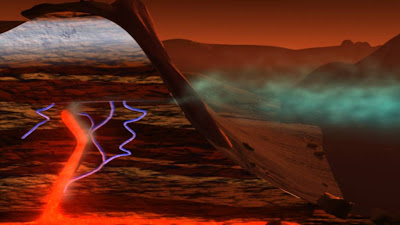

Scientists don't yet know enough to say with certainty what the source of the Martian methane is, but this artist's concept depicts a possibility. In this illustration, subsurface water, carbon dioxide and the planet's internal heat combine to release methane. Although we don’t have evidence on Mars of active volcanoes today, ancient methane trapped in ice "cages" might now be released. Credit: NASA/Susan Twardy

Thursday, January 15, 2009

Mars today is a world of cold and lonely deserts, apparently without life of any kind, at least on the surface. Worse still, it looks like Mars has been cold and dry for billions of years, with an atmosphere so thin, any liquid water on the surface quickly boils away while the sun's ultraviolet radiation scorches the ground.

But there is evidence of a warmer and wetter past -- features resembling dry riverbeds and minerals that form in the presence of water indicate water once flowed through Martian sands. Since liquid water is required for all known forms of life, scientists wonder if life could have risen on Mars, and if it did, what became of it as the Martian climate changed.

New research reveals there is hope for Mars yet. The first definitive detection of methane in the atmosphere of Mars indicates the planet is still alive, in either a biologic or geologic sense, according to a team of NASA and university scientists.

"Methane is quickly destroyed in the Martian atmosphere in a variety of ways, so our discovery of substantial plumes of methane in the northern hemisphere of Mars in 2003 indicates some ongoing process is releasing the gas," said Dr. Michael Mumma of NASA's Goddard Space Flight Center in Greenbelt, Md. "At northern mid-summer, methane is released at a rate comparable to that of the massive hydrocarbon seep at Coal Oil Point in Santa Barbara, Calif.

" Methane -- four atoms of hydrogen bound to a carbon atom -- is the main component of natural gas on Earth. It's of interest to astrobiologists because organisms release much of Earth's methane as they digest nutrients. However, other purely geological processes, like oxidation of iron, also release methane. "Right now, we don’t have enough information to tell if biology or geology -- or both -- is producing the methane on Mars," said Mumma. "But it does tell us that the planet is still alive, at least in a geologic sense. It's as if Mars is challenging us, saying, hey, find out what this means." Mumma is lead author of a paper on this research appearing in Science Express Jan. 15.

If microscopic Martian life is producing the methane, it likely resides far below the surface, where it's still warm enough for liquid water to exist. Liquid water, as well as energy sources and a supply of carbon, are necessary for all known forms of life.

"On Earth, microorganisms thrive 2 to 3 kilometers (about 1.2 to 1.9 miles) beneath the Witwatersrand basin of South Africa, where natural radioactivity splits water molecules into molecular hydrogen (H2) and oxygen. The organisms use the hydrogen for energy. It might be possible for similar organisms to survive for billions of years below the permafrost layer on Mars, where water is liquid, radiation supplies energy, and carbon dioxide provides carbon," said Mumma.

"Gases, like methane, accumulated in such underground zones might be released into the atmosphere if pores or fissures open during the warm seasons, connecting the deep zones to the atmosphere at crater walls or canyons," said Mumma.

"Microbes that produced methane from hydrogen and carbon dioxide were one of the earliest forms of life on Earth," noted Dr. Carl Pilcher, Director of the NASA Astrobiology Institute which partially supported the research. "If life ever existed on Mars, it's reasonable to think that its metabolism might have involved making methane from Martian atmospheric carbon dioxide."

However, it is possible a geologic process produced the Martian methane, either now or eons ago. On Earth, the conversion of iron oxide (rust) into the serpentine group of minerals creates methane, and on Mars this process could proceed using water, carbon dioxide, and the planet's internal heat. Although we don’t have evidence on Mars of active volcanoes today, ancient methane trapped in ice "cages" called clathrates might now be released.

The team found methane in the atmosphere of Mars by carefully observing the planet over several Mars years (and all Martian seasons) with NASA's Infrared Telescope Facility, run by the University of Hawaii, and the W. M. Keck telescope, both at Mauna Kea, Hawaii. The team used spectrometer instruments attached to the telescopes to make the detection. Spectrometers spread light into its component colors, like a prism separates white light into a rainbow.

The team looked for dark areas in specific places along the rainbow (light spectrum) where methane was absorbing sunlight reflected from the Martian surface. They found three such areas, called absorption lines, which together are a definitive signature of methane, according to the team. They were able to distinguish lines from Martian methane from the methane in Earth's atmosphere because the motion of the Red Planet shifted the position of the Martian lines, much as a speeding ambulance causes its siren to change pitch as it passes by.

"We observed and mapped multiple plumes of methane on Mars, one of which released about 19,000 metric tons of methane," said Dr. Geronimo Villanueva of the Catholic University of America, Washington, D.C. Villanueva is stationed at NASA Goddard and is co-author of the paper. "The plumes were emitted during the warmer seasons -- spring and summer -- perhaps because the permafrost blocking cracks and fissures vaporized, allowing methane to seep into the Martian air. Curiously, some plumes had water vapor while others did not," said Villanueva.

According to the team, the plumes were seen over areas that show evidence of ancient ground ice or flowing water. For example, plumes appeared over northern hemisphere regions such as east of Arabia Terra, the Nili Fossae region, and the south-east quadrant of Syrtis Major, an ancient volcano 1,200 kilometers (about 745 miles) across.

It will take future missions, like NASA's Mars Science Laboratory, to discover the origin of the Martian methane. One way to tell if life is the source of the gas is by measuring isotope ratios. Isotopes are heavier versions of an element; for example, deuterium is a heavier version of hydrogen. In molecules that contain hydrogen, like water and methane, the rare deuterium occasionally replaces a hydrogen atom. Since life prefers to use the lighter isotopes, if the methane has less deuterium than the water released with it on Mars, it's a sign that life is producing the methane. The research was funded by NASA's Planetary Astronomy Program and the NASA Astrobiology Institute.

Wednesday, January 21, 2009

Frantic Activity Revealed in Dusty Stellar actories


Thanks to the Very Large Telescope's acute and powerful near-infrared eye, astronomers have uncovered a host of new young, massive and dusty stellar nurseries in nearby galaxy NGC 253. The centre of this galaxy appears to harbour a twin of our own Milky Way's supermassive black hole.

ESO PR Photo 02a/09
Credit: ESO

January 19, 2009

Astronomers from the Instituto de AstrofĂ­sica de Canarias (Spain) used NACO, a sharp-eyed adaptive optics instrument on ESO's Very Large Telescope (VLT), to study the fine detail in NGC 253, one of the brightest and dustiest spiral galaxies in the sky. Adaptive Optics (AO) corrects for the blurring effect introduced by the Earth's atmosphere. This turbulence causes the stars to twinkle in a way that delights poets, but frustrates astronomers, since it smears out the images. With AO in action the telescope can produce images that are as sharp as is theoretically possible, as if the telescope were in space.

NACO revealed features in the galaxy that were only 11 light-years across. "Our observations provide us with so much spatially resolved detail that we can, for the first time, compare them with the finest radio maps for this galaxy — maps that have existed for more than a decade," says Juan Antonio Fernández-Ontiveros, the lead author of the paper reporting the results [1].

Astronomers identified 37 distinct bright regions, a threefold increase on previous results, packed into a tiny region at the core of the galaxy, comprising just one percent of the galaxy's total size. The astronomers combined their NACO images with data from another VLT instrument, VISIR, as well as with images from the NASA/ESA Hubble Space Telescope and radio observations made by the Very Large Array and the Very Large Baseline Interferometer. Combining these observations, taken in different wavelength regimes, provided a clue to the nature of these regions.

"We now think that these are probably very active nurseries that contain many stars bursting from their dusty cocoons," says Jose Antonio Acosta-Pulido, a member of the team. NGC 253 is known as a starburst galaxy, after its very intense star formation activity. Each bright region could contain as many as one hundred thousand young, massive stars.

This comprehensive set of data also leads astronomers to conclude that the centre of NGC 253 hosts a scaled-up version of Sagittarius A*, the bright radio source that lies at the core of the Milky Way and which we know harbours a massive black hole (see ESO 46/08). "We have thus discovered what could be a twin of our Galaxy's Centre," says co-author Almudena Prieto.

Hubble Snaps Images of a Nebula Within a Cluster


Credit: NASA, ESA, and the Hubble Heritage Team (STScI/AURA)

The unique planetary nebula NGC 2818 is nested inside the open star cluster NGC 2818A. Both the cluster and the nebula reside over 10,000 light-years away, in the southern constellation Pyxis (the Compass).

NGC 2818 is one of very few planetary nebulae in our galaxy located within an open cluster. Open clusters, in general, are loosely bound and they disperse over hundreds of millions of years. Stars that form planetary nebulae typically live for billions of years. Hence, it is rare that an open cluster survives long enough for one of its members to form a planetary nebula. This open cluster is particularly ancient, estimated to be nearly one billion years old.

The spectacular structure of NGC 2818 (also known as PLN 261+8.1) contains the outer layers of a sun-like star that were sent off into interstellar space during the star's final stages of life. These glowing gaseous shrouds were shed by the star after it ran out of fuel to sustain the nuclear reactions in its core.

Planetary nebulae can have extremely varied structures. NGC 2818 has a complex shape that is difficult to interpret. However, because of its location within the cluster, astronomers have access to information about the nebula, such as its age and distance, that might not otherwise be known.

Planetary nebulae fade away gradually over tens of thousands of years. The hot, remnant stellar core of NGC 2818 will eventually cool off for billions of years as a white dwarf. Our own sun will undergo a similar process, but not for another 5 billion years or so.

This Hubble image was taken in November 2008 with the Wide Field Planetary Camera 2. The colors in the image represent a range of emissions coming from the clouds of the nebula: red represents nitrogen, green represents hydrogen, and blue represents oxygen.

Astronomers Observe Heat From Hot Jupiter


TrES-3b is a gas giant like Jupiter, but with an orbit much closer to its star than Mercury is to our Sun. That puts it into the category of "hot jupiter" planets. This graphic illustrates the concept of a "hot jupiter". Credit: Leiden Observatory.


This image shows a comparison between the sizes of the orbits of TrES-3b and Mercury around the primary star. Note that while the orbits are to scale, the sizes of the planets and the star are not.


This image shows the star eclipsing the planet. As the planet disappears behind the star, the light coming from the whole system decreases because of the absence of the planet's light. This allows for precise measurements of the light emitted by the planet.

January 13, 2009

Two teams of astronomers have measured light emitted from extrasolar planets around sun-like stars for the first time ever using ground-based telescopes. These results were obtained simultaneously and independently by the two teams for two different planets. These landmark observations open new possibilities for studying exoplanets and their atmospheres.

The measurements were conducted by a team of Astronomers from the University of Leiden, using the William Herschel Telescope (WHT) on La Palma (Canary Islands, Spain) and the United Kingdom Infrared Telescope (UKIRT) on Mauna Kea in Hawai`i. The planet, named TrES-3b, is in a very tight orbit around its host star, TrES-3, transiting the stellar disk once per 31 hours. For comparison, Mercury orbits the sun once every 88 days. TrES-3b is just a little larger than Jupiter, yet orbits around its parent star much closer than Mercury does, making it a "hot jupiter." UKIRT observations caught the transit, from which the size of the planet has been worked out extremely precisely. The WHT observations show the moment the planet moves behind the star, and allow the strength of the planet light to be measured. Astronomers have been trying to observe this effect from the ground for many years, and this is the first success.

Ernst de Mooij, leader of the research team, emphasises, “while a few such observations have been conducted previously from space, they involved measurements at long wavelengths, where the contrast in brightness between the planet and the star is much higher. These are not only the first ground-based observations of this kind, they are also the first to be conducted in the near-infrared, at wavelengths of 2 micron for this planet, where it emits most of its radiation.” Fellow researcher Dr Ignas Snellen adds, “we have been able to measure the temperature of TrES-3b to be a bit over 2000 Kelvin. Since we know how much energy it should receive by the type of its host star, this gives us insights into the thermal structure of the planet's atmosphere, which is consistent with the prediction that this planet should have a so-called 'inversion layer.' It is absolutely amazing that we can now really probe the properties of such a distant world”.

An atmospheric inversion layer is a layer of air where the normal change of temperature with altitude reverses. For example, while we are all familiar with the general decrease of the air temperature as we rise above the ground, often there is a point (usually at a good few thousand feet) where the temperature starts to increase again. This inversion layer prevents air below the inversion layer from escaping to higher altitude. Many places on Earth have strong inversion layers, such as big cities with lots of pollution. Mauna Kea in Hawai`i has a tropical inversion layer about 2,000 feet thick, which usually sits well below the summit. It is this inversion layer that isolates the upper atmosphere from the moist maritime air at lower levels, ensuring that the summit skies are dry and clear, making Mauna Kea such an excellent observing site. It is interesting that the world's great observatories are situated above inversion layers and are now being used to study inversions in planetary atmospheres outside our own solar system.

Current theory says that there are two types of "hot jupiters," one with an inversion layer, and one without. The type is predicted to depend on the amount of light the planet receives from its star. If the inversion layer could be confirmed, for example by measurements at other wavelengths, these observations would fit in perfectly with this theory.

Measuring the emitted light from a planet at different wavelengths reveals the planet's spectrum. This spectrum can be used to determine the planet's day-side temperature. In addition, this spectrum will depend on many physical processes in the planet's atmosphere, such as absorption by molecules like water, carbon monoxide and methane, redistribution of heat around the planet, and temperature structure as a function of height (the aforementioned inversion layer). It will be very useful to be able to compare these for different planets in different environments. "The shorter infrared wavelength targeted in our work is where the planet emits most of its energy and where the molecules have the most influence on the spectrum," says de Mooij.

Alongside the discovery of de Mooij and Snellen, a second team has made a ground-based detection of a different extrasolar planet, OGLE-TR-56b, at the wavelength of 1 micron. Both landmark observations will open up a new window for studying exoplanets and their atmospheres using ground-based telescopes. They show great promise for using future extremely large telescopes which will have much higher sensitivity than the telescopes used today.

Professor Gary Davis, Director of UKIRT, said "this first direct detection of light emitted by another planet, using existing telescopes on the ground, is a major milestone in the study of planets beyond our own Solar System. This is a very exciting scientific discovery, and it nicely demonstrates that existing telescopes like UKIRT and WHT continue to deliver results at the forefront of astronomical research."

Stellar cannibalism is key to formation of overweight stars


Blue Stragglers in Globular Cluster
Credit:NASA Goddard Space Flight Center


January 13, 2009

Researchers have discovered that the mysterious overweight stars known as blue stragglers are the result of 'stellar cannibalism' where plasma is gradually pulled from one star to another to form a massive, unusually hot star that appears younger than it is. The process takes place in binary stars - star systems consisting of two stars orbiting around their common centre of mass. This helps to resolve a long standing mystery in stellar evolution.v

The research, which is part funded by the UK's Science and Technology Facilities Council (STFC) and carried out by scientists at Southampton University and the McMaster University in Canada, is published in the journal Nature on Thursday 15 January.

Blue stragglers are found throughout the Universe in globular clusters - collections of about 100, 000 stars, tightly bound by gravity. According to conventional theories, the massive blue stragglers found in these clusters should have died long ago because all stars in a cluster are born at the same time and should therefore be at a similar phase. These massive rogue stars, however, appear to be much younger than the other stars and are found in virtually every observed cluster.

Dr Christian Knigge from Southampton University, who led the study, comments: "The origin of blue stragglers has been a long-standing mystery. The only thing that was clear is that at least two stars must be involved in the creation of every single blue straggler, because isolated stars this massive simply should not exist in these clusters.

Professor Alison Sills from the McMaster University explains further: "We've known of these stellar anomalies for 55 years now. Over time two main theories have emerged: that blue stragglers were created through collisions with other stars; or that one star in a binary system was 'reborn' by pulling matter off its companion.

The researchers looked at blue stragglers in 56 globular clusters. They found that the total number of blue stragglers in a given cluster did not correlate with predicted collision rate - dispelling the theory that blue stragglers are created through collisions with other stars.

They did, however, discover a connection between the total mass contained in the core of the globular cluster and the number of blue stragglers observed within in. Since more massive cores also contain more binary stars, they were able to infer a relationship between blue stragglers and binaries in globular clusters. They also showed that this conclusion is supported by preliminary observations that directly measured the abundance of binary stars in cluster cores. All of this points to "stellar cannibalism" as the primary mechanism for blue straggler formation.

Dr Knigge says: "This is the strongest and most direct evidence to date that most blue stragglers, even those found in the cluster cores, are the offspring of two binary stars. In our future work we will want to determine whether the binary parents of blue stragglers evolve mostly in isolation, or whether dynamical encounters with other stars in the clusters are required somewhere along the line in order to explain our results."

This discovery comes as the world celebrates the International Year of Astronomy in 2009.

XMM-Newton measures speedy spin of rare celestial object


About this Image: False colour X-ray image of the sky region around SGR 1627-41 obtained with XMM-Newton. The emission indicated in red comes from the debris of an exploded massive star. It covers a region more extended than that previously deduced from radio observations, surrounding the SGR. This suggests that the exploded star was the magnetar’s progenitor.

Credits: ESA/XMM-Newton/EPIC (P. Esposito et al.)

January 13, 2009

XMM-Newton has caught the fading glow of a tiny celestial object, revealing its rotation rate for the first time. The new information confirms this particular object as one of an extremely rare class of stellar zombie – each one the dead heart of a star that refuses to die.

There are just five so-called Soft Gamma-ray Repeaters (SGRs) known, four in the Milky Way and one in our satellite galaxy, the Large Magellanic Cloud. Each is between 10 and 30 km across, yet contains about twice the mass of the Sun. Each one is the collapsed core of a large star that has exploded, collectively called neutron stars.

What sets the Soft Gamma-ray Repeaters apart from other neutron stars is that they possess magnetic fields that are up to 1000 times stronger. This has led astronomers to call them magnetars.

SGR 1627-41 was discovered in 1998 by NASA’s Compton Gamma Ray Observatory when it burst into life emitting around a hundred short flares during a six-week period. It then faded before X-ray telescopes could measure its rotation rate. Thus, SGR 1627-41 was the only magnetar with an unknown period.

Last summer, SGR 1627-41 flared back into life. But it was located in a region of sky that ESA’s XMM-Newton was unable to point at for another four months. This was because XMM-Newton has to keep its solar panels turned towards the Sun for power. So astronomers waited until Earth moved along its orbit, carrying XMM-Newton with it and bringing the object into view. During that time, SGR 1627-41 began fading fast. When it came into view in September 2008, thanks to the superior sensitivity of the EPIC instrument on XMM-Newton, it was still detectable.A team of astronomers took the necessary observations and revealed that it rotates once every 2.6 seconds. “This makes it the second fastest rotating magnetar known,” says Sandro Mereghetti, INAF/Istituto di Astrofisica Spaziale e Fisica Cosmica, Milan, one of the team.A team of astronomers took the necessary observations and revealed that it rotates once every 2.6 seconds. “This makes it the second fastest rotating magnetar known,” says Sandro Mereghetti, INAF/Istituto di Astrofisica Spaziale e Fisica Cosmica, Milan, one of the team.

Theorists are still puzzling over how these objects can have such strong magnetic fields. One idea is that they are born spinning very quickly, at 2-3 milliseconds. Ordinary neutron stars are born spinning at least ten times more slowly. The rapid rotation of a new-born magnetar, combined with convection patterns in its interior, gives it a highly efficient dynamo, which builds up such an enormous field.

With a rotation rate of 2.6 seconds, this magnetar must be old enough to have slowed down. Another clue to the magnetar’s age is that it is still surrounded by a supernova remnant. During the measurement of its rotation rate, XMM-Newton also detected X-rays coming from the debris of an exploded star, possibly the same one that created the magnetar. “These usually fade to invisibility after a few tens of thousand years. The fact that we still see this one means it is probably only a few thousand years old”, says Mereghetti.

If it flares again, the team plan to re-measure its rotation rate. Any difference will tell them how quickly the object is decelerating. There is also the chance that SGR 1627-41 will release a giant flare. Only three such events have been seen in the last 30 years, each from a different SGR, but not from SGR 1627-41.

These superflares can supply as much energy to Earth as solar flares, even though they are halfway across the Galaxy, whereas the Sun is at our celestial doorstep. “These are intriguing objects; we have much still to learn about them,” says Mereghetti.

Saturday, January 10, 2009

Could Quark Stars Explain Magnetars Strong Magnetic Field?


The magnetic field surrounding the mysterious magnetar
Credit:NASA


Magnetars are the violent, exotic cousins of the well known neutron star. They emit excessive amounts of gamma-rays, X-rays and possess a powerful magnetic field. Neutron stars also have very strong magnetic fields (although weak when compared with magnetars), conserving the magnetic field of the parent star before it exploded as a supernova. However, the huge magnetic field strength predicted from observations of magnetars is a mystery. Where do magnetars get their strong magnetic fields? According to new research, the answer could lie in the even more mysterious quark star…

It is well known that neutron stars have very strong magnetic fields. Neutron stars, born from supernovae, preserve the angular momentum and magnetism of the parent star. Therefore, neutron stars are extremely magnetic, often rapidly spinning bodies, ejecting powerful streams of radiation from their poles (seen from Earth as a pulsar should the collimated radiation sweep through our field of view). Sometimes, neutron stars don't behave as they should, ejecting copious amounts of X-rays and gamma-rays, exhibiting a very powerful magnetic field. These strange, violent entities are known as magnetars. As they are a fairly recent discovery, scientists are working hard to understand what magnetars are and how they acquired their strong magnetic field.

Denis Leahy, from the University of Calgary, Canada, presented a study on magnetars at a January 6th session at this week's AAS meeting in Long Beach, revealing the hypothetical "quark star" could explain what we are seeing. Quark stars are thought to be the next stage up from neutron stars; as gravitational forces overwhelm the structure of the neutron degenerate matter, quark matter (or strange matter) is the result. However, the formation of a quark star may have an important side effect. Colour ferromagnetism in color-flavour locking quark matter (the most dense form of quark matter) could be a viable mechanism for generating immensely powerful magnetic flux as observed in magnetars. Therefore, magnetars may be the consequence of very compressed quark matter.


These results were arrived at by computer simulation, how can we observe the effect of a quark star — or the "quark star phase" of a magnetar — in a supernova remnant? According to Leahy, the transition from neutron star to quark star could occur from days to thousands of years after the supernova event, depending on the conditions of the neutron star. And what would we see when this transition occurs? There should be a secondary flash of radiation from the neutron star after the supernova due to liberation of energy as the neutron structure collapses, possibly providing astronomers with an opportunity to "see" a magnetar being "switched on". Leahy also calculates that 1-in-10 supernovae should produce a magnetar remnant, so we have a pretty good chance at spotting the mechanism in action.

Black Holes Lead Galaxy Growth, New Research Shows


VLA image (right) of gas in young galaxy seen as it was
when the Universe was only 870 million years old.
CREDIT: NRAO/AUI/NSF, SDSS


Astronomers may have solved a cosmic chicken-and-egg problem -- the question of which formed first in the early Universe -- galaxies or the supermassive black holes seen at their cores.

"It looks like the black holes came first. The evidence is piling up," said Chris Carilli, of the National Radio Astronomy Observatory (NRAO). Carilli outlined the conclusions from recent research done by an international team studying conditions in the first billion years of the Universe's history in a lecture presented to the American Astronomical Society's meeting in Long Beach, California.Earlier studies of galaxies and their central black holes in the nearby Universe revealed an intriguing linkage between the masses of the black holes and of the central "bulges" of stars and gas in the galaxies. The ratio of the black hole and the bulge mass is nearly the same for a wide range of galactic sizes and ages. For central black holes from a few million to many billions of times the mass of our Sun, the black hole's mass is about one one-thousandth of the mass of the surrounding galactic bulge.

"This constant ratio indicates that the black hole and the bulge affect each others' growth in some sort of interactive relationship," said Dominik Riechers, of Caltech. "The big question has been whether one grows before the other or if they grow together, maintaining their mass ratio throughout the entire process."

In the past few years, scientists have used the National Science Foundation's Very Large Array radio telescope and the Plateau de Bure Interferometer in France to peer far back in the 13.7 billion-year history of the Universe, to the dawn of the first galaxies.

"We finally have been able to measure black-hole and bulge masses in several galaxies seen as they were in the first billion years after the Big Bang, and the evidence suggests that the constant ratio seen nearby may not hold in the early Universe. The black holes in these young galaxies are much more massive compared to the bulges than those seen in the nearby Universe," said Fabian Walter of the Max-Planck Institute for Radioastronomy (MPIfR) in Germany.

"The implication is that the black holes started growing first."

The next challenge is to figure out how the black hole and the bulge affect each others' growth. "We don't know what mechanism is at work here, and why, at some point in the process, the 'standard' ratio between the masses is established," Riechers said.

New telescopes now under construction will be key tools for unraveling this mystery, Carilli explained. "The Expanded Very Large Array (EVLA) and the Atacama Large Millimeter/submillimeter Array (ALMA) will give us dramatic improvements in sensitivity and the resolving power to image the gas in these galaxies on the small scales required to make detailed studies of their dynamics," he said.

"To understand how the Universe got to be the way it is today, we must understand how the first stars and galaxies were formed when the Universe was young. With the new observatories we'll have in the next few years, we'll have the opportunity to learn important details from the era when the Universe was only a toddler compared to today's adult," Carilli said.

Carilli, Riechers and Walter worked with Frank Bertoldi of Bonn University; Karl Menten of MPIfR; and Pierre Cox and Roberto Neri of the Insitute for Millimeter Radio Astronomy (IRAM) in France.

The National Radio Astronomy Observatory is a facility of the National Science Foundation, operated under cooperative agreement by Associated Universities, Inc.

Hubble Finds Stars That 'Go Ballistic'


Credit: NASA, ESA, and R. Sahai (NASA's Jet Propulsion Laboratory)

Even some stars go ballistic, racing through interstellar space like bullets and tearing through clouds of gas.

Images from NASA's Hubble Space Telescope reveal 14 young, runaway stars plowing through regions of dense interstellar gas, creating brilliant arrowhead structures and trailing tails of glowing gas. These arrowheads, or bow shocks, form when the stars' powerful stellar winds, streams of matter flowing from the stars, slam into surrounding dense gas. The phenomenon is similar to that seen when a speeding boat pushes through water on a lake.

"We think we have found a new class of bright, high-velocity stellar interlopers," says astronomer Raghvendra Sahai of NASA's Jet Propulsion Laboratory in Pasadena, Calif., and leader of the Hubble study. "Finding these stars is a complete surprise because we were not looking for them. When I first saw the images, I said 'Wow. This is like a bullet speeding through the interstellar medium.' Hubble's sharp 'eye' reveals the structure and shape of these bow shocks."

The astronomers can only estimate the ages, masses, and velocities of these renegade stars. The stars appear to be young— just millions of years old. Their ages are based partly on their strong stellar winds.

Most stars produce powerful winds either when they are very young or very old. Only very massive stars greater than 10 times the Sun's mass have stellar winds throughout their lifetimes. But the objects observed by Hubble are not very massive, because they do not have glowing clouds of ionized gas around them. They are medium-sized stars that are a few to eight times more massive than the Sun. The stars are not old because the shapes of the nebulae around aging, dying stars are very different, and old stars are almost never found near dense interstellar clouds.

Depending on their distance from Earth, the bullet-nosed bow shocks could be 100 billion to a trillion miles wide (the equivalent of 17 to 170 solar system diameters, measured out to Neptune's orbit). The bow shocks indicate that the stars are traveling fast, more than 112,000 miles an hour (more than 180,000 kilometers an hour) with respect to the dense gas they are plowing through, which is roughly five times faster than typical young stars.

"The high-speed stars were likely kicked out of their homes, which were probably massive star clusters," Sahai says.

There are two possible ways this stellar expulsion could have happened. One way is if one star in a binary system exploded as a supernova and the partner got kicked out. Another scenario is a collision between two binary star systems or a binary system and a third star. One or more of these stars could have picked up energy from the interaction and escaped the cluster.

Assuming their youthful phase lasts only a million years and they are moving at roughly 112,000 miles an hour, the stars have traveled about 160 light-years.

Runaway stars have been seen before. The Infrared Astronomical Satellite (IRAS), which performed an all-sky infrared survey in 1983, spied a few similar-looking objects. The first observation of these objects was in the late 1980s. But those stars produced much larger bow shocks than the stars in the Hubble study, suggesting that they are more massive stars with more powerful stellar winds.

"The stars in our study are likely the lower-mass and/or lower-speed counterparts to the massive stars with bow shocks detected by IRAS," Sahai explains. "We think the massive runaway stars observed before were just the tip of the iceberg. The stars seen with Hubble may represent the bulk of the population, both because many more lower-mass stars inhabit the universe than higher-mass stars, and because a much larger number are subject to modest speed kicks."

Astronomers have not spotted many of these stellar interlopers before because they are hard to find. "You don't know where to look for them because you cannot predict where they will be," Sahai says. "So all of them have been found serendipitously, including the 14 stars we found with Hubble."

Sahai and his team used Hubble's Advanced Camera for Surveys to examine 35 objects that appeared as bright infrared sources in the IRAS archive. They were looking for long-lived pre-planetary nebulae, puffed-up aging stars on the verge of shedding most of their outer layers to become glowing planetary nebulae. Instead, the astronomers stumbled upon the runaway stars.

The team is planning follow-up studies to search for more interlopers, as well as study selected objects from this Hubble survey in greater detail to understand their effects on their environment.

"One of the questions that these very showy encounters raise is what effect they have on the clouds," says team member Mark Morris of the University of California, Los Angeles. "Is it an insignificant flash in the pan, or do the strong winds from these stars stir up the clouds and thereby slow down their evolution toward forming another generation of stars?"

Sahai will discuss his team's results at an 11 a.m. (PST) press conference Jan. 7, at the American Astronomical Society meeting in Long Beach, Calif.

The science team consists of R. Sahai of NASA's Jet Propulsion Laboratory in Pasadena, Calif., M. Morris of the University of California in Los Angeles, M. Claussen of the National Radio Astronomy Observatory in Socorro, N.M., and R. Ainsworth of the University of Tennessee in Knoxville.

AAS Session 328: Black Holes I, January 6th


The debate of whether or not a supermassive black hole (SMBH) was kicked out of the centre of a galaxy continues in the Black Holes I session at the AAS. According to Stefanie Komossa and her team at the Max Plank Institute for extraterrestrial Physics (MPE) back in May 2008, spectroscopic data of a galactic core appeared to show a collision event between two SMBHs. In this case, the smaller SMBH was propelled out of its host galaxy by an intense and focused "superkick" by gravitational waves.

However, the delegates attending Session 328 have other ideas…

Tamara Bogdanovic, University of Maryland, kicked off the Black Hole I Session with an investigation into the spectroscopic data derived by Komossa et al. Bogdanovic presented her research on the possibility that rather than showing a superkick, the data could be showing the motion of binary SMBHs around the galactic core after a galactic merger. She made the rather sobering statement that there were, "more publications than data," highlighting the fact that far from being conclusive evidence of a superkick, that more subtle mechanisms may be at work. Model data of orbiting binaries appear to fit the same spectroscopic analysis just as well as the superkick situation. As binary SMBHs would be long-lived objects, there's a good (statistical) chance of observing them. Further work is required, however, possibly using the Very Long Baseline Array (VLBA).

Dipanker Maitra, of the University of Amsterdam, then presented his results of time-dependent modelling of Sagittarius A* (the SBH at the centre of our galaxy). It turns out that there are more high energy flare events detected from Sag A* than expected from the predicted accretion rate. Maitra models the time lag observed in radio data between the first high-energy flares and the following low energy flares.

Jen Blum, from the University of Maryland, then took on the emissions from a stellar black hole in the X-ray binary GRS 1915+105. Key to Blum's research is to investigate the strange asymmetric iron emission line. It looks like this asymmetry can be explained by a combination of special relativity and general relativity effects near the space-time warping black hole.

David Garofalo, who works at JPL/Caltech, then followed quickly with his research of the "central engine" inside galactic nuclei, investigating how strong a SMBH's magnetic field can be. In his models, he finds the spin of the black hole is key to magnetic field strength. Counter-intuitively, Garofalo's work suggests that the fastest spinning black holes may have the weakest magnetic field. Also, slowly spinning SMBHs appear to have a larger gap region. He is quick to point out that his model only shows us what configurations are possible, but concludes with the suggestion that you don't need a fast-spinning SMBH for powerful jets to be generated. "[It's a] tug-o-war between gravity and the Lorentz forces," he said when referring to his model, "but other [unaccounted for] physics may significantly modify the model."

Avery Broderick, from the Canadian Institute for Theoretical Astrophysics, examines jets produced by the Milky Way's SMBH and M87. Both are fantastic objects to study as they are relatively close. However, the angular resolution of instrumentation needs to be boosted, or new techniques are needed to understand jet mechanisms.

Massimo Dotti, from the University of Michigan, re-explored Komossa's research, also supporting Tamara Bogdanovic's work that a superkick may not have caused the emissions studied by Komossa. He also shows that a galactic merger and then SMBH binary can generate similar red-shifted and blue-shifted components of emission profiles. Dotti then showed details of his model and proposed some observational constrains.

Bonus speaker and NASA scientist Teddy Cheung then discussed his search for "offset galactic nuclei" that may be evidence for SMBH collisions in the centre of galaxies. According to Cheung, the calculations to find the black hole masses can be "done on the back of an envelope… the flap of the envelope!" He then showed some results of the observation campaign, pointing to a few candidates that might reveal a SMBH binary partner may have achieved escape velocity (i.e. been kicked out of the galaxy), but he emphasised that this number was small. Radio data of pre-merger and post-merger lobes were also presented, helping future studies characterize collision and merger events.

All in all, Session 328 was a superb start to the conference for me, really opening my eyes to the cutting edge supermassive black hole research going on around the world. There's a lot more where that came from…

NASA's Swift Shows Active Galaxies Are Different Near and Far


Swift's Hard X-ray Survey offers the first unbiased census of active galactic nuclei in decades. Dense clouds of dust and gas, illustrated here, can obscure less energetic radiation from an active galaxy's central black hole. High-energy X-rays, however, easily pass through. Credit: ESA/NASA/AVO/Paolo Padovani


Merging systems account for about 30 percent of the active galaxies cataloged by Swift. This image from the 2m telescope at Kitt Peak National Observatory in Arizona shows NGC 1142, an active galaxy undergoing such a collision. Credit: NASA/Swift/NOAO/Michael Koss (Univ. of Maryland) and Richard Mushotzky


This image shows a typical "red and dead" galaxy as seen by the Kitt Peak 2m telescope. The galaxy shows no sign of active star formation. Its color reddens as existing stars age. Credit: NASA/Swift/NOAO/Michael Koss (Univ. of Maryland) and Richard Mushotzky


A beautiful "blue and booming" spiral galaxy sparkles with the light of rich clusters containing hot, young, massive stars. The blue color indicates the galaxy has a healthy "pulse" of star formation. The galaxy was imaged using the 2m telescope at Kitt Peak. Credit: NASA/Swift/NOAO/Michael Koss (Univ. of Maryland) and Richard Mushotzky

Tuesday, January 06, 2009

An ongoing X-ray survey undertaken by NASA's Swift spacecraft is revealing differences between nearby active galaxies and those located about halfway across the universe. Understanding these differences will help clarify the relationship between a galaxy and its central black hole.

"There's a lot we don't know about the workings of supermassive black holes," says Richard Mushotzky of NASA's Goddard Space Flight Center in Greenbelt, Md. Astronomers think the intense emission from the centers, or nuclei, of active galaxies arises near a central black hole containing more than a million times the sun's mass. "Some of these feeding black holes are the most luminous objects in the universe. Yet we don't know why the massive black hole in our own galaxy and similar objects are so dim."

NASA's Swift spacecraft is designed to hunt gamma-ray bursts. But in the time between these almost-daily cosmic explosions, Swift's Burst Alert Telescope (BAT) scans the sky. The survey is now the largest and most sensitive census of the high-energy X-ray sky.

Mushotzky today presented a progress report on the BAT Hard X-ray Survey at the American Astronomical Society meeting in Long Beach, Calif. "The BAT sees about half of the entire sky every day," he says. "Now we have cumulative exposures for most of the sky that exceed 10 weeks."

Galaxies that are actively forming stars have a distinctly bluish color ("blue and booming"), while those not doing so appear quite red. Nearly a decade ago, surveys with NASA's Chandra X-Ray Observatory and ESA's XMM-Newton showed that active galaxies some 7 billion light-years away were mostly massive "red and dead” galaxies in normal environments.

The BAT survey looks much closer to home, within about 600 million light-years. There, the colors of active galaxies fall midway between blue and red. Most are spiral and irregular galaxies of normal mass, and more than 30 percent are colliding. "This is roughly in line with theories that mergers shake up a galaxy and 'feed the beast' by allowing fresh gas to fall toward the black hole," Mushotzky says.

Until the BAT survey, astronomers could never be sure they were seeing most of the active galactic nuclei. An active galaxy's core is often obscured by thick clouds of dust and gas that block ultraviolet, optical and low-energy ("soft") X-ray light. Dust near the central black hole may be visible in the infrared, but so are the galaxy's star-formation regions. And seeing the black hole's radiation through dust it has heated gives us a view that is one step removed from the central engine. "We're often looking through a lot of junk," Mushotzky says.

But "hard" X-rays -- those with energies between 14,000 and 195,000 electron volts -- can penetrate the galactic gunk and allow a clear view. Dental X-rays work in this energy range.

Unlike most telescopes, the Swift's BAT contains no optics to focus incoming radiation. Instead, images are made by analyzing the shadows cast by 52,000 randomly placed lead tiles on 32,000 hard X-ray detectors.

Astronomers think that all big galaxies have a massive central black hole, but less than 10 percent of these are active today. Active galaxies are thought to be responsible for about 20 percent of all energy radiated over the life of the universe, and are thought to have had a strong influence on the way structure evolved in the cosmos.

Swift, launched in November 2004, is managed by NASA Goddard. It was built and is being operated in collaboration with Penn State, the Los Alamos National Laboratory, and General Dynamics in the U.S.; the University of Leicester and Mullard Space Sciences Laboratory in the United Kingdom; Brera Observatory and the Italian Space Agency in Italy; plus additional partners in Germany and Japan.

NASA'S Fermi Telescope Unveils a Dozen New Pulsars


Tuesday, January 06, 2009

NASA's Fermi Gamma-ray Space Telescope has discovered 12 new gamma-ray-only pulsars and has detected gamma-ray pulses from 18 others. The finds are transforming our understanding of how these stellar cinders work.

"We know of 1,800 pulsars, but until Fermi we saw only little wisps of energy from all but a handful of them," says Roger Romani of Stanford University, Calif. "Now, for dozens of pulsars, we're seeing the actual power of these machines."A pulsar is a rapidly spinning and highly magnetized neutron star, the crushed core left behind when a massive sun explodes. Most were found through their pulses at radio wavelengths, which are thought to be caused by narrow, lighthouse-like beams emanating from the star's magnetic poles.

If the magnetic poles and the star's spin axis don't align exactly, the spinning pulsar sweeps the beams across the sky. Radio telescopes on Earth detect a signal if one of those beams happens to swing our way. Unfortunately, any census of pulsars is automatically biased because we only see those whose beams sweep past Earth.

"That has colored our understanding of neutron stars for 40 years," Romani says. The radio beams are easy to detect, but they represent only a few parts per million of a pulsar's total power. Its gamma rays, on the other hand, account for 10 percent or more. "For the first time, Fermi is giving us an independent look at what heavy stars do," he adds.

Pulsars are phenomenal cosmic dynamos. Through processes not fully understood, a pulsar's intense electric and magnetic fields and rapid spin accelerate particles to speeds near that of light. Gamma rays let astronomers glimpse the particle accelerator's heart.

"We used to think the gamma rays emerged near the neutron star's surface from the polar cap, where the radio beams form," says Alice Harding of NASA's Goddard Space Flight Center in Greenbelt, Md. "The new gamma-ray-only pulsars put that idea to rest." She and Romani spoke today at the American Astronomical Society meeting in Long Beach, Calif.

Astronomers now believe the pulsed gamma rays arise far above the neutron star. Particles produce gamma rays as they accelerate along arcs of open magnetic field. For the Vela pulsar, the brightest persistent gamma-ray source in the sky, the emission region is thought to lie about 300 miles from the star, which is only 20 miles across.

Existing models place the gamma-ray emission along the boundary between open and closed magnetic field lines. One version starts at high altitudes; the other implies emission from the star's surface all the way out. "So far, Fermi observations to date cannot distinguish which of these models is correct," Harding says.

Because rotation powers their emissions, isolated pulsars slow as they age. The 10,000-year-old CTA 1 pulsar, which the Fermi team announced in October, slows by about a second every 87,000 years.

Fermi also picked up pulsed gamma rays from seven millisecond pulsars, so called because they spin between 100 and 1,000 times a second. Far older than pulsars like Vela and CTA 1, these seemingly paradoxical objects get to break the rules by residing in binary systems containing a normal star. Stellar matter accreted from the companion can spin up the pulsar until its surface moves at an appreciable fraction of light speed.

NASA’s Fermi Gamma-ray Space Telescope is an astrophysics and particle physics partnership, developed in collaboration with the U.S. Department of Energy, along with important contributions from academic institutions and partners in France, Germany, Italy, Japan, Sweden and the United States.

Gamma-Ray Burst Offers First Peek at a Young Galaxy's Star Factory


GRB 080607 exploded June 7, 2008, in the constellation Coma Berenices. The box indicates the sky area shown in the Swift image. Credit: DSS/STScI/AURA


This image merges Swift optical (blue, green) and X-ray views of GRB 080607. The white spot at center is the burst’s optical afterglow. Credit: NASA/Swift/Stefan Immler


The Peters Automated Infrared Imaging Telescope (PAIRITEL) in Arizona caught GRB 080607’s afterglow (circled) about three minutes after the explosion. The afterglow’s light has been greatly dimmed and reddened by interstellar dust in its host galaxy, 11.5 billion light years away. Credit: Adam Miller and Daniel Perley/UC Berkeley.

january, 2009

Astronomers combining data from NASA's Swift satellite, the W. M. Keck Observatory in Hawaii, and other facilities have, for the first time, identified gas molecules in the host galaxy of a gamma-ray burst.

The explosion, designated GRB 080607, occurred in June. "This burst gave us the opportunity to 'taste' the star-forming gas in a young galaxy more than 11 billion light-years away," says University of California, Santa Cruz, professor Xavier Prochaska. The finding provides insight into star formation when the universe was about one-sixth its present age.

Gamma-ray bursts -- the universe's most luminous explosions -- create bright afterglows. Their light encodes information about the gas and dust it encounters on its way to Earth.

"We clearly see absorption from two molecular gases: hydrogen and carbon monoxide. Those are gases we associate with star-forming regions in our own galaxy," Prochaska says. The team believes that the burst exploded behind a thick molecular cloud similar to those that spawn stars in our galaxy today.

Gamma rays from GRB 080607 triggered Swift's Burst Alert Telescope shortly after 2:07 a.m. EDT on June 7, 2008. Swift calculated the burst's position, beamed the location to a network of observatories, and turned to study the afterglow.

That night, University of California, Berkeley, professor Joshua Bloom and graduate students Daniel Perley and Adam Miller were using the Low Resolution Imaging Spectrometer on the 10m Keck I Telescope in Hawaii. "Because afterglows fade rapidly, we really had to scramble when we received the alert," Perley says. "But in less than 15 minutes, we were on target and collecting data."

A pair of robotic observatories also responded quickly. The NASA-supported Peters Automated Infrared Imaging Telescope (PAIRITEL) on Mount Hopkins, Ariz., and the Katzman Automatic Imaging Telescope (KAIT) at Lick Observatory on Mount Hamilton, Calif., observed the burst's afterglow within three minutes of Swift's alert.

The spectrum from Keck established that the explosion took place 11.5 billion light-years away. GRB 080607 blew up when the universe was just 2.2 billion years old.

The molecular cloud in the burst's host galaxy was so dense, less than 1 percent of the afterglow's light was able to penetrate it. "Intrinsically, this afterglow is the second brightest ever seen. That's the only reason we were able to observe it at all," Prochaska says.

Screening from thick molecular clouds provides a natural explanation for so-called "dark bursts," which lack associated afterglows. "We suspect that previous events like GRB 080607 were just too faint to be observed," says team member Yaron Sheffer of the University of Toledo, Ohio.

Nearly half of the absorption lines found in the Keck spectrum are unidentified. The team expects that understanding them will provide new data on the simplest space molecules.

Prochaska and Sheffer presented the findings today at the 213th meeting of the American Astronomical Society in Long Beach, Calif. A paper describing the results will appear in a future issue of Astrophysical Journal Letters.

Most gamma-ray bursts occur when massive stars run out of nuclear fuel. As the star’s core collapses into a black hole or neutron star, gas jets punch through the star and into space. Bright afterglows occur as the jets heat gas that was previously shed by the star. Because a massive star lives only a few tens of millions of years, it never drifts far from its natal cloud.

Swift, launched in November 2004, is managed by NASA's Goddard Space Flight Center in Greenbelt, Md. It was built and is being operated in collaboration with Penn State, the Los Alamos National Laboratory, and General Dynamics in the U.S.; the University of Leicester and Mullard Space Sciences Laboratory in the United Kingdom; Brera Observatory and the Italian Space Agency in Italy; plus additional partners in Germany and Japan.

Cassiopeia A Comes Alive Across Time and Space


Credit: NASA/CXC/SAO/D.Patnaude et al.(1)

Credit: Visualization: NASA/CXC/D.Berry;
Model: NASA/CXC/MIT/T.Delaney et al.

Two new efforts have taken a famous supernova remnant from the static to the dynamic. A new movie of data from NASA's Chandra X-ray Observatory shows changes in time never seen before in this type of object. And, an unprecedented and dramatic three-dimensional visualization of the same remnant by a separate team is being released.

Nearly ten years ago, Chandra's "First Light" image of Cassiopeia A (Cas A) revealed previously unseen structures and detail. Now, after eight years of observation, scientists have been able to construct a movie that tracks the remnant's expansion and changes over time.

"With Chandra, we have watched Cas A over a relatively small amount of its life, but so far the show has been amazing," said Daniel Patnaude of the Smithsonian Astrophysical Observatory in Cambridge, Mass. "And, we can use this to learn more about the aftermath of the star's explosion."

A separate, but equally fascinating visualization featuring Cas A was presented, along with the Patnaude team's results, at a press conference at the American Astronomical Society meeting in Long Beach, Calif. Based on data from Chandra, NASA's Spitzer Space Telescope, and ground-based optical telescopes, Tracey Delaney and her colleagues have created the first threedimensional fly-through of a supernova remnant."We have always wanted to know how the pieces we see in two dimensions fit together with each other in real life," said Delaney of the Massachusetts Institute of Technology. "Now we can see for ourselves with this 'hologram' of supernova debris."

This ground-breaking visualization of Cas A was made possible through a collaboration with the Astronomical Medicine project based at Harvard. The goal of this project is to bring together the best techniques from two very different fields, astronomy and medical imaging.

"Right now, we are focusing on improving three-dimensional visualization in both astronomy and medicine,"said Harvard's Alyssa Goodman who heads the Astronomical Medicine project. "This project with Cas A is exactly what we have hoped would come out of it."

While these are stunning visuals, both the data movie from Patnaude and the 3-D model from Delaney are, more importantly, rich resources for science. The two teams are trying to get a much more complete understanding of how this famous supernova explosion and its remnant work.

Patnaude and his team have measured the expansion velocity of features in Cas A from motions in the movie, and find it is slower than expected based on current theoretical models. Patnaude thinks the explanation for this mysterious loss of energy is cosmic ray acceleration.

Using estimates of the properties of the supernova explosion, including its energy and dynamics, Patnaude's group show that about 30% of the energy in this supernova has gone into accelerating cosmic rays, energetic particles that are generated, in part, by supernova remnants and constantly bombard the Earth's atmosphere. The flickering in the movie provides valuable new information about where the acceleration of these particles occurs.Likewise, the new 3-D model of Cas A provides researchers with unique ability to study this remnant. With this new tool, Delaney and colleagues found two components to the explosion, a spherical component from the outer layers of the star and a flattened component from the inner layers of the star.

Notable features of the model are high-velocity plumes from this internal material that are shooting out from the explosion. Plumes, or jets, of silicon appear in the northeast and southwest, while plumes of iron are seen in the southeast and north. Astronomers had known about the plumes and jets before, but did not know that they all came out in a broad, disk-like structure.

The implication of this work is that astronomers who build models of supernova explosions must now consider that the outer layers of the star come off spherically, but the inner layers come out more disk like with high-velocity jets in multiple directions.

Cassiopeia A is the remains of a star thought to have exploded about 330 years ago, and is one of the youngest remnants in the Milky Way galaxy. The study of Cas A and remnants like it help astronomers better understand how the explosions that generate them seed interstellar gas with heavy elements, heat it with the energy of their radiation, and trigger blast waves from which new stars form.

Larry Rudnick, from the University of Minnesota, led the Spitzer part of the Delaney study. NASA's Marshall Space Flight Center, Huntsville, Ala., manages the Chandra program for the agency's Science Mission Directorate. The Smithsonian Astrophysical Observatory controls science and flight operations from the Chandra X-ray Center in Cambridge, Mass.

Star Light, Star Bright, Its Explanation is Out of Sight


Credit: NASA, ESA, and K. Barbary
(University of California, Berkeley/Lawrence Berkeley National Lab,
Supernova Cosmology Project)
jan 2009

A mysterious flash of light from somewhere near or far in the universe is still keeping astronomers in the dark long after it was first detected by NASA's Hubble Space Telescope in 2006. It might represent an entirely new class of stellar phenomena that has previously gone undetected in the universe, say researchers.

Astronomers commonly observe intense flashes of light from a variety of stellar explosions and outbursts, such as novae and supernovae. Hubble discovered the cosmic flash on February 21, 2006. It steadily rose in brightness for 100 days, and then dimmed back to oblivion after another 100 days.

The rise and fall in brightness has a signature that simply has never been recorded for any other type of celestial event. Supernovae peak after no more than 70 days, and gravitational lensing events are much shorter. Therefore, this observation defies a simple explanation, reports Kyle Barbary of the Lawrence Berkeley National Laboratory (LBNL) in Berkeley, Calif. He is describing the bizarre Hubble observation at the 213th meeting of the American Astronomical Society in Long Beach, Calif. "We have never seen anything like it," he concludes.

The spectral fingerprints of light coming from the object, cataloged as SCP 06F6, also have eluded identification as being due to any specific element. One guess is that the features are redshifted molecular carbon absorption lines in a star roughly one billion light-years away.

But searches through various astronomical survey catalogs for the source of the light have not uncovered any evidence for a star or galaxy at the location of the flash. The Supernova Cosmology Project at LBNL discovered it serendipitously in a search for supernovae.

Hubble was aimed at a cluster of galaxies 8 billion light-years away in the spring constellation Bootes. But the mystery object could be anywhere in between, even in the halo of our own Milky Way galaxy.

Papers published by other researchers since the event was reported in June 2006, have suggested a bizarre zoo of possibilities: the core collapse and explosion of a carbon rich star, a collision between a white dwarf and an asteroid, or the collision of a white dwarf with a black hole.

But Barbary does not believe that any model offered so far fully explains the observations. "I don't think we really know what the discovery means until we can observe similar objects in the future."

All-sky surveys for variable phenomena, such as those to be conducted with the planned Large Synoptic Survey Telescope, may ultimately find similar transient events in the universe.

Tuesday, January 6, 2009

Brown Dwarfs Don't Hang Out With Stars


Credit: NASA, ESA, and M. Stumpf (Max-Planck-Institute for Astronomy)
January 05, 2009

Brown dwarfs, objects that are less massive than stars but larger than planets, just got more elusive, based on a study of 233 nearby multiple-star systems by NASA's Hubble Space Telescope. Hubble found only two brown dwarfs as companions to normal stars. This means the so-called "brown dwarf desert" (the absence of brown dwarfs around solar-type stars) extends to the smallest stars in the universe.

Sergio Dieterich of Georgia State University in Atlanta and team leader of the study is reporting the results today at the 213th meeting of the American Astronomical Society (AAS) in Long Beach, Calif.

"We still did not find brown dwarfs around small red stars whose mass is only slightly above the hydrogen burning limit. Especially when we consider the fact that brown dwarfs binaries do exist, the fact that there are very few binaries whose components lie on different sides of the hydrogen burning limit is significant," says Dieterich.

The 233 stars surveyed are part of the RECONS (Research Consortium on Nearby Stars) survey meant to understand the nature of the sun's nearest stellar neighbors, both individually and as a population. The current primary goals are to discover and characterize "missing" members of the sample of stars within 32.6 light-years (10 parsecs) of Earth.

RECONS searches for nearby stars through analyzing existing all-sky surveys, combined with observations by a variety of telescopes in both hemispheres. A total of 12 brown dwarfs are currently known within 32.6 light-years of Earth, as compared to 239 red dwarf stars (stars that are largely 20 percent the mass of our sun and are roughly half its diameter and temperature).

In fact, the number of known brown dwarfs is close to that of known extrasolar planets. However, the number of exoplanets known in this region so far is very likely only a lower limit as smaller-mass exoplanets are not within our capability of detection at present.

The Hubble survey, taken with Hubble's Near Infrared Camera and Multi-Object Spectrometer (NICMOS), provides strong statistics pointing to the fact that brown dwarfs do not exist around even the least massive stars. "If mass ratio was the driving factor we would expect to find more brown dwarfs around small red stars than around solar type stars," says Dieterich.

These results are complementary to another study also being reported at the AAS meeting by Micaela Stumpf of the Max-Planck-Institute for Astronomy in Heidelberg, Germany. The results imply that brown dwarfs tend to hang out with their own kind.

Nearly ten years' worth of NICMOS observations, combined with recent ground-based adaptive optics results, have provided a first estimate of the orbit of the double brown dwarf system Kelu-1 AB. The eccentric orbit is tilted nearly edge-on to Earth and the dwarfs complete an orbit every 38 years.

Based on the orbital dynamics, the total mass of the system is estimated to be 184 Jupiter masses. But, based on spectroscopic and photometric measurements, the two brown dwarfs are no larger than 61 and 50 Jupiter masses, respectively (a star is no smaller than 75 Jupiter masses). Stumpf is reporting that there may in fact be a third member of the system to account for the "missing mass." This would make it potentially the first-ever confirmed triple brown dwarf system.

All-sky surveys planned for the next decade, with advanced telescopes like the Large Synoptic Survey Telescope, promise to ultimately solve the puzzle of the "brown dwarf desert" by doing deep infrared searches for the underlying brown dwarf population.

Hubble Views Galactic Core in Unprecedented New Detail


Credit for Hubble image: NASA, ESA, and Q.D. Wang (University of Massachusetts, Amherst) Credit for Spitzer image: NASA, Jet Propulsion Laboratory, and S. Stolovy (Spitzer Science Center/Caltech)

This composite color infrared image of the center of our Milky Way galaxy reveals a new population of massive stars and new details in complex structures in the hot ionized gas swirling around the central 300 light-years. This sweeping panorama is the sharpest infrared picture ever made of the Galactic core. It offers a nearby laboratory for how massive stars form and influence their environment in the often violent nuclear regions of other galaxies.

This view combines the sharp imaging of the Hubble Space Telescope's Near Infrared Camera and Multi-Object Spectrometer (NICMOS) with color imagery from a previous Spitzer Space Telescope survey done with its Infrared Astronomy Camera (IRAC). The Galactic core is obscured in visible light by intervening dust clouds, but infrared light penetrates the dust.

The spatial resolution of the NICMOS image corresponds to 0.025 light-years at the distance of the Galactic core of 26,000 light-years. Hubble reveals details in objects as small as 20 times the size of our own solar system.

The NICMOS mosaic image represents the largest piece of sky ever mapped for one NICMOS observing program. It was combined with a full-color Spitzer image to yield a color composite of the nuclear region. The picture measures 300 x 115 light-years. Outside the boundary of the NICMOS survey, the IRAC exposures (which are 1/10th as sharp) can be seen at wavelengths of 3.6 microns (shown as blue), 4.5 microns (shown as green), 5.8 microns (shown as orange), and 8.0 microns (shown as red).

The new NICMOS data show the glow from ionized hydrogen gas as well as a multitude of stars. Hubble reveals an important population of stars with strong stellar winds, signified by excess emission from ionized gas at one infrared wavelength (1.87 microns) compared to another slightly different wavelength (1.90 microns).

NICMOS shows a large number of these massive stars distributed throughout the region. A new finding is that astronomers now see that the massive stars are not confined to one of the three known clusters of massive stars in the Galactic Center, known as the Central cluster, the Arches cluster, and the Quintuplet cluster. These three clusters are easily seen as tight concentrations of bright, massive stars in the NICMOS image. The distributed stars may have formed in isolation, or they may have originated in clusters that have been disrupted by strong gravitational tidal forces.

The winds and radiation from these stars form the complex structures seen in the core, and in some cases, they may be triggering new generations of stars. At upper left, large arcs of ionized gas are resolved into arrays of intriguingly organized linear filaments indicating perhaps a critical role of the influence of locally strong magnetic fields.

The lower left region shows pillars of gas sculpted by winds from hot massive stars in the Quintuplet cluster. At the center of the image, ionized gas surrounding the supermassive black hole at the center of the galaxy is confined to a bright spiral embedded within a circum-nuclear dusty inner-tube-shaped torus.

The NICMOS mosaic required 144 Hubble orbits to make 2,304 science exposures. It was taken between February 22 and June 5, 2008.