Showing posts with label Edited. Show all posts

Thursday, December 24, 2009

Stellar Family Portrait Takes Imaging Technique to New Extremes


picture: Zoom in onto Trumpler 14
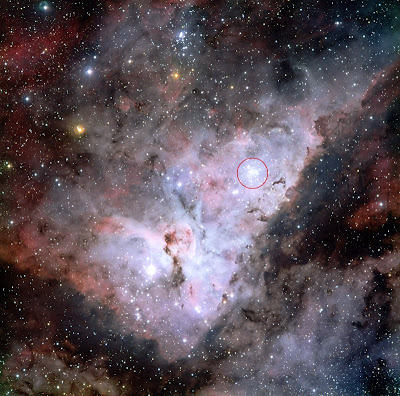
picture: Trumpler 14 in the Carina Nebula


picture: Widest adaptive optics view of the open star cluster Trumpler 14

The young star cluster Trumpler 14 is revealed in another stunning ESO image. The amount of exquisite detail seen in this portrait, which beautifully reveals the life of a large family of stars, is due to the Multi-conjugate Adaptive optics Demonstrator (MAD) on ESO’s Very Large Telescope. Never before has such a large patch of sky been imaged using adaptive optics [1], a technique by which astronomers are able to remove most of the atmosphere's blurring effects.

Noted for harbouring Eta Carinae — one of the wildest and most massive stars in our galaxy — the impressive Carina Nebula also houses a handful of massive clusters of young stars. The youngest of these stellar families is the Trumpler 14 star cluster, which is less than one million years old — a blink of an eye in the Universe’s history. This large open cluster is located some 8000 light-years away towards the constellation of Carina (the Keel).

A team of astronomers, led by Hugues Sana, acquired astounding images of the central part of Trumpler 14 using the Multi-conjugate Adaptive optics Demonstrator (MAD, [2]) mounted on ESO’s Very Large Telescope (VLT). Thanks to MAD, astronomers were able to remove most of the blurring effects of the atmosphere and thus obtain very sharp images. MAD performs this correction over a much larger patch of the sky than any other current adaptive optics instrument, allowing astronomers to make wider, crystal-clear images.

Thanks to the high quality of the MAD images, the team of astronomers could obtain a very nice family portrait. They found that Trumpler 14 is not only the youngest — with a refined, newly estimated age of just 500 000 years — but also one of the most populous star clusters within the nebula. The astronomers counted about 2000 stars in their image, spanning the whole range from less than one tenth up to a factor of several tens of times the mass of our own Sun. And this in a region which is only about six light-years across, that is, less than twice the distance between the Sun and its closest stellar neighbour!

The most prominent star is the supergiant HD 93129A, one of the most luminous stars in the Galaxy. This titan has an estimated mass of about 80 times that of the Sun and is approximately two and a half million times brighter! It makes a stellar couple — a binary star — with another bright, massive star. The astronomers found that massive stars tend to pair up more often than less massive stars, and preferably with other more massive stars.

The Trumpler 14 cluster is undoubtedly a remarkable sight to observe: this dazzling patch of sky contains several white-blue, hot, massive stars, whose fierce ultraviolet light and stellar winds are blazing and heating up the surrounding dust and gas. Such massive stars rapidly burn their vast hydrogen supplies — the more massive the star, the shorter its lifespan. These giants will end their brief lives dramatically in convulsive explosions called supernovae, just a few million years from now.

A few orange stars are apparently scattered through Trumpler 14, in charming contrast to their bluish neighbours. These orange stars are in fact stars located behind Trumpler 14. Their reddened colour is due to absorption of blue light in the vast veils of dust and gas in the cloud.

The technology used in MAD to correct for the effect of the Earth’s atmosphere over large areas of sky will play a crucial role in the success of the next generation European Extremely Large Telescope (E-ELT).

Notes

[1] Telescopes on the ground suffer from a blurring effect introduced by atmospheric turbulence. This turbulence causes the stars to twinkle in a way that delights poets but frustrates astronomers, since it smears out the fine details of the images. However, with adaptive optics techniques, this major drawback can be overcome so that the telescope produces images that are as sharp as theoretically possible, i.e. approaching conditions in space. Adaptive optics systems work by means of a computer-controlled deformable mirror that counteracts the image distortion introduced by atmospheric turbulence. It is based on real-time optical corrections computed at very high speed (several hundreds of times each second) from image data obtained by a wavefront sensor (a special camera) that monitors light from a reference star.

[2] Present adaptive optics systems can only correct the effect of atmospheric turbulence in a very small region of the sky — typically 15 arcseconds or less — the correction degrading very quickly when moving away from the reference star. Engineers have therefore developed new techniques to overcome this limitation, one of which is multi-conjugate adaptive optics. MAD uses up to three stars instead of one as references to remove the blur caused by atmospheric turbulence over a field of view thirty times larger than that available to existing techniques.

Date: Thursday, December 03, 2009

Key Terms: Adaptive optics,open cluster,young star cluster,ESO, Trumpler 14,Very Large Telescope,MAD,HD 93129A,Binary Star,Stellar Winds,E-ELT,Arcsecond,Carina Constellation(the keel).

Revised and Edited By: Imran Khan.
year: 2009

A Superbright Supernova That’s the First of Its Kind


picture: In this schematic illustration of the material ejected from SN 2007bi, the radioactive nickel core (white) decays to cobalt, emitting gamma rays and positrons that excite surrounding layers (textured yellow) rich in heavy elements like iron. The outer layers (dark shadow) are lighter elements such as oxygen and carbon, where any helium must reside, which remain unilluminated and do not contribute to the visible spectrum.

But not the last, now that astronomers know where to look

Berkeley, CA – An extraordinarily bright, extraordinarily long-lasting supernova named SN 2007bi, snagged in a search by a robotic telescope, turns out to be the first example of the kind of stars that first populated the Universe. The superbright supernova occurred in a nearby dwarf galaxy, a kind of galaxy that’s common but has been little studied until now, and the unusual supernova could be the first of many such events soon to be discovered.

SN 2007bi was found early in 2007 by the international Nearby Supernova Factory (SNfactory) based at the U.S. Department of Energy’s Lawrence Berkeley National Laboratory. The supernova’s spectrum was unusual, and astronomers at the University of California at Berkeley subsequently obtained a more detailed spectrum. Over the next year and a half the Berkeley scientists participated in a collaboration led by Avishay Gal-Yam of Israel’s Weizmann Institute of Science to collect and analyze much more data as the supernova slowly faded away.

The analysis indicated that the supernova’s precursor star could only have been a giant weighing at least 200 times the mass of our Sun and initially containing few elements besides hydrogen and helium – a star like the very first stars in the early Universe.

“Because the core alone was some 100 solar masses, the long-hypothesized phenomenon called pair instability must have occurred,” says astrophysicist Peter Nugent. A member of the SNfactory, Nugent is the co-leader of the Computational Cosmology Center (C3), a collaboration between Berkeley Lab’s Physics Division and Computational Research Division (CRD), where Nugent is a staff scientist. “In the extreme heat of the star’s interior, energetic gamma rays created pairs of electrons and positrons, which bled off the pressure that sustained the core against collapse.”

“SN 2007bi was the explosion of an exceedingly massive star,” says Alex Filippenko, a professor in the Astronomy Department at UC Berkeley whose team helped obtain, analyze, and interpret the data. “But instead of turning into a black hole like many other heavyweight stars, its core went through a nuclear runaway that blew it to shreds. This type of behavior was predicted several decades ago by theorists, but never convincingly observed until now.”

SN 2007bi is the first confirmed observation of a pair-instability supernova. The researchers describe their results in the 3 December 2009 issue of Nature.

On the trail of a strange beast

SN 2007bi was recorded on images taken as part of the Palomar-QUEST Survey, an automated search with the wide-field Oschin Telescope at the California Institute of Technology’s Palomar Observatory, and was quickly detected and categorized as an unusual supernova by the SNfactory. The SNfactory has so far discovered nearly a thousand supernovae of all types and amassed thousands of spectra, but has focused on those designated Type Ia, the “standard candles” used to study the expansion history of the Universe. SN 2007bi, however, turned out not to be a Type Ia. For one thing, it was at least ten times as bright.

“The thermonuclear runaway experienced by the core of SN 2007bi is reminiscent of that seen in the explosions of white dwarfs as Type Ia supernovae,” says Filippenko, “but on a much larger scale and with a far greater amount of power.”

“The discovery is a great example of how we can get all the science, in addition to cosmology, out of the SNfactory search,” says Greg Aldering, SNfactory project leader, who was not an author of the Nature paper. “Berkeley Lab and Caltech’s Astronomy Department agreed that we would split the work, the Lab handling the Type Ia’s and Caltech all the other types.”

Nugent contacted Gal-Yam, then a Caltech postdoctoral fellow, the lead investigator for the all-other category. “I asked, are you interested? He said, sure!” Nugent then contacted Filippenko, who was about to conduct a night of observation with the 10-meter Keck I telescope on the summit of Mauna Kea in Hawaii. Filippenko immediately set out to obtain an optical spectrum of the unusual supernova.

Caltech researchers subsequently acquired additional spectra with the Keck telescope, as did Paolo Mazzali’s team from the Max Planck Institute for Astrophysics in Garching, Germany, using the Very Large Telescope (VLT) in Chile.

Says Mazzali, “The Keck and VLT spectra clearly indicated that an extremely large amount of material was ejected by the explosion, including a record amount of radioactive nickel, which caused the expanding gases to glow very brightly.”

Rollin Thomas of CRD, a member of C3 and the SNfactory, aided the early analysis, using the Franklin supercomputer at the National Energy Research Scientific Computing Center (NERSC) to run a code he developed to generate numerous synthetic spectra for comparison with the real spectrum.

“The code uses hundreds of cores to systematically test a large number of simplified model supernovae, searching through the candidates by adjusting parameters until it finds a good fit,” says Thomas. “This kind of data-driven approach is key to helping us understand new types of transients for which no reliable theoretical predictions yet exist.” The model fit was unambiguous: SN 2007bi was a pair-instability supernova.

“The central part of the huge star had fused to oxygen near the end of its life, and was very hot,” Filippenko explains. “Then the most energetic photons of light turned into electron-positron pairs, robbing the core of pressure and causing it to collapse. This led to a nuclear runaway explosion that created a large amount of radioactive nickel, whose decay energized the ejected gas and kept the supernova visible for a long time.”

Gal-Yam organized a team of collaborators from many institutions to continue to observe SN 2007bi and obtain data as it slowly faded over a span of 555 days. Says Gal-Yam, “As our follow-up observations started to roll in, I immediately realized this must be something new. And indeed it turned out to be a fantastic example of how we are finding new types of stellar explosions.”

Because it had no hydrogen or helium lines, the usual classification scheme would have labeled the supernova a Type Ic. But it was so much brighter than an ordinary Type Ic that it reminded Nugent of only one prior event, a supernova designated SN 1999as, found by the international Supernova Cosmology Project but unfortunately three weeks after its peak brightness.

Understanding a supernova requires a good record of its rise and fall in brightness, or light curve. Although SN 2007bi was detected more than a week after its peak, Nugent delved into years of data compiled by NERSC from the SNfactory and other surveys. He found that the Catalina Sky Survey had recorded SN 2007bi before its peak brightness and could provide enough data to calculate the duration of the rising curve, an extraordinarily long 70 days – more evidence for the pair-instability identification.

A fossil laboratory of the early Universe

“It’s significant that the first unambiguous example of a pair-instability supernova was found in a dwarf galaxy,” says Nugent. “These are incredibly small, very dim galaxies that contain few elements heavier than hydrogen and helium, so they are models of the early Universe.”
Dwarf galaxies are ubiquitous but so faint and dim – “they take only a few pixels on a camera,” says Nugent, “and until recently, with the development of wide-field projects like the SNfactory, astronomers had wanted to fill the chip with galaxies” – that they’ve rarely been studied. SN 2007bi is expected to focus attention on what Gal-Yam and his collaborators call “fossil laboratories to study the early Universe.”

Says Filippenko, “In the future, we might end up detecting the very first generation of stars, early in the history of the Universe, through explosions such as that of SN 2007bi – long before we have the capability of directly seeing the pre-explosion stars.”

With the advent of the multi-institutional Palomar Transient Factory, a fully automated, wide-field survey to find transients, led by Caltech’s Shri Kulkarni, and with the aid of the Deep Sky Survey established by Nugent at NERSC to compile historical data from Palomar-QUEST, the SNfactory, the Near Earth Asteroid Team, and other surveys, the collaborators expect they will soon find many more ultrabright, ultramassive supernovae, revealing the role of these supernovae in creating the Universe as we know it today.


Edited By : Imran Khan
Key Terms: Pair Instability Supernova,SN 2007bi,light curve
Year:2009
Wednesday, December 02, 2009

Monday, August 31, 2009

Orbital chaos may destroy Earth


Image: possible orbital chaos collision between Venus and Earth

A force known as orbital chaos may cause our solar system to go haywire, leading to a possible collision between earth and Venus or Mars, according to a study released today.The good news is that the likelihood of such a smash-up is small, around one-in-2500.And even if the planets did careen into one another, it would not happen before another 3.5 billion years.

Indeed, there is a 99 per cent chance that the sun's posse of planets will continue to circle in an orderly pattern throughout the expected life span of our life-giving star, another five billion years, the study found.After that, the sun will likely expand into a red giant, engulfing earth and its other inner planets - Mercury, Venus and Mars - in the process.Astronomers have long been able to calculate the movement of planets with great accuracy hundreds, even thousands of years in advance. This is how eclipses have been predicted. But peering further into the future of celestial mechanics with exactitude is still beyond our reach, said Jacques Laskar, a researcher at the Observatoire de Paris and lead author of the study.

"The most precise long-term solutions for the orbital motion of the solar system are not valid over more than a few tens of millions of years," he said.

Using powerful computers, Mr Laskar and colleague Mickael Gastineau generated numerical simulations of orbital instability over the next five billion years.
Unlike previous models, they took into account Albert Einstein's theory of general relativity. Over a short time span, this made little difference, but over the long haul it resulted in dramatically different orbital paths.The researchers looked at 2501 possible scenarios, 25 of which ended with a severely disrupted solar system.

"There is one scenario in which Mars passes very close to earth," 794 kilometres to be exact, said Mr Laskar."When you come that close, it is almost the same as a collision because the planets get torn apart."

Life on earth, if there still were any, would almost certainly cease to exist.To get a more fine-grained view of how this might unfold, Mr Laskar and Mr Gastineau ran an additional 200 computer models, slightly changing the path of Mars each time.All but five of them ended in a two-way collision involving the sun, earth, Mercury, Venus or Mars. A quarter of them saw earth smashed to pieces.The key to all the scenarios of extreme orbital chaos was the rock closest to the sun, found the study, published in the British journal Nature."Mercury is the trigger, and would be be the first planet to be destabilised because it has the smallest mass," said Mr Laskar.At some point Mercury's orbit would get into resonance with that of Jupiter, throwing the smaller orb even more out of kilter, he said.Once this happens, the so-called "angular momentum" from the much larger Jupiter would wreak havoc on the other inner planets' orbits too.

"The simulations indicate that Mercury, in spite of its diminutive size, poses the greatest risk to our present order," said University of California scientist Gregory Laughlin in a commentary, also published in Nature.

Edited By: Imran Khan
Key Terms: Observatorie de paris,Angular momentum,computer simulations and models
Year: 2009