Showing posts with label Saturn's moon. Show all posts

Wednesday, April 24, 2013

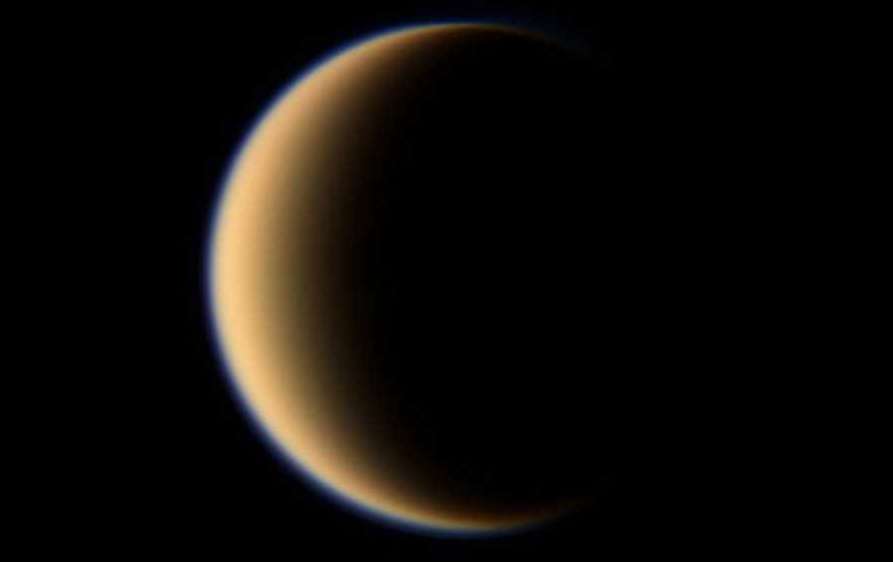
Ice cloud over Titan's south pole


Fig :  The recently formed south polar vortex stands out in the color-swaddled atmosphere of Saturn's largest moon, Titan, in this natural color view from NASA's Cassini spacecraft. NASA/JPL-Caltech/Space Science Institute

By Jet Propulsion Laboratory, Pasadena, California, NASA's Goddard Space Flight Center, Greenbelt, Maryland

 Published: April 12, 2013

An ice cloud taking shape over Titan’s south pole is the latest sign that the change of seasons is setting off a cascade of radical changes in the atmosphere of Saturn’s largest moon. Made from an unknown ice, this type of cloud has long hung over Titan’s north pole, where it is now fading, according to observations made by the composite infrared spectrometer (CIRS) on NASA’s Cassini spacecraft.

“We associate this particular kind of ice cloud with winter weather on Titan, and this is the first time we have detected it anywhere but the north pole,” said Donald E. Jennings of NASA’s Goddard Space Flight Center in Greenbelt, Maryland.

The southern ice cloud, which shows up in the far infrared part of the light spectrum, is evidence that an important pattern of global air circulation on Titan has reversed direction. When Cassini first observed the circulation pattern, warm air from the southern hemisphere was rising high in the atmosphere and was transported to the cold north pole. There, the air cooled and sank down to lower layers of the atmosphere and formed ice clouds. A similar pattern, called a Hadley cell, carries warm, moist air from Earth’s tropics to the cooler middle latitudes.

Based on modeling, scientists had long predicted a reversal of this circulation once Titan’s north pole began to warm and its south pole began to cool. The official transition from winter to spring at Titan’s north pole occurred in August 2009. But because each of the moon’s seasons lasts about 7.5 Earth years, researchers still did not know exactly when this reversal would happen or how long it would take.

The first signs of the reversal came in data acquired in early 2012, which came shortly after the start of southern fall on Titan, when Cassini images and visual and infrared mapping spectrometer data revealed the presence of a high-altitude “haze hood” and a swirling polar vortex at the south pole. Both features have long been associated with the cold north pole. Later, Cassini scientists reported that infrared observations of Titan’s winds and temperatures made by CIRS had provided definitive evidence of air sinking, rather than upwelling, at the south pole. By looking back through the data, the team narrowed down the change in circulation to within six months of the 2009 equinox.

Despite the new activity at the south pole, the southern ice cloud had not appeared yet. CIRS didn’t detect it until about July 2012, a few months after the haze and vortex were spotted in the south.

“This lag makes sense because first the new circulation pattern has to bring loads and loads of gases to the south pole. Then, the air has to sink. The ices have to condense. And the pole has to be under enough shadow to protect the vapors that condense to form those ices,” said Carrie Anderson from Goddard.

At first blush, the southern ice cloud seems to be building rapidly. The northern ice cloud, on the other hand, was present when Cassini first arrived and has been slowly fading the entire time the spacecraft has been observing it.

So far, the identity of the ice in these clouds has eluded scientists, though they have ruled out simple chemicals, such as methane, ethane and hydrogen cyanide, which are typically associated with Titan. One possibility is that “species X,” as some team members call the ice, could be a mixture of organic compounds.

“What’s happening at Titan’s poles has some analogy to Earth and to our ozone holes,” said F. Michael Flasar of Goddard. “And on Earth, the ices in the high polar clouds aren’t just window dressing: They play a role in releasing the chlorine that destroys ozone. How this affects Titan chemistry is still unknown. So it’s important to learn as much as we can about this phenomenon, wherever we find it.”

Thursday, November 8, 2012

Glowing Titan in the Dark


Figure : This set of images from NASA's Cassini spacecraft shows Saturn's moon Titan glowing in the dark. Titan was behind Saturn at the time, in eclipse from the sun. The image on the left is a calibrated, but unprocessed image from Cassini's imaging camera. The image on the right was processed to exclude reflected light off Saturn, and it is clear that even where Titan did not receive any Saturnshine, it is still emitting light. Some light appears to be emanating from high in the atmosphere (noted by the outer dashed line at about 625 miles [1,000 kilometers] in altitude). But more surprisingly, most of it is diffusing up from lower down in the moon's haze, from about 190 miles (300km) above the surface. //Credit: NASA/JPL-Caltech/SSI

By Cassini Imaging Central Lab, Boulder, Colorado, Jet Propulsion Laboratory, 
Pasadena, California

Published: November 6, 2012
A literal shot in the dark by imaging cameras on NASA’s Cassini spacecraft has yielded an image of a visible glow from Titan, emanating not just from the top of Titan’s atmosphere, but also from deep in the atmosphere through the moon’s haze. A person in a balloon in Titan’s haze layer wouldn’t see the glow because it’s too faint — something like a millionth of a watt. Scientists were able to detect it with Cassini because the spacecraft’s cameras are able to take long-exposure images.

“It turns out that Titan glows in the dark, though very dimly,” said Robert West at NASA’s Jet Propulsion Laboratory (JPL) in Pasadena, California. “It’s a little like a neon sign, where electrons generated by electrical power bang into neon atoms and cause them to glow. Here we’re looking at light emitted when charged particles bang into nitrogen molecules in Titan’s atmosphere.”

Scientists are interested in studying the input of energy from the Sun and charged particles into Titan’s atmosphere because it is at the heart of the natural organic chemistry factory that exists in Titan’s atmosphere.

“Scientists want to know what galvanizes the chemical reactions forming the heavy molecules that develop into Titan’s thick haze of organic chemicals,” said Linda Spilker, also from JPL. “This kind of work helps us understand what kind of organic chemistry could have existed on an early Earth.” The light, known as airglow, is produced when atoms and molecules are excited by ultraviolet sunlight or electrically charged particles. Cassini scientists already have seen an airglow from Titan’s nitrogen molecules caused by X-rays and ultraviolet radiation from the Sun when Titan was illuminated by our star. During 2009, Titan passed through Saturn’s shadow, offering a unique opportunity for Cassini instruments to observe any luminescence from Titan while in darkness. Cassini’s imaging cameras could see in very dim light by using exposure times of 560 seconds.

Scientists expected to see a glow in the high atmosphere (above 400 miles [700 kilometers] in altitude) where charged particles from the magnetic bubble around Saturn strip electrons off atmospheric molecules at Titan. Although an extremely weak emission was seen in that region, they were surprised to see Titan’s dark face glow in visible wavelengths of light from deeper in the atmosphere (at about 190 miles [300km] above the surface), as though illuminated by moonshine from nearby satellites.

The scientists took into account sunlight reflected off Saturn. There was still a glow from the part of Titan that was dark. The luminescence was diffusing up from too deep for charged particles from the Sun to be exciting atmospheric particles. The area also was not affected by the shooting of charged particles into the magnetic fields, which is what causes aurorae.

Scientists’ best guess is that the glow is being caused by deeper-penetrating cosmic rays or by light emitted due to some kind of chemical reaction deep in the atmosphere.

“This is exciting because we’ve never seen this at Titan before,” West said. “It tells us that we don’t know all there is to know about Titan and makes it even more mysterious.”

Scientists have previously reported that the night side of Venus’ atmosphere also produces a glow, called the ashen light. Some have suggested that lightning on Venus is responsible, although that explanation is not universally accepted. While Cassini’s radio-wave instrument has detected lightning at Saturn, it has not detected lightning at Titan. Scientists plan to keep looking for clues as Cassini continues to make its way around the Saturn system for another season.

Sunday, January 15, 2012

Latest computer model explains lakes and storms on Titan


Figure: Titan is covered in a thick atmosphere with abundant methane. Credit: NASA/JPL/Space Science Institute

By California Institute of Technology, Pasadena

Published: January 5, 2012

Saturn’s largest moon, Titan, is an intriguing alien world that’s covered in a thick atmosphere abundant with methane. With an average surface temperature of a brisk –300° Fahrenheit (–185° Celsius) and a diameter just less than half of Earth’s, Titan boasts methane clouds and fog as well as rainstorms and plentiful lakes of liquid methane. It’s the only place in the solar system, other than Earth, that has large bodies of liquid on its surface.

The origins of many of these features, however, remain puzzling to scientists. Now, researchers at the California Institute of Technology (Caltech) have developed a computer model of Titan’s atmosphere and methane cycle that, for the first time, explains many of these phenomena in a relatively simple and coherent way.

In particular, the new model explains three baffling observations of Titan. One oddity was discovered in 2009 when researchers found that Titan’s methane lakes tend to cluster around its poles, and noted that there are more lakes in the northern hemisphere than in the south.

Secondly, the areas at low latitudes near Titan’s equator are known to be dry, lacking lakes and regular precipitation. But when the Huygens probe landed on Titan in 2005, it saw channels carved out by flowing liquid, possibly runoff from rain. And in 2009, Caltech researchers discovered raging storms that may have brought rain to this supposedly dry region.

Finally, scientists uncovered a third mystery when they noticed that clouds observed over the past decade — during summer in Titan’s southern hemisphere — cluster around southern middle and high latitudes.

Scientists have proposed various ideas to explain these features, but their models either can’t account for all of the observations, or do so by requiring exotic processes such as cryogenic volcanoes that spew methane vapor to form clouds. The Caltech researchers say their new computer model, on the other hand, can explain all these observations and does so using relatively straightforward and fundamental principles of atmospheric circulation.

“We have a unified explanation for many of the observed features,” said Tapio Schneider from Caltech. “It doesn’t require cryovolcanoes or anything esoteric.”

Schneider said the team’s simulations were able to reproduce the distribution of clouds that’s been observed, which was not the case with previous models. The new model also produces the right distribution of lakes. Methane tends to collect in lakes around the poles because the sunlight there is weaker on average, he said. Energy from the Sun normally evaporates liquid methane on the surface, but since there’s generally less sunlight at the poles, it’s easier for liquid methane there to accumulate into lakes.

But then why are there more lakes in the northern hemisphere? Schneider points out that Saturn’s slightly elongated orbit means that Titan is farther from the Sun when it’s summer in the northern hemisphere. Kepler’s second law says that a planet orbits more slowly the farther it is from the Sun, which means that Titan spends more time at the far end of its elliptical orbit, when it’s summer in the north. As a result, the northern summer is longer than the southern summer. And since summer is the rainy season in Titan’s polar regions, the rainy season is longer in the north. Although the summer rains in the southern hemisphere are more intense — triggered by stronger sunlight because Titan is closer to the Sun during southern summer — there’s more rain over the course of a year in the north, filling more lakes.

In general, however, Titan’s weather is bland, and the regions near the equator are particularly dull, the researchers say. Years can go by without a drop of rain, leaving the lower latitudes of Titan parched. It was a surprise, then, when the Huygens probe saw evidence of rain runoff in the terrain. That surprise only increased in 2009 when Schaller, Brown, Schneider, and Henry Roe discovered storms in this same, supposedly rainless, area.

No one really understood how those storms arose, and previous models failed to generate anything more than a drizzle. But the new model was able to produce intense downpours during Titan’s vernal and autumnal equinoxes — enough liquid to carve out the type of channels that Huygens found. With the model, the researchers can now explain the storms. “It rains very rarely at low latitudes,” Schneider said. “But when it rains, it pours.”

The new model differs from previous ones in that it’s 3-D and simulates Titan’s atmosphere for 135 Titan years — equivalent to 3,000 years on Earth — so that it reaches a steady state. The model also couples the atmosphere to a methane reservoir on the surface, simulating how methane is transported throughout the moon.

The model successfully reproduces what scientists have already seen on Titan, but perhaps what’s most exciting, Schneider said, is that it also can predict what scientists will see in the next few years. For instance, based on the simulations, the researchers predict that the changing seasons will cause the lake levels in the north to rise over the next 15 years. They also predict that clouds will form around the north pole in the next two years. Making testable predictions is “a rare and beautiful opportunity in the planetary sciences,” Schneider said. “In a few years, we’ll know how right or wrong they are.”

“This is just the beginning,” he adds. “We now have a tool to do new science with, and there’s a lot we can do and will do.”

Tuesday, September 27, 2011

A huge doughnut-shaped cloud of water vapor created by Enceladus


Water vapor and ice erupt from Saturn's moon Enceladus, the source of a newly discovered doughnut-shaped cloud around Saturn.

Credit: NASA/JPL/Space Science Institute

Published: September 22, 2011

Chalk up one more feat for Saturn's intriguing moon Enceladus. The small, dynamic moon spews out dramatic plumes of water vapor and ice — first seen by NASA's Cassini spacecraft in 2005. It possesses simple organic particles and may house liquid water beneath its surface. Its geyser-like jets create a gigantic halo of ice, dust, and gas around Enceladus that helps feed Saturn's E ring. Now, thanks again to those icy jets, Enceladus is the only moon in our solar system known to substantially influence the chemical composition of its parent planet.

In June, the European Space Agency (ESA) announced that its Herschel Space Observatory, which has important NASA contributions, had found a huge doughnut-shaped cloud, or torus, of water vapor created by Enceladus encircling Saturn. The torus is more than 373,000 miles (600,000 kilometers) across and about 37,000 miles (60,000 km) thick. It appears to be the source of water in Saturn's upper atmosphere.

Though it is enormous, the cloud had not been seen before because water vapor is transparent at most visible wavelengths of light, but Herschel could see the cloud with its infrared detectors. "Herschel is providing dramatic new information about everything from planets in our own solar system to galaxies billions of light-years away," said Paul Goldsmith from NASA's Jet Propulsion Laboratory in Pasadena, California.

The discovery of the torus around Saturn did not come as a complete surprise. NASA's Voyager and Hubble missions had given scientists hints of the existence of water-bearing clouds around Saturn. Then in 1997, ESA’s Infrared Space Observatory confirmed the presence of water in Saturn's upper atmosphere. NASA's Submillimeter Wave Astronomy Satellite also observed water emission from Saturn at far-infrared wavelengths in 1999.

While a small amount of gaseous water is locked in the warm, lower layers of Saturn's atmosphere, it can't rise to the colder, higher levels. To get to the upper atmosphere, water molecules must be entering Saturn's atmosphere from somewhere in space. But from where and how? Those were mysteries until now.

Build the model, and the data will come
The answer came by combining Herschel's observations of the giant cloud of water vapor created by Enceladus' plumes with computer models that researchers had already been developing to describe the behavior of water molecules in clouds around Saturn.

One of these researchers is Tim Cassidy from the University of Colorado, Boulder. "What's amazing is that the model, which is one iteration in a long line of cloud models, was built without knowledge of the observation,” said Cassidy. “Those of us in this small modeling community were using data from Cassini, Voyager, and the Hubble telescope, along with established physics. We weren't expecting such detailed 'images' of the torus, and the match between model and data was a wonderful surprise."

The results show that, though most of the water in the torus is lost to space, some of the water molecules fall and freeze on Saturn's rings, while a small amount — about 3 to 5 percent — gets through the rings to Saturn's atmosphere. This is just enough to account for the water that has been observed there.

Herschel's measurements combined with the cloud models also provided new information about the rate at which water vapor is erupting out of the dark fractures known as "tiger stripes" on Enceladus' southern polar region. Previous measurements by the Ultraviolet Imaging Spectrograph (UVIS) instrument aboard the Cassini spacecraft showed that the moon is ejecting about 440 pounds (200 kilograms) of water vapor every second.

"With the Herschel measurements of the torus from 2009 and 2010 and our cloud model, we were able to calculate a source rate for water vapor coming from Enceladus," said Cassidy. "It agrees very closely with the UVIS finding, which used a completely different method."

"We can see the water leaving Enceladus, and we can detect the end product — atomic oxygen — in the Saturn system," said Cassini UVIS science team member Candy Hansen from the Planetary Science Institute in Tucson, Arizona. "It's very nice with Herschel to track where it goes in the meantime."

While a small fraction of the water molecules inside the torus end up in Saturn's atmosphere, most are broken down into separate atoms of hydrogen and oxygen. "When water hangs out in the torus, it is subject to the processes that dissociate water molecules, first to hydrogen and hydroxide, and then the hydroxide dissociates into hydrogen and atomic oxygen," said Hansen. “This oxygen is dispersed through the Saturn system. Cassini discovered atomic oxygen on its approach to Saturn before it went into orbit insertion. At the time, no one knew where it was coming from. Now we do."

"The profound effect this little moon Enceladus has on Saturn and its environment is astonishing," said Hansen.

Saturday, October 30, 2010

Unsteady rocking motion of Saturn's icy moon may keep its oceans liquid


At least four distinct plumes of water ice spew out from the south polar region of Saturn's moon Enceladus in this dramatically illuminated image.
Photo by NASA/JPL/Space Science Institute


Goddard Space Flight Center, Greenbelt, Maryland

October 7,2010

Saturn's icy moon Enceladus should not be one of the most promising places in our solar system to look for extraterrestrial life. Instead, it should have frozen solid billions of years ago. Located in the frigid outer solar system, it's too far from the sun to have oceans of liquid water, a necessary ingredient for known forms of life on its surface.

Some worlds, like Mars or Jupiter's moon Europa, give hints that they might harbor liquid water beneath their surfaces. Mars is about 4,200 miles (6,800 kilometers) across and Europa almost 2,000 miles (3,200 km) across. However, with a diameter only slightly more than 500 miles (800 km), Enceladus just doesn't have the bulk needed for its interior to stay warm enough to maintain liquid water underground.

With temperatures around -324 degrees Fahrenheit (-198 degrees Celsius), the surface of Enceladus is indeed frozen. However, in 2005, NASA's Cassini spacecraft discovered a giant plume of water gushing from cracks in the surface over the moon's south pole, indicating that there was a reservoir of water beneath the ice. Analysis of the plume by Cassini revealed that the water is salty, indicating the reservoir is large, perhaps even a global subsurface ocean. Scientists estimate from the Cassini data that the south polar heating is equivalent to a continuous release of about 13 billion watts of energy.

To explain this mysterious warmth, some scientists invoke radiation coupled with tidal heating. As it formed, Enceladus, like all solar system objects, incorporated matter from the cloud of gas and dust left over from our sun's formation. In the outer solar system, as Enceladus formed it grew as ice and rock coalesced. If Enceladus was able to gather greater amounts of rock, which contained radioactive elements, enough heat could have been generated by the decay of the radioactive elements in its interior to melt the body.

However, in smaller moons like Enceladus, the cache of radioactive elements usually is not massive enough to produce significant heat for long, and the moon should have soon cooled and solidified. So, unless another process within Enceladus somehow generated heat, any liquid formed by the melting of its interior would have frozen long ago.

This led scientists to consider the role of tidal heating as a way to keep Enceladus warm enough for liquid water to remain under its surface. Enceladus' orbit around Saturn is slightly oval-shaped. As it travels around Saturn, Enceladus moves closer in and then farther away. When Enceladus is closer to Saturn, it feels a stronger gravitational pull from the planet than when it is farther away. Like gently squeezing a rubber ball slightly deforms its shape, the fluctuating gravitational tug on Enceladus causes it to flex slightly. The flexing, called gravitational tidal forcing, generates heat from friction deep within Enceladus.

The gravitational tides also produce stress that cracks the surface ice in certain regions, like the south pole, and may be reworking those cracks daily. Tidal stress can pull these cracks open and closed while also shearing them back and forth. As they open and close, the sides of the south polar cracks move as much as a few feet, and they slide against each other by up to a few feet as well. This movement generates friction, which releases extra heat at the surface at locations that should be predictable with our understanding of tidal stress.

To test the tidal heating theory, scientists with the Cassini team created a map of the gravitational tidal stress on the moon's icy crust and compared it to a map of the warm zones created using Cassini's composite infrared spectrometer instrument (CIRS). Assuming the greatest stress is where the most friction occurs, and therefore where the most heat is released, areas with the most stress should overlap the warmest zones on the CIRS map.

"However, they don't exactly match," said Terry Hurford of NASA's Goddard Space Flight Center in Greenbelt, Maryland. "For example, in the fissure called the Damascus Sulcus, the area experiencing the greatest amount of shearing is about 31 miles (50 kilometers) from the zone of greatest heat."

Hurford and his team believe the discrepancy can be resolved if Enceladus' rotation rate is not uniform — if it wobbles slightly as it rotates. Enceladus' wobble, technically called "libration," is barely noticeable. "Cassini observations have ruled out a wobble greater than about 2 degrees with respect to Enceladus' uniform rotation rate," said Hurford.

The team created a computer simulation that made maps of the surface stress on Enceladus for various wobbles, and found a range where the areas of greatest stress line up better with the observed warmest zones.

"Depending on whether the wobble moves with or against the movement of Saturn in Enceladus' sky, a wobble ranging from 2 degrees down to 0.75 degree produces the best fit to the observed warmest zones," said Hurford.

The wobble also helps with the heating conundrum by generating about five times more heat in Enceladus' interior than tidal stress alone, and the extra heat makes it likely that Enceladus' ocean could be long-lived, according to Hurford. This is significant in the search for life, because life requires a stable environment to develop.

The wobble is probably caused by Enceladus' uneven shape. "Enceladus is not completely spherical, so as it moves in its orbit, the pull of Saturn's gravity generates a net torque that forces the moon to wobble," said Hurford. Also, Enceladus' orbit is kept oval-shaped, maintaining the tidal stress, because of the gravitational tug from Dione, a neighboring larger moon. Dione is farther away from Saturn than Enceladus, so it takes longer to complete its orbit. For every orbit Dione completes, Enceladus finishes two, producing a regular alignment that pulls Enceladus' orbit into an oval shape.

Tuesday, August 18, 2009

Scientists discover storms in the tropics of Titan


This image of Titan is a product of observations taken with the Palomar 200-inch telescope, JPL adaptive optics system, and Cornell-built PHARO near-infrared camera. A. Bouchez

August 13, 2009

For all its similarities to Earth-clouds that pour rain — albeit liquid methane not liquid water — onto the surface producing lakes and rivers, vast dune fields in desert-like regions, plus a smoggy orange atmosphere, Saturn's largest moon, Titan, is generally "a very bland place," according to Mike Brown of the California Institute of Technology (Caltech).

"We can watch for years and see almost nothing happen," said Brown. "This is bad news for people trying to understand Titan's meteorological cycle. Not only do things happen infrequently, but we tend to miss them when they do happen because nobody wants to waste time on big telescopes."

However, just because weather occurs infrequently, it doesn't mean it never occurs, nor does it mean that astronomers can't catch it in the act.

In April 2008, that's just what Emily Schaller, now at the University of Arizona, and her colleagues accomplished when they observed a large system of storm clouds appear in the apparently dry mid-latitudes and spread in a southeastward direction across the moon. Eventually, the storm generated a number of bright but transient clouds over Titan's tropical latitudes, a region where clouds had never been seen and where it was thought they were extremely unlikely to form.

"A couple of years ago, we set up a highly efficient system on a smaller telescope to figure out when to use the biggest telescopes," Brown said. The first telescope, NASA's Infrared Telescope Facility, on Mauna Kea, Hawaii, takes a spectrum of Titan almost every single night. "From that we can't tell much, but we can say 'no clouds,' 'a few clouds,' or, if we get lucky, 'monster clouds,'" he said.

"The period during which I was collecting data for my thesis corresponded entirely to an extended period of essentially no clouds, so we never really got to show the full power of the combined telescopes," Schaller said. "But then, after finishing my thesis, I walked back across campus to my office to look at the data from the previous night to find that Titan suddenly had the biggest clouds ever."

The day after the telescope's big find, Schaller, Brown, and Roe began tracking the clouds with the large Gemini telescope on Mauna Kea and watched this system evolve for a month. "And what a cool show it was," Brown said.

"The first cloud was seen near the tropics and was caused by a still-mysterious process, but it behaved almost like an explosion in the atmosphere, setting off waves that traveled around the planet, triggering their own clouds," Brown said. "Within days a huge cloud system had covered the south pole, and sporadic clouds were seen all the way up to the equator."

Schneider, an expert on atmospheric circulations, was instrumental in helping to sort out the complicated chain of events that followed the initial outburst of cloud activity.

"The month-long event has many important implications for understanding the hydrological cycle on Titan," said Brown, "but one of the reasons I am most excited about it is that it shows clouds near the equator — where the European Space Agency's Huygens probe landed — for the first time. For a while now, people have speculated that the equatorial regions are simply too dry to ever have significant clouds."

And yet, the images snapped by the Huygens probe in January 2005 revealed small-scale channels and streams that looked just like features created by fluids — by water here on Earth and probably by liquid methane on Titan.

Experts had speculated for years on how there could be streams and channels in a region with no rain. The new results suggest those speculations may prove unnecessary. "No one considered how storms in one location can trigger them in many other locations," said Brown.

Caltech, Pasadena, California

Friday, December 26, 2008

Titan's volcanoes give NASA spacecraft chilly reception


This infrared projection map of Titan was composed from images taken by NASA's Cassini spacecraft, visual and infrared mapping spectrometer. The location of two regions that changed in brightness are labeled. These regions are hypothesized by some to be areas of cryovolcanic activity on Titan. NASA/JPL/University of Arizona

December 16, 2008

Provided by JPL, Pasadena, California


Data collected during several recent flybys of Titan by NASA's Cassini spacecraft provide supporting evidence to scientists who think the saturnian moon contains active cryovolcanoes spewing a super-chilled liquid into its atmosphere.

"Cryovolcanoes are some of the most intriguing features in the solar system," said Rosaly Lopes, a Cassini radar team investigation scientist from NASA's Jet Propulsion Laboratory (JPL) in Pasadena, California.

Rather than erupting molten rock, it is theorized that the cryovolcanoes of Titan would erupt volatiles such as water, ammonia, and methane. Scientists have suspected cryovolcanoes might inhabit Titan, and the Cassini mission has collected data on several previous passes of the moon that suggest their existence. Imagery of the moon includes a suspect haze hovering over flow-like surface formations. Scientists point to these as signs of cryovolcanism.

"Cassini data have raised the possibility that Titan's surface is active," said Jonathan Lunine, a Cassini interdisciplinary scientist from the Lunar and Planetary Laboratory, University of Arizona, Tucson. "This is based on evidence that changes have occurred on the surface of Titan, between flybys of Cassini, in regions where radar images suggest a kind of volcanism has taken place."

What led some Cassini scientists to believe that things are happening now were changes in brightness and reflectance detected at two distinct regions of Titan. Reflectance is the ratio of light that radiates onto a surface to the amount reflected back. These changes were documented by Visible and Infrared Mapping Spectrometer data collected on Titan flybys from July 2004 to March 2006. In one of the two regions, the reflectance of the surface surged upward and remained higher than expected. In the other region, the reflectance shot up but then trended downward. There is also evidence that ammonia frost is present at one of the two changing sites. The ammonia was evident only at times when the region was inferred to be active.

"Ammonia is widely believed to be present only beneath the surface of Titan," said Robert M. Nelson of JPL, a scientist for Cassini's Visual and Infrared Mapping Spectrometer team. "The fact that we found it appearing at times when the surface brightened strongly suggests that material was being transported from Titan's interior to its surface."

Some Cassini scientists indicate that such volcanism could release methane from Titan's interior, which explains Titan's seemingly continuous supply of fresh methane. Without replenishment, scientists say, Titan's original atmospheric methane should have been exhausted long ago.

But other scientists familiar with the spectrometer data argue that the ammonia identification is not certain, and that the purported brightness changes might not be associated with changes on Titan's surface. Instead they might result from the transient appearances of ground "fogs" of ethane droplets very near Titan's surface, driven by atmospheric rather than geophysical processes. Nelson has considered the ground fog option, stating, "There remains the possibility that the effect is caused by a local fog, but, if so, we would expect it to change in size over time due to wind activity, which is not what we see."

An alternative hypothesis to an active Titan suggests the saturnian moon could be taking its landform evolution cues from a moon of Jupiter.

"Like Callisto, Titan may have formed as a relatively cold body, and may have never undergone enough tidal heating for volcanism to occur," said Jeffrey Moore, a planetary geologist at the NASA Ames Research Center, Moffett Field, California. "The flow-like features we see on the surface may just be icy debris that has been lubricated by methane rain and transported down slope into sinuous piles like mudflows."

Saturn moon Enceladus shows more signs of activity


December 16, 2008

Provided by NASA, Washington, DC

The closer scientists look at Saturn's small moon Enceladus, the more they find evidence of an active world. The most recent flybys of Enceladus made by NASA's Cassini spacecraft provide new signs of ongoing changes on and around the moon. Details in the latest high-resolution images of Enceladus indicate that the south polar surface changes over time.

Close views of the southern polar region, where jets of water vapor and icy particles spew from vents within the moon's distinctive "tiger stripe" fractures, provide surprising evidence of earthlike tectonics. They yield insight into what may be happening within the fractures. The latest data on the plume — the huge cloud of vapor and particles fed by the jets that extend into space — show it varies over time and has a far-reaching effect on Saturn's magnetosphere.

"Of all the geologic provinces in the Saturn system that Cassini has explored, none has been more thrilling or carries greater implications than the region at the southernmost portion of Enceladus," said Carolyn Porco, Cassini imaging team leader at the Space Science Institute in Boulder, Colorado.

A panel of Cassini scientists presented these new findings Monday in a news briefing at the American Geophysical Union's Fall Meeting in San Francisco.

"Enceladus has earthlike spreading of the icy crust, but with an exotic difference — the spreading is almost all in one direction, like a conveyor belt," said Paul Helfenstein, Cassini imaging associate at Cornell University in Ithaca, New York.

"Enceladus has asymmetric spreading on steroids," Helfenstein said. "We are not certain about the geological mechanisms that control the spreading, but we see patterns of divergence and mountain-building similar to what we see on Earth, which suggests that subsurface heat and convection are involved."

The tiger stripes are analogous to the mid-ocean ridges on Earth's seafloor where volcanic material wells up and creates new crust. Using Cassini-based digital maps of the moon's south polar region, Helfenstein reconstructed a possible history of the tiger stripes by working backward in time and progressively snipping away older and older sections of the map, each time finding that the remaining sections fit together like puzzle pieces.

Images from recent close flybys also have bolstered a theory that condensation from the jets erupting from the surface may create ice plugs that close off old vents and force new vents to open. The opening and clogging of vents also corresponds with measurements indicating the plume varies from month to month and year to year.

"We see no obvious distinguishing markings on the surface in the immediate vicinity of each jet source, which suggests that the vents may open and close and thus migrate up and down the fractures over time," Porco said. "Over time, the particles that rain down onto the surface from the jets may form a continuous blanket of snow along a fracture."

Enceladus' output of ice and vapor dramatically impacts the entire Saturnian system by supplying the ring system with fresh material and loading ionized gas from water vapor into Saturn's magnetosphere.

"The ions added to the magnetosphere are spun up from Enceladus' orbital speed to the rotational speed of Saturn," said Cassini magnetometer science team member Christopher Russell of the University of California, Los Angeles. "The more material is added by the plume, the harder this is for Saturn to do, and the longer it takes to accelerate the new material."

With water vapor, organic compounds and excess heat emerging from Enceladus' south polar terrain, scientists are intrigued by the possibility of a liquid-water-rich habitable zone beneath the moon's south pole.

Tuesday, December 23, 2008

Up close and personal with Enceladus


This nearly equatorial view shows cratered regions on Enceladus in the central part of its leading hemisphere and high northern latitudes. Much of the rest of the geologically active moon is relatively crater free and covered by fractures and folds.

The Cassini spacecraft's narrow-angle camera captured this view June 28, 2007. NASA/JPL/Space Science Institute


March 10, 2008

Provided by NASA

NASA's Cassini spacecraft will make an unprecedented "in your face" flyby of Saturn's moon Enceladus.

The spacecraft, orchestrating its closest approach to date, will skirt along the edges of huge Old-Faithful-like geysers erupting from giant fractures on the south pole of Enceladus. Cassini will sample scientifically valuable water-ice, dust and gas in the plume.

The source of the geysers is of great interest to scientists who think liquid water, perhaps even an ocean, may exist in the area. While flying through the edge of the plumes, Cassini will be approximately 120 miles from the surface. At closest approach to Enceladus, Cassini will be only 30 miles from the moon.

"This daring flyby requires exquisite technical finesse, but it has the potential to revolutionize our knowledge of the geysers of Enceladus. The Cassini mission team is eager to see the scientific results, and so am I," says Alan Stern, associate administrator of NASA's Science Mission Directorate, Washington.

Scientists and mission personnel studying the anatomy of the plumes have found that flying at these close distances poses little threat to Cassini because, despite the high speed of Cassini, the plume particles are small. The spacecraft routinely crosses regions made up of dust-size particles in its orbit around Saturn.

Cassini's cameras will take a back seat on this flyby as the main focus turns to the spacecraft's particle analyzers that will study the composition of the plumes. The cameras will image Enceladus on the way in and out, between the observations of the particle analyzers.

Images will reveal northern regions of the moon previously not captured by Cassini. The analyzers will "sniff and taste" the plume. Information on the density, size, composition and speed of the gas and the particles will be collected.

"There are two types of particles coming from Enceladus, one pure water-ice, the other water-ice mixed with other stuff," says Sascha Kempf, deputy principal investigator for Cassini's Cosmic Dust Analyzer at the Max Planck Institute for Nuclear Physics in Heidelberg, Germany. "We think the clean water-ice particles are being bounced off the surface and the dirty water-ice particles are coming from inside the moon. This flyby will show us whether this concept is right or wrong."

In 2005, Cassini's multiple instruments discovered that this icy outpost is gushing water vapor geysers out to a distance of three times the radius of Enceladus. The moon is only 310 miles in diameter, but despite its petite size, its one of the most scientifically compelling bodies in our solar system. The icy water particles are roughly one ten-thousandth of an inch, or about the width of a human hair. The particles and gas escape the surface at jet speed at approximately 800 miles per hour. The eruptions appear to be continuous, refreshing the surface and generating an enormous halo of fine ice dust around Enceladus, which supplies material to one of Saturn's rings, the E-ring.

Several gases, including water vapor, carbon dioxide, methane, perhaps a little ammonia and either carbon monoxide or nitrogen gas make up the gaseous envelope of the plume.

"We want to know if there is a difference in composition of gases coming from the plume versus the material surrounding the moon. This may help answer the question of how the plume formed," says Hunter Waite, principal investigator for Cassini's Ion and Neutral Mass Spectrometer at the Southwest Research Institute, San Antonio.

This is the first of four Cassini flybys of Enceladus this year. In June, Cassini completes its prime mission, a 4-year tour of Saturn. Cassini's next flyby of Enceladus is planned for August, well into Cassini's proposed extended mission. Cassini will perform seven Enceladus flybys in its extended mission. If this encounter proves safe, future passes may bring the spacecraft even closer than this one. How close Cassini will be allowed to approach will be determined based on data from this flyby.

Sunday, October 19, 2008

NASA confirms liquid lake on Saturn moon


photo:This artist concept shows a mirror-smooth lake on the surface of the smoggy moon Titan. Cassini scientists have concluded that at least one of the large lakes observed on Saturn’s moon Titan contains liquid hydrocarbons, and have positively identified ethane. This result makes Titan the only place in our solar system beyond Earth known to have liquid on its surface.

Date:July 31, 2008

Cassini spacecraft reveals a large body of liquid ethane, methane, other hydrocarbons, and nitrogen on Titan.NASA scientists have concluded that at least one of the large lakes observed on Saturn's moon Titan contains liquid hydrocarbons, and have positively identified the presence of ethane. This makes Titan the only body in our solar system beyond Earth known to have liquid on its surface.

Scientists made the discovery using data from an instrument aboard the Cassini spacecraft. The instrument identified chemically different materials based on the way they absorb and reflect infrared light. Before Cassini, scientists thought Titan would have global oceans of methane, ethane, and other light hydrocarbons. More than 40 close flybys of Titan by Cassini show no such global oceans exist, but hundreds of dark lake-like features are present. Until now, it was not known whether these features were liquid or simply dark, solid material.

"This is the first observation that really pins down that Titan has a surface lake filled with liquid," said Bob Brown of the University of Arizona, Tucson. Brown is the team leader of Cassini's visual and mapping instrument. The results will be published in the July 31 issue of the journal Nature.

Ethane and several other simple hydrocarbons have been identified in Titan's atmosphere, which consists of 95 percent nitrogen, with methane making up the other 5 percent. Ethane and other hydrocarbons are products from atmospheric chemistry caused by the breakdown of methane by sunlight.

Some of the hydrocarbons react further and form fine aerosol particles. All of these things in Titan's atmosphere make detecting and identifying materials on the surface difficult, because these particles form a ubiquitous hydrocarbon haze that hinders the view. Liquid ethane was identified using a technique that removed the interference from the atmospheric hydrocarbons.

The visual and mapping instrument observed a lake, Ontario Lacus, in Titan's south polar region during a close Cassini flyby in December 2007. The lake is roughly 7,800 square miles (20,200 square kilometers) in area, slightly larger than North America's Lake Ontario.

"Detection of liquid ethane confirms a long-held idea that lakes and seas filled with methane and ethane exist on Titan," said Larry Soderblom, a Cassini interdisciplinary scientist with the U.S. Geological Survey in Flagstaff, Arizona. "The fact we could detect the ethane spectral signatures of the lake even when it was so dimly illuminated, and at a slanted viewing path through Titan's atmosphere, raises expectations for exciting future lake discoveries by our instrument."

The ethane is in a liquid solution with methane, other hydrocarbons and nitrogen. At Titan's surface temperatures, approximately -300° Fahrenheit (-185° Celsius), these substances can exist as both liquid and gas. Titan shows overwhelming evidence of evaporation, rain, and fluid-carved channels draining into what, in this case, is a liquid hydrocarbon lake.

Earth has a hydrological cycle based on water and Titan has a cycle based on methane. Scientists ruled out the presence of water ice, ammonia, ammonia hydrate and carbon dioxide in Ontario Lacus. The observations also suggest the lake is evaporating. It is ringed by a dark beach, where the black lake merges with the bright shoreline. Cassini also observed a shelf and beach being exposed as the lake evaporates.

"During the next few years, the vast array of lakes and seas on Titan's north pole mapped with Cassini's radar instrument will emerge from polar darkness into sunlight, giving the infrared instrument rich opportunities to watch for seasonal changes of Titan's lakes,"
Soderblom said.

Launched in October 1997, Cassini's 12 instruments have returned a daily stream of data from Saturn's system. The mission is a cooperative project of NASA, the European Space Agency and the Italian Space Agency.

Tuesday, October 7, 2008

Whatever happens on Titan,stays on Titan


photo: This natural color composite was taken during the Cassini spacecraft's April 16, 2005, flyby of Titan. It is a combination of images taken through three filters that are sensitive to red, green and violet light.It shows approximately what Titan would look like to the human eye: a hazy orange globe surrounded by a tenuous, bluish haze. The orange color is due to the hydrocarbon particles which make up Titan's atmospheric haze. This obscuring haze was particularly frustrating for planetary scientists following the NASA Voyager mission encounters in 1980-81. Fortunately, Cassini is able to pierce Titan's veil at infrared wavelengths (see PIA06228).North on Titan is up and tilted 30 degrees to the right.The images to create this composite were taken with the Cassini spacecraft wide angle camera on April 16, 2005, at distances ranging from approximately 173,000 to 168,200 kilometers (107,500 to 104,500 miles) from Titan and from a Sun-Titan-spacecraft, or phase, angle of 56 degrees. Resolution in the images is approximately 10 kilometers per pixel.

Titan Facts:

Orbital characteristics:

Semi-major axis =1221870 km
Eccentricity =0.0288
Orbital period =15.945 days
Inclination =0.34854° (to Saturn's equator)

Physical characteristics:

Mean radius =2576 ± 2.00 km (0.404 Earths)
Surface area =8.3×10⁷ km2
Mass =1.345 2 ± 0.000 2×10²³ kg (0.0225 Earths)
Mean density =1.879 8 ± 0.0044 g/cm3
Equatorial surface gravity =1.352 m/s2 (0.14 g)
Escape velocity =2.639 km/s
Axial tilt= zero
Albedo =0.22
Temperature =93.7 K (−179.45 °C)
Apparent magnitude =7.9

Atmosphere:

Surface pressure =146.7 kPa
Composition =98.4% nitrogen, 1.6% methane


Titan or Saturn VI is the largest moon of Saturn, the only moon known to have a dense atmosphere,and the only object other than Earth for which clear evidence of stable bodies of surface liquid has been found.

Titan is the sixth ellipsoidal moon from Saturn. Frequently described as a planet-like moon, Titan has a diameter roughly 50% larger than Earth's moon and is 80% more massive. It is the second-largest moon in the Solar System, after Jupiter's moon Ganymede, and it is larger by volume than the smallest planet, Mercury, although only half as massive. Titan was the first known moon of Saturn, discovered in 1655 by the Dutch astronomer Christiaan Huygens.

Titan is primarily composed of water ice and rocky material. Much as with Venus until the Space Age, the dense, opaque atmosphere prevented understanding of Titan's surface until new information accumulated with the arrival of the Cassini–Huygens mission in 2004, including the discovery of liquid hydrocarbon lakes in the satellite's polar regions. These are the only large, stable bodies of surface liquid known to exist anywhere other than Earth. The surface is geologically young; although mountains and several possible cryovolcanoes have been discovered, it is relatively smooth and few impact craters have been discovered.

The atmosphere of Titan is largely composed of nitrogen and its climate includes methane and ethane clouds. The climate—including wind and rain—creates surface features that are similar to those on Earth, such as sand dunes and shorelines, and, like Earth, is dominated by seasonal weather patterns. With its liquids (both surface and subsurface) and robust nitrogen atmosphere, Titan is viewed as analogous to the early Earth, although at a much lower temperature. The satellite has thus been cited as a possible host for microbial extraterrestrial life or, at least, as a prebiotic environment rich in complex organic chemistry. Researchers have suggested a possible underground liquid ocean might serve as a biotic environment.

Orbit and rotation:

Titan orbits Saturn once every 15 days and 22 hours. Like the Earth's moon and many of the other gas giant satellites, its orbital period is identical to its rotational period; Titan is thus tidally locked in synchronous rotation with Saturn. Its orbital eccentricity is 0.0288, and it is inclined 0.348 degree relative to the Saturnian equator. Viewed from Earth, the moon reaches an angular distance of about 20 Saturn radii (just over 1.2 million kilometers) from Saturn and subtends a disk 0.8 arcseconds in diameter.

Titan is locked in a 3:4 orbital resonance with the small, irregularly shaped satellite Hyperion. A "slow and smooth" evolution of the resonance—in which Hyperion would have migrated from a chaotic orbit—is considered unlikely, based on models. Hyperion likely formed in a stable orbital island, while massive Titan absorbed or ejected bodies that made close approaches.

Bulk characteristics:


photo: Titan's internal structure

Titan is 5150 km across, compared to 4879 km for the planet Mercury and 3474 km for Earth's moon. Before the arrival of Voyager 1 in 1980, Titan was thought to be slightly larger than Ganymede (diameter 5262 km) and thus the largest moon in the Solar System; this was an overestimation caused by Titan's dense, opaque atmosphere, which extends many miles above its surface and increases its apparent diameter.Titan's diameter and mass (and thus its density) are similar to Jovian moons Ganymede and Callisto. Based on its bulk density of 1.88 g/cm³, Titan's bulk composition is half water ice and half rocky material. Though similar in composition to Dione and Enceladus, it is denser due to gravitational compression.

Titan is probably differentiated into several layers with a 3400 km rocky center surrounded by several layers composed of different crystal forms of ice. Its interior may still be hot and there may be a liquid layer consisting of water and ammonia between the ice Ih crust and deeper ice layers made of high-pressure forms of ice. Evidence for such an ocean has recently been uncovered by the Cassini probe in the form of natural extremely low frequency (ELF) radio waves in Titan's atmosphere. Titan's surface is thought to be a poor reflector of ELF waves, so they may instead be reflecting off the liquid-ice boundary of a subsurface ocean.Surface features were observed by the Cassini spacecraft to systematically shift by up to 30 km between October 2005 and May 2007, which suggests that the crust is decoupled from the interior, and provides additional evidence for an interior liquid layer.

Atmosphere:


photo: True-color image of layers of haze in Titan's atmosphere.

Titan is the only known moon with a fully developed atmosphere that consists of more than just trace gases. Atmosphere thickness has been suggested ranging between 200 km and 880 km. The atmosphere of Titan is opaque at many wavelengths and a complete reflectance spectrum of the surface is impossible to acquire from the outside; it was this haziness that led to errors in diameter estimates.

The presence of a significant atmosphere was first suspected by Spanish astronomer Josep Comas Solà, who observed distinct limb darkening on Titan in 1903, and confirmed by Gerard P. Kuiper in 1944 using a spectroscopic technique that yielded an estimate of an atmospheric partial pressure of methane of the order of 100 millibars (10 kPa). Observations from the Voyager space probes have shown that the Titanian atmosphere is denser than Earth's, with a surface pressure more than one and a half times that of our planet. It supports opaque haze layers that block most visible light from the Sun and other sources and renders Titan's surface features obscure. The atmosphere is so thick and the gravity so low that humans could fly through it by flapping "wings" attached to their arms.The Huygens probe was unable to detect the direction of the Sun during its descent, and although it was able to take images from the surface, the Huygens team likened the process to "taking pictures of an asphalt parking lot at dusk".

The atmosphere is 98.4% nitrogen—the only dense, nitrogen-rich atmosphere in the solar system aside from the Earth's—with the remaining 1.6% composed of methane and trace amounts of other gases such as hydrocarbons (including ethane, diacetylene, methylacetylene, acetylene, propane), cyanoacetylene, hydrogen cyanide, carbon dioxide, carbon monoxide, cyanogen, argon and helium. The orange color as seen from space must be produced by other more complex chemicals in small quantities, possibly tholins, tar-like organic precipitates. The hydrocarbons are thought to form in Titan's upper atmosphere in reactions resulting from the breakup of methane by the Sun's ultraviolet light, producing a thick orange smog. Titan has no magnetic field and sometimes orbits outside Saturn's magnetosphere, directly exposing it to the solar wind. This may ionize and carry away some molecules from the top of the atmosphere. In November 2007, scientists uncovered evidence of negative ions with roughly 10 000 times the mass of hydrogen in Titan's ionosphere, which are believed to fall into the lower regions to form the orange haze which obscures Titan's surface. Their structure is not currently known, but they are believed to be tholins, and may form the basis for the formation of more complex molecules, such as polycyclic aromatic hydrocarbons.

Energy from the Sun should have converted all traces of methane in Titan's atmosphere into hydrocarbons within 50 million years; a relatively short time compared to the age of the Solar System. This suggests that methane must be somehow replenished by a reservoir on or within Titan itself. That Titan's atmosphere contains over a thousand times more methane than carbon monoxide would appear to rule out significant contributions from cometary impacts, since comets are composed of more carbon monoxide than methane. That Titan might have accreted an atmosphere from the early Saturnian nebula at the time of formation also seems unlikely; in such a case, it ought to have atmospheric abundances similar to the solar nebula, including hydrogen and neon. Many astronomers have suggested that the ultimate origin for the methane in Titan's atmosphere is from within Titan itself, released via eruptions from cryovolcanoes. A possible biological origin for the methane has not been discounted.

There is also a pattern of air circulation found flowing in the direction of Titan's rotation, from west to east. Observations by Cassini of the atmosphere made in 2004 also suggest that Titan is a "super rotator", like Venus, with an atmosphere that rotates much faster than its surface.

Titan's ionosphere is also more complex than Earth's, with the main ionosphere at an altitude of 1,200 km but with an additional layer of charged particles at 63 km. This splits Titan's atmosphere to some extent into two separate radio-resonating chambers. The source of natural ELF waves on Titan is unclear as there does not appear to be extensive lightning activity.

Surface features:


photo: Titan in false color showing surface details and atmosphere. "Xanadu" is the bright region at the centre-right

The surface of Titan has been described as "complex, fluid-processed,geologically young". The Cassini spacecraft has used radar altimetry and synthetic aperture radar (SAR) imaging to map portions of Titan during its close fly-bys of the moon. The first images revealed a diverse geology, with both rough and smooth areas. There are features that seem volcanic in origin, which probably disgorge water mixed with ammonia. There are also streaky features, some of them hundreds of kilometers in length, that appear to be caused by windblown particles. Examination has also shown the surface to be relatively smooth; the few objects that seem to be impact craters appeared to have been filled in, perhaps by raining hydrocarbons or volcanoes. Radar altimetry suggests height variation is low, typically no more than 150 meters. Occasional elevation changes of 500 meters have been discovered and Titan has mountains that sometimes reach several hundred meters to more than 1 kilometer in height.

Titan's surface is marked by broad regions of bright and dark terrain. These include Xanadu, a large, reflective equatorial area about the size of Australia. It was first identified in infrared images from the Hubble Space Telescope in 1994, and later viewed by the Cassini spacecraft. The convoluted region is filled with hills and cut by valleys and chasms. It is criss-crossed in places by dark lineaments—sinuous topographical features resembling ridges or crevices. These may represent tectonic activity, which would indicate that Xanadu is geologically young. Alternatively, the lineaments may be liquid-formed channels, suggesting old terrain that has been cut through by stream systems.There are dark areas of similar size elsewhere on the moon, observed from the ground and by Cassini; it had been speculated that these are methane or ethane seas, but Cassini observations seem to indicate otherwise.

Liquids:

The possibility that there were seas of liquid methane on Titan were first suggested based on Voyager 1 and 2 data that showed Titan to have a thick atmosphere of approximately the correct temperature and composition to support them, but direct evidence wasn't obtained until 1995 when data from Hubble and other observations had already suggested the existence of liquid methane on Titan, either in disconnected pockets or on the scale of satellite-wide oceans, similar to water on Earth.

The Cassini mission confirmed the former hypothesis, although not immediately. When the probe arrived in the Saturnian system in 2004, it was hoped that hydrocarbon lakes or oceans might be detectable by reflected sunlight from the surface of any liquid bodies, but no specular reflections were initially observed. At Titan's south pole, an enigmatic dark feature named Ontario Lacus was the first suspected lake identified, possibly created by clouds that are observed to cluster in the area.A possible shoreline was also identified at the pole via radar imagery Following a flyby on July 22, 2006, in which the Cassini spacecraft's radar imaged the northern latitudes (which are currently in winter), a number of large, smooth (and thus dark to radar) patches were seen dotting the surface near the pole. Based on the observations, scientists announced "definitive evidence of lakes filled with methane on Saturn's moon Titan" in January 2007. The Cassini–Huygens team concluded that the imaged features are almost certainly the long-sought hydrocarbon lakes, the first stable bodies of surface liquid found off Earth. Some appear to have channels associated with liquid and lie in topographical depressions.In June 2008, Cassini's Visible and Infrared Mapping Spectrometer confirmed the presence of liquid ethane beyond doubt in a lake in Titan's southern hemisphere.

Impact craters:


photo: Impact crater on Titan's surface

Radar, SAR and imaging data from Cassini have revealed a relative paucity of impact craters on Titan's surface, suggesting a youthful surface. The few impact craters discovered include a 440 km wide multi-ring impact basin named Menrva (seen by Cassini's ISS as a bright-dark concentric pattern). A smaller 80 km wide, flat-floored crater named Sinlap and a 30 km crater with a central peak and dark floor named Ksa have also been observed. Radar and Cassini imaging have also revealed a number of "crateriforms", circular features on the surface of Titan that may be impact related, but lack certain features that would make identification certain. For example, a 90 km wide ring of bright, rough material known as Guabonito has been observed by Cassini. This feature is thought to be an impact crater filled in by dark, windblown sediment. Several other similar features have been observed in the dark Shangri-la and Aaru regions. Radar observed several circular features that may be craters in the bright region Xanadu during Cassini's April 30, 2006 flyby of Titan.

Pre-Cassini models of impact trajectories and angles suggest that where the impactor strikes the water ice crust, a small amount of ejecta remains as liquid water within the crater. It may persist as liquid for centuries or longer, sufficient for "the synthesis of simple precursor molecules to the origin of life". While infill from various geological processes is one reason for Titan's relative deficiency of craters, atmospheric shielding also plays a role; it is estimated that Titan's atmosphere reduces the number of craters on its surface by a factor of two.

Cryovolcanism and mountains:


photo: Near-infrared image of Tortola Facula, thought to be a possible cryovolcano.

Scientists have speculated that conditions on Titan resemble those of early Earth, though at a much lower temperature. Evidence of volcanic activity from the latest Cassini mission suggests that temperatures are probably much higher in hotbeds, enough for liquid water to exist. Argon 40 detection in the atmosphere indicates that volcanoes spew plumes of "lava" composed of water and ammonia. Cassini detected methane emissions from one suspected cryovolcano, and volcanism is now believed to be a significant source of the methane in the atmosphere.One of the first features imaged by Cassini, Ganesa Macula, resembles the geographic features called "pancake domes" found on Venus, and is thus believed to be cryovolcanic in origin.

The pressure necessary to drive the cryovolcanoes may be caused by ice "underplating" Titan's outer shell. The low-pressure ice, overlaying a liquid layer of ammonium sulfate, ascends buoyantly, and the unstable system can produce dramatic plume events. Titan is resurfaced through the process by grain-sized ice and ammonium sulfate ash, which helps produce a wind-shaped landscape and sand dune features.

A mountain range measuring 150 km long, 30 km wide and 1.5 km high was discovered by Cassini in 2006. This range lies in the southern hemisphere and is thought to be composed of icy material and covered in methane snow. The movement of tectonic plates, perhaps influenced by a nearby impact basin, could have opened a gap through which the mountain's material upwelled. Prior to Cassini, scientists assumed that most of the topography on Titan would be impact structures, yet these findings reveal that similar to Earth, the mountains were formed through geological processes.

Dark terrain:


photo: Sand dunes on Earth (top), compared with dunes on Titan's surface.

In the first images of Titan's surface taken by Earth-based telescopes in the early 2000s, large regions of dark terrain were revealed straddling Titan's equator.Prior to the arrival of Cassini, these regions were thought to be seas of organic matter like tar or liquid hydrocarbons. Radar images captured by the Cassini spacecraft have instead revealed some of these regions to be extensive plains covered in longitudinal sand dunes, up to 330 meters high. The longitudinal (or linear) dunes are believed to be formed by moderately variable winds that either follow one mean direction or alternate between two different directions. Dunes of this type are always aligned with average wind direction. In the case of Titan, steady zonal (eastward) winds combine with variable tidal winds (approximately 0.5 meter per second). The tidal winds are the result of tidal forces from Saturn on Titan's atmosphere, which are 400 times stronger than the tidal forces of the Moon on Earth and tend to drive wind toward the equator. This wind pattern causes sand dunes to build up in long parallel lines aligned west-to-east. The dunes break up around mountains, where the wind direction shifts.

The sand on Titan might have formed when liquid methane rained and eroded the ice bedrock, possibly in the form of flash floods. Alternatively, the sand could also have come from organic solids produced by photochemical reactions in Titan's atmosphere. Studies of dunes' composition in May, 2008, revealed that they possessed less water than the rest of Titan, and are most likely to derive from organic material clumping together after raining onto the surface.

Climate:


photo: A graph detailing temperature, pressure, and other aspects of Titan's climate. The atmospheric haze lowers the temperature in the lower atmosphere, while methane raises the temperature at the surface. Cryovolcanoes erupt methane into the atmosphere, which then rains down onto the surface, forming lakes.

Titan's surface temperature is about 94 K (−179 °C, or −290 °F). At this temperature water ice does not sublimate or evaporate, so the atmosphere is nearly free of water vapor. The haze in Titan's atmosphere contributes to the moon's anti-greenhouse effect by reflecting sunlight away from the satellite, making its surface significantly colder than its upper atmosphere. The clouds on Titan, probably composed of methane, ethane or other simple organics, are scattered and variable, punctuating the overall haze. This atmospheric methane conversely creates a greenhouse effect on Titan's surface, without which Titan would be far colder.The findings of the Huygens probe indicate that Titan's atmosphere periodically rains liquid methane and other organic compounds onto the moon's surface. In October 2007, observers noted an increase in apparent opacity in the clouds above the equatorial Xanadu region, suggestive of "methane drizzle", though this was not direct evidence for rain. It is possible that areas of Titan's surface may be coated in a layer of tholins, but this has not been confirmed.

Simulations of global wind patterns based on wind speed data taken by Huygens during its descent have suggested that Titan's atmosphere circulates in a single enormous Hadley cell. Warm air rises in Titan's southern hemisphere—which was experiencing summer during Huygens' descent—and sinks in the northern hemisphere, resulting in high-altitude air flow from south to north and low-altitude airflow from north to south. Such a large Hadley cell is only possible on a slowly rotating world such as Titan. The pole-to-pole wind circulation cell appears to be centered on the stratosphere; simulations suggest it ought to change every twelve years, with a three-year transition period, over the course of Titan's year (30 terrestrial years). This cell creates a global band of low pressure—what is in effect a variation of Earth's Intertropical Convergence Zone. Unlike on Earth, however, where the oceans confine the ITCZ to the tropics, on Titan, the zone wanders from one pole to the other, taking methane rainclouds with it. This means that Titan, despite its frigid temperatures, can be said to have a tropical climate.

The number of methane lakes visible near Titan's southern pole is decidedly smaller than the number observed near the north pole. As the south pole is currently in summer and the north in winter, an emerging hypothesis is that methane rains onto the poles in winter and evaporates in summer.

Clouds:


photo: A cloud imaged in false colour over Titan's north pole

In September 2006, Cassini imaged a large cloud at a height of 40 km over Titan's north pole. Although methane is known to condense in Titan's atmosphere, the cloud was more likely to be ethane, as the detected size of the particles was only 1–3 micrometers and ethane can also freeze at these altitudes. In December, Cassini again observed cloud cover and detected methane, ethane and other organics. The cloud was over 2400 km in diameter and was still visible during a following flyby a month later. One hypothesis is that it is currently raining (or, if cool enough, snowing) on the north pole; the downdrafts at high northern latitudes are strong enough to drive organic particles towards the surface. These were the strongest evidence yet for the long-hypothesised "methanological" cycle (analogous to Earth's hydrological cycle) on Titan.

Clouds have also been found over the south pole. While typically covering 1% of Titan's disk, outburst events have been observed in which the cloud cover rapidly expands to as much as 8%. One hypothesis asserts that the southern clouds are formed when heightened levels of sunlight during the Titanian summer generate uplift in the atmosphere, resulting in convection. This explanation is complicated by the fact that cloud formation has been observed not only post–summer solstice but also at mid-spring. Increased methane humidity at the south pole possibly contributes to the rapid increases in cloud size. It is currently summer in Titan's southern hemisphere and will remain so until 2010, when Saturn's orbit, which governs the moon's motion, will tilt the northern hemisphere towards the Sun. When the seasons switch, ethane will begin to condense over the south pole.

Research models that match well with observations suggest that clouds on Titan cluster at preferred coordinates and that cloud cover varies by distance from the surface on different parts of the satellite. In the polar regions (above 60 degrees latitude), widespread and permanent ethane clouds appear in and above the troposphere; at lower latitudes, mainly methane clouds are found between 15 and 18 km, and are more sporadic and localized. In the summer hemisphere, frequent, thick but sporadic methane clouds seem to cluster around 40°.

Ground-based observations also reveal seasonal variations in cloud cover. Over the course of Saturn's 30-year orbit, Titan's cloud systems appear to manifest for 25 years, and then fade for four to five years before reappearing again.

Prebiotic conditions and possible life:


photo: True Huygens image from Titan's surface

Scientists believe that the atmosphere of early Earth was similar in composition to the current atmosphere on Titan. Many hypotheses have developed that attempt to bridge the step from chemical to biological evolution. The Miller-Urey experiment and several following experiments have shown that with an atmosphere similar to that of Titan and the addition of UV radiation, complex molecules and polymer substances like tholins can be generated. The reaction starts with dissociation of nitrogen and methane, forming hydrocyan and ethyne. Further reactions have been studied extensively.

All of these experiments have led to the suggestion that enough organic material exists on Titan to start a chemical evolution analogous to what is thought to have started life on Earth. While the analogy assumes the presence of liquid water for longer periods than is currently observable, several theories suggest that liquid water from an impact could be preserved under a frozen isolation layer. It has also been observed that liquid ammonia oceans could exist deep below the surface; one model suggests an ammonia–water solution as much as 200 km deep beneath a water ice crust, conditions that, "while extreme by terrestrial standards, are such that life could indeed survive". Heat transfer between the interior and upper layers would be critical in sustaining any sub-surface oceanic life.

Detection of microbial life on Titan would depend on its biogenic effects. That the atmospheric methane and nitrogen are of biological origin has been examined, for example. Hydrogen has been cited as one molecule suitable to test for life on Titan: if methanogenic life is consuming atmospheric hydrogen in sufficient volume, it will have a measurable effect on the mixing ratio in the troposphere.

Despite these biological possibilities, there are formidable obstacles to life on Titan, and any analogy to Earth is inexact. At a vast distance from the Sun, Titan is frigid (a fact exacerbated by the anti-greenhouse effect of its cloud cover), and its atmosphere lacks CO2. Given these difficulties, the topic of life on Titan may be best described as an experiment for examining theories on conditions necessary prior to flourishing life on Earth. While life itself may not exist, the prebiotic conditions of the Titanian environment, and the possible presence of organic chemistry, remain of great interest in understanding the early history of the terrestrial biosphere. Using Titan as a prebiotic experiment involves not only observation through spacecraft, but laboratory experiment, and chemical and photochemical modelling on Earth.

An alternate explanation for life's hypothetical existence on Titan has been proposed: if life were to be found on Titan, it would be statistically more likely to have originated from Earth than to have appeared independently, a process known as panspermia. It is theorized that large asteroid and cometary impacts on Earth's surface have caused hundreds of millions of fragments of microbe-laden rock to escape Earth's gravity. Calculations indicate that a number of these would encounter many of the bodies in the solar system, including Titan.

Conditions on Titan could become far more habitable in future. Six billion years from now, as the Sun becomes a red giant, surface temperatures could rise to ~200K, high enough for stable oceans of water/ammonia mixture to exist on the surface. As the Sun's ultraviolet output decreases, the haze in Titan's upper atmosphere will deplete, lessening the anti-greenhouse effect on the surface and enabling the greenhouse created by atmospheric methane to play a far greater role. These conditions together could create an environment agreeable to exotic forms of life, and will subsist for several hundred million years, long enough for at least primitive life to form.

While the Cassini–Huygens mission was not equipped to provide evidence for biology or complex organics, it did support the theory of an environment on Titan that is similar, in some ways, to that of the primordial Earth.

There are a wide range of options for future missions to Titan that might address these and other questions,including orbiters, landers, balloons etc.


Dark side of the solar system,dense atmosphere,compact size,huge amount of hydrocarbons,rocky hidden surface,opaque at many wavelengths,hidden geological features,hidden lakes,large methane clouds,methane rains...........Our Titan must be hiding something.

Wednesday, October 1, 2008

Icy Titan


photo: This painting shows the Huygens probe descending through some high clouds in Titan's murky atmosphere. ESA
photo: April 28, 2003

Astronomers peer through the haze enveloping Saturn's largest moon and find evidence of water ice on Titan's surface.In November 1997, NASA and the European Space Agency launched the Cassini spacecraft and its Huygens probe on its way to explore Saturn and its large, mysterious moon, Titan. Five and a half years later, we're still not sure what the Huygens probe will find when it descends through Titan's atmosphere to the moon's surface. But now, astronomers have taken a peek through some small spectral "windows" to learn that Huygens may land on a large region of icy bedrock when it touches down in January 2005.

Since its discovery in 1655, Titan has remained a mystery to scientists who have wondered what lies beneath the moon's thick, hazy atmosphere. Even after the Pioneer and Voyager spacecraft flew past Saturn in the late 1970s and early '80s, Titan appeared to be little more than a foggy, orange orb.

Still, scientists have managed to learn a few things about Titan's atmospheric cloak. Ten times as massive as Earth's atmosphere, it is primarily made of nitrogen and methane. Incoming ultraviolet light from the sun destroys methane molecules, leading to the formation of organic compounds, which scientists suspect produce an organic "rain" from Titan's methane clouds. Researchers have estimated that, if this process has been ongoing for the entire 4.6 billion years of Titan's existence, about 800 meters of liquid and solid sediment should blanket the surface, perhaps forming huge lakes or oceans.However, a team headed by University of Arizona planetary scientist Caitlin Griffith reports that not all of Titan's surface appears to be covered by these dark precipitates. Using the United Kingdom Infrared Telescope and NASA's Infrared Telescope Facility atop Mauna Kea in Hawaii, Griffith and her colleagues took advantage of several narrow, haze-piercing, infrared "windows" tucked among the strong methane bands of Titan's spectrum to study the moon's surface. They detected features characteristic of water ice, and the results reminded them of one of Jupiter's large, icy moons. "Titan's spectra resemble Ganymede's spectrum, dominated by ice features," they write in the April 25 issue of Science.


photo: This image of Titan is a product of observations taken with the Palomar 200-inch telescope, JPL adaptive optics system, and Cornell-built PHARO near-infrared camera. It shows dark and light surface features on Titan's leading hemisphere and possible clouds on the moon's southern limb.

"This is somewhat surprising because Titan is believed to have a lot of organic gook on its surface," Griffith adds.

The results may make sense in relation to Hubble Space Telescope and ground-based observations of Titan's surface. Since 1994, these near-infrared observations have revealed large, dark and light patches on Titan's surface.

"It's not clear what the darker material is, but one possibility is that it is these organic liquids and sediments," Griffith states. "The images, taken together with our results, suggest that organic stuff is moved around on the surface in such a way as to expose [bright] bedrock ice."