Thursday, February 11, 2010

Giant Intergalactic Gas Stream Longer than Thought


Combined radio/optical image shows Milky Way, Magellanic Clouds, and the new radio image of the Magellanic Stream. Blue and white are the Milky Way and Magellanic Clouds. Red is the hydrogen gas in the Magellanic Stream, in the disks of the Magellanic Clouds, and in the stream's Leading Arm. The Milky Way is horizontal in the middle of the image; the Magellanic Clouds are the light spots at the center-right portion of the image, from which the gas stream originates. Brown is dust clouds in the Milky Way. CREDIT: Nidever, et al., NRAO/AUI/NSF and Meilinger, Leiden-Argentine-Bonn Survey, Parkes Observatory, Westerbork Observatory, Arecibo Observatory.

Monday, January 04, 2010

The astronomers used the National Science Foundation's Robert C. Byrd Green Bank Telescope (GBT) to fill important gaps in the picture of gas streaming outward from the Magellanic Clouds. The first evidence of such a flow, named the Magellanic Stream, was discovered more than 30 years ago, and subsequent observations added tantalizing suggestions that there was more. However, the earlier picture showed gaps that left unanswered whether this other gas was part of the same system.

"We now have answered that question. The stream is continuous," said David Nidever, of the University of Virginia. "We now have a much more complete map of the Magellanic Stream," he added. The astronomers presented their findings to the American Astronomical Society's meeting in Washington, DC.

The Magellanic Clouds are the Milky Way's two nearest neighbor galaxies, about 150,000 to 200,000 light-years distant from the Milky Way. Visible in the Southern Hemisphere, they are much smaller than our Galaxy and may have been distorted by its gravity.

Nidever and his colleagues observed the Magellanic Stream for more than 100 hours with the GBT. They then combined their GBT data with that from earlier studies with other radio telescopes, including the Arecibo telescope in Puerto Rico, the Parkes telescope in Australia, and the Westerbork telescope in the Netherlands. The result shows that the stream is more than 40 percent longer than previously known with certainty.

One consequence of the added length of the gas stream is that it must be older, the astronomers say. They now estimate the age of the stream at 2.5 billion years.

The revised size and age of the Magellanic Stream also provides a new potential explanation for how the flow got started.

"The new age of the stream puts its beginning at about the time when the two Magellanic Clouds may have passed close to each other, triggering massive bursts of star formation," Nidever explained. "The strong stellar winds and supernova explosions from that burst of star formation could have blown out the gas and started it flowing toward the Milky Way," he said.

"This fits nicely with some of our earlier work that showed evidence for just such blowouts in the Magellanic Clouds," said Steven Majewski, of the University of Virginia.

Earlier explanations for the stream's cause required the Magellanic Clouds to pass much closer to the Milky Way, but recent orbital simulations have cast doubt on such mechanisms.

Nidever and Majewski worked with Butler Burton of the Leiden Observatory and the National Radio Astronomy Observatory, and Lou Nigra of the University of Wisconsin. In addition to presenting the results to the American Astronomical Society, the scientists have submitted a paper to the Astrophysical Journal.

Centuries-Old Star Mystery Coming to a Close


This graph of data from multiple telescopes shows the distribution of light from a pair of stars known as Epsilon Aurigae. For centuries, astronomers had not been able to figure out the nature of this "eclipsing binary system," in which a bright naked-eye star is eclipsed by a companion object every 27 years.Data from NASA's Spitzer Space Telescope are pointing to a solution to this age-old riddle. The Spitzer data, shown in bright yellow and orange, provide the missing puzzle pieces need to fit all the data on the star together into a neat model. The blue data show ultraviolet observations, and the light yellow/green data are from visible-light telescopes. The blue data show light from the companion object, a so-called B star, while the light yellow data show light from the main bright star, called an F star. The orange and bright yellow data from Spitzer show light from the F star and a dusty disk that is surrounding the B-star.The new model indicates that the F star is not a supergiant as a favored theory had proposed but a dying star with a lot less mass.

January,2010

For almost two centuries, humans have looked up at a bright star called Epsilon Aurigae and watched with their own eyes as it seemed to disappear into the night sky, slowly fading before coming back to life again. Today, as another dimming of the system is underway, mysteries about the star persist. Though astronomers know that Epsilon Aurigae is eclipsed by a dark companion object every 27 years, the nature of both the star and object has remained unclear.

Now, new observations from NASA's Spitzer Space Telescope -- in combination with archived ultraviolet, visible and other infrared data -- point to one of two competing theories, and a likely solution to this age-old puzzle. One theory holds that the bright star is a massive supergiant, periodically eclipsed by two tight-knit stars inside a swirling, dusty disk. The second theory holds that the bright star is in fact a dying star with a lot less mass, periodically eclipsed by just a single star inside a disk. The Spitzer data strongly support the latter scenario.

"We've really shifted the balance of the two competing theories," said Donald Hoard of NASA's Spitzer Science Center at the California Institute of Technology in Pasadena. "Now we can get busy working out all the details." Hoard presented the results today at the 215th meeting of the American Astronomical Meeting in Washington.

Epsilon Aurigae can be seen at night from the northern hemisphere with the naked eye, even in some urban areas. Last August, it began its roughly two-year dimming, an event that happens like clockwork every 27.1 years and results in the star fading in brightness by one-half. Professional and amateur astronomers around the globe are watching, and the International Year of Astronomy 2009 marked the eclipse as a flagship "citizen science" event. More information is at http://www.citizensky.org .

Astronomers study these eclipsing binary events to learn more about the evolution of stars. Because one star passes in front of another, additional information can be gleaned about the nature of the stars. In the case of Epsilon Aurigae, what could have been a simple calculation has instead left astronomers endlessly scratching their heads. Certain aspects of the event, for example the duration of the eclipse, and the presence of "wiggles" in the brightness of the system during the eclipse, have not fit nicely into models. Theories have been put forth to explain what's going on, some quite elaborate, but none with a perfect fit.

The main stumper is the nature of the naked-eye star -- the one that dims and brightens. Its spectral features indicate that it's a monstrous star, called an F supergiant, with 20 times the mass, and up to 300 times the diameter, of our sun. But, in order for this theory to be true, astronomers had to come up with elaborate scenarios to make sense of the eclipse observations. They said that the eclipsing, companion star must actually be two so-called B stars surrounded by an orbiting disk of dusty debris. And some scenarios were even more exotic, calling for black holes and massive planets.

A competing theory proposed that the bright star was actually a less massive, dying star. But this model had holes too. There was no simple solution.

Hoard became interested in the problem from a technological standpoint. He wanted to see if Spitzer, whose delicate infrared arrays are too sensitive to observe the bright star directly, could be coaxed to observe it using a clever trick. "We pointed the star at the corner of four of Spitzer's pixels, instead of directly at one, to effectively reduce its sensitivity." What's more, the observation used exposures lasting only one-hundredth of a second -- the fastest that images can be obtained by Spitzer.

The resulting information, in combination with past Spitzer observations, represents the most complete infrared data set for the star to date. They confirm the presence of the companion star's disk, without a doubt, and establish the particle sizes as being relatively large like gravel rather than like fine dust.

But Hoard and his colleagues were most excited about nailing down the radius of the disk to approximately four times the distance between Earth and the sun. This enabled the team to create a multi-wavelength model that explained all the features of the system. If they assumed the F star was actually a much less massive, dying star, and they also assumed that the eclipsing object was a single B star embedded in the dusty disk, everything snapped together.

"It was amazing how everything fell into place so neatly," said Steve Howell of the National Optical Astronomy Observatory in Tucson, Ariz. "All the features of this system are interlinked, so if you tinker with one, you have to change another. It's been hard to get everything to fall together perfectly until now."

According to the astronomers, there are still many more details to figure out. The ongoing observations of the current eclipse should provide the final clues needed to put this mystery of the night sky to rest.

Forming the present-day spiral galaxies


Image credit: NASA, ESA, Sloan Digital Sky Survey,
R. Delgado-Serrano and F. Hammer (Observatoire de Paris)

Using data from the NASA/ESA Hubble Space Telescope, astronomers have, for the first time, created a demographic census of galaxy types and shapes from a time before the Earth and the Sun existed, to the present day. The results show that, contrary to contemporary thought, more than half of the present-day spiral galaxies had so-called peculiar shapes only 6 billion years ago, which, if confirmed, highlights the importance of collisions and mergers in the recent past of many galaxies. It also provides clues for the unique status of our own galaxy, the Milky Way.


Thursday, February 04, 2010

Galaxy morphology, or the study of the shapes and formation of galaxies, is a critical and much-debated topic in astronomy. An important tool for this is the Hubble sequence or Hubble tuning-fork diagram [1], a classification scheme invented in 1926 by the same Edwin Hubble in whose honour the space telescope is named.

A team of European astronomers led by François Hammer of the Observatoire de Paris has, for the first time, completed a demographic census of galaxy types at two different points in the Universe's history — in effect, creating two Hubble sequences — that help explain how galaxies form [2]. In this survey, researchers sampled 116 local galaxies and 148 distant galaxies.

Contrary to previous thought, the astronomers showed that the Hubble sequence six billion years ago was very different from the one that astronomers see today.

"Six billion years ago, there were many more peculiar galaxies than now — a very surprising result," says Rodney Delgado-Serrano, lead author of the related paper recently published in and highlighted on the cover of Astronomy & Astrophysics. "This means that in the last six billion years, these peculiar galaxies must have become normal spirals, giving us a more dramatic picture of the recent Universe than we had before."

The astronomers think that these peculiar galaxies did indeed become spirals through collisions and merging. Tracing the history of galaxy formation leads us to the way our Universe presently looks. Like any review of a life, there are chaotic, tumultuous times and more dormant periods and, like many teenagers, developing galaxies often collide with those in their way. Crashes between galaxies give rise to enormous new galaxies and, although it was commonly believed that galaxy mergers decreased significantly eight billion years ago, the new result implies that mergers were still occurring frequently after that time — up to as recently as four billion years ago.

"Our aim was to find a scenario that would connect the current picture of the Universe with the morphologies of distant, older galaxies — to find the right fit for this puzzling view of galaxy evolution", says Hammer.

Also contrary to the widely held opinion that galaxy mergers result in the formation of elliptical galaxies, Hammer and his team support a scenario in which these cosmic clashes result in spiral galaxies. In a parallel paper published in Astronomy & Astrophysics [3], Hammer and his team delve further into their "spiral rebuilding" hypothesis, which proposes that peculiar galaxies affected by gas-rich mergers are slowly reborn as giant spirals with discs and central bulges.

Although our own Milky Way galaxy is a spiral galaxy, it seems to have been spared much of the teenage drama; its formation history has been rather quiet and it has avoided violent collisions in astronomically recent times. However, the large Andromeda galaxy from our neighbourhood has not been so lucky and fits well into the "spiral rebuilding" scenario. Researchers continue to seek out explanations for this.

Hammer and his team used data from the Sloan Digital Sky Survey [4] undertaken by Apache Point Observatory, New Mexico, USA and from the GOODS field and Hubble Ultra Deep Field taken by the Advanced Camera for Surveys (ACS) aboard Hubble.

Notes for editors:

[1] Hubble's scheme divides regular galaxies into three broad classes — ellipticals, lenticulars and spirals — based on their visual appearance (originally on photographic plates). A fourth class contains galaxies with an irregular appearance.

[2] R. Delgado-Serrano, et al, 2010, How was the Hubble Sequence, 6 Giga-years ago?, Astronomy & Astrophysics, 509, A78

[3] F. Hammer et al., 2009, The Hubble Sequence: just a vestige of merger events?, Astronomy & Astrophysics, 507, 1313

[4] Over eight years of operations, the Sloan Digital Sky Survey (SDSS) obtained deep, multicolour images covering more than a quarter of the sky and created three-dimensional maps containing more than 930 000 galaxies and more than 120 000 quasars. The SDSS used a dedicated 2.5-metre telescope at Apache Point Observatory, New Mexico, equipped with two powerful special purpose instruments. The 120-megapixel camera imaged 1.5 square degrees of sky at a time, about eight times the area of the full Moon. A pair of spectrographs fed by optical fibres measured spectra of (and hence distances to) more than 600 galaxies and quasars in a single observation.

SDSS J1254+0846: Quasar Pair Captured in Galaxy Collision


Credit X-ray (NASA/CXC/SAO/P. Green et al.),
Optical (Carnegie Obs./Magellan/W.Baade Telescope/J.S.Mulchaey)

This composite image shows the effects of two galaxies caught in the act of merging. A Chandra X-ray Observatory image shows a pair of quasars in blue, located about 4.6 billion light years away, but separated on the sky by only about 70 thousand light years. These bright sources, collectively called SDSS J1254+0846, are powered by material falling onto supermassive black holes. An optical image from the Baade-Magellan telescope in Chile, in yellow, shows tidal tails - gravitational-stripped streamers of stars and gas -- fanning out from the two colliding galaxies.

This represents the first time a luminous pair of quasars has been clearly seen in an ongoing galaxy merger. "Quasars are the most luminous compact objects in the Universe, and though about a million of them are now known, it's incredibly hard work to find two quasars side by side," said Paul Green, from the Harvard-Smithsonian Center for Astrophysics in Cambridge, MA, who led the study.

This pair of quasars was first detected by the Sloan Digital Sky Survey, a large-scale astronomical survey of galaxies and quasars. They were observed with the Magellan telescope to determine whether the quasars were close enough to show clear signs of interactions between their host galaxies. "The tidal tails fanning out from the galaxies that we see in the optical image are a sure sign, the litmus test of an ongoing galaxy merger," said Green.

This result represents strong evidence for the prediction that a pair of quasars would be triggered during a merger. The galaxy disks both appear to be nearly face-on to Earth, which may explain why the X-rays from Chandra show no signs of absorption by intervening gas or dust.

A Little Telescope Goes a Long Way


This artist concept shows the planetary system called HD 189733, located 63 light-years away in the constellation Vulpecula. Image credit: NASA/JPL-Caltech


This chart explains how astronomers measure the signatures of chemicals in the atmospheres of planets that orbit other stars, called exoplanets. Image credit: NASA/JPL-Caltech


NASA's Infrared Telescope Facility atop Mauna Kea, Hawaii.

Wednesday, February 03, 2010

NASA astronomers have successfully demonstrated that a David of a telescope can tackle Goliath-size questions in the quest to study Earth-like planets around other stars. Their work, reported today in the journal Nature, provides a new tool for ground-based observatories, promising to accelerate by years the search for prebiotic, or life-related, molecules on planets orbiting stars beyond our solar system.

The scientists reported on a new technique used with a relatively small Earth-based telescope to identify an organic molecule in the atmosphere of a Jupiter-size planet nearly 63 light-years away. The measurement revealed details of the exoplanet's atmospheric composition and conditions, an unprecedented achievement from an Earth-based observatory.

The surprising new finding comes from a venerable 30-year-old, 3-meter-diameter (10-foot) telescope that ranks 40th among ground-based telescopes - NASA's Infrared Telescope Facility atop Mauna Kea, Hawaii.

The new technique promises to further speed the work of studying planet atmospheres by enabling studies from the ground that were previously possible only through a few very high-performance space telescopes. "Given favorable observing conditions, this work suggests we may be able to detect organic molecules in the atmospheres of terrestrial planets with existing instruments," said lead author Mark Swain, an astronomer at NASA's Jet Propulsion Laboratory, Pasadena, Calif. This can allow fast and economical advances in focused studies of exoplanet atmospheres, accelerating our understanding of the growing stable of exoplanets.

"The fact that we have used a relatively small, ground-based telescope is exciting because it implies that the largest telescopes on the ground, using this technique, may be able to characterize terrestrial exoplanet targets," Swain said.

Currently, more than 400 exoplanets are known. Most are gaseous like Jupiter, but some "super-Earths" are thought to be large terrestrial, or rocky, worlds. A true Earth-like planet, with the same size as our planet and distance from its star, has yet to be discovered. NASA's Kepler mission is searching from space now, and is expected to find several of these earthly worlds by the end of its three-and-a-half-year prime mission.

On Aug. 11, 2007, Swain and his team turned the infrared telescope to the hot, Jupiter-size planet HD 189733b in the constellation Vulpecula. Every 2.2 days, the planet orbits a K-type main sequence star slightly cooler and smaller than our sun. HD189733b had already yielded breakthrough advances in exoplanet science, including detections of water vapor, methane and carbon dioxide, using space telescopes. Using the new technique, the astronomers successfully detected carbon dioxide and methane in the atmosphere of HD 189733b with a spectrograph, which splits light into its components to reveal the distinctive spectral signatures of different chemicals. Their key work was development of a novel calibration method to remove systematic observation errors caused by the variability of Earth's atmosphere and instability due to the movement of the telescope system as it tracks its target.

"As a consequence of this work, we now have the exciting prospect that other suitably equipped yet relatively small ground-based telescopes should be capable of characterizing exoplanets," said John Rayner, the NASA Infrared Telescope Facility support scientist who built the SpeX spectrograph used for these measurements. "On some days we can't even see the sun with the telescope, and the fact that on other days we can now obtain a spectrum of an exoplanet 63 light-years away is astonishing."

In the course of their observations, the team found unexpected bright infrared emission from methane that stands out on the day side of HD189733b, indicating some kind of activity in the planet's atmosphere. Swain said this puzzling feature could be related to the effect of ultraviolet radiation from the planet's parent star hitting the planet's upper atmosphere, but more detailed study is needed. "This feature indicates the surprises that await us as we study exoplanet atmospheres," he added.

"An immediate goal for using this technique is to more fully characterize the atmosphere of this and other exoplanets, including detection of organic and possibly prebiotic molecules" like those that preceded the evolution of life on Earth, said Swain. "We're ready to undertake that task." Some early targets will be the super-Earths. Used in synergy with observations from NASA's Hubble, Spitzer and the future James Webb Space Telescope, the new technique "will give us an absolutely brilliant way to characterize super-Earths," Swain said.

Other authors are Pieter Deroo, Gautam Vasisht and Pin Chen of JPL; Caitlin A. Griffith of the University of Arizona, Tucson; Giovanna Tinetti of University College London; Ian J. Crossfield of UCLA; Azam Thatte of the Georgia Institute of Technology, Atlanta; Jeroen Bouwman, Cristina Afonso and Thomas Henning of Max-Planck Institute for Astronomy, Heidelberg, Germany; and Daniel Angerhausen of the German SOFIA Institute, Stuttgart, Germany.

The work was carried out with funding from NASA's Office of Space Science in Washington, D.C. The NASA Infrared Telescope Facility is managed by the University of Hawaii's Institute for Astronomy. JPL is managed by the California Institute of Technology for NASA.

Suspected Asteroid Collision Leaves Odd X-Pattern of Trailing Debris


Picture Credit: NASA

Tuesday, February 02, 2010

NASA's Hubble Space Telescope has imaged a mysterious X-shaped debris pattern and trailing streamers of dust that suggest a head-on collision between two asteroids. Astronomers have long thought that the asteroid belt is being ground down through collisions, but such a smashup has never before been seen.

The comet-like object imaged by Hubble, called P/2010 A2, was first discovered by the LINEAR (Lincoln Near-Earth Asteroid Research program) sky survey on January 6. New Hubble images taken on January 25 and 29 show a complex X-pattern of filamentary structures near the nucleus.

"This is quite different from the smooth dust envelopes of normal comets," says principal investigator David Jewitt of the University of California at Los Angeles. "The filaments are made of dust and gravel, presumably recently thrown out of the nucleus. Some are swept back by radiation pressure from sunlight to create straight dust streaks. Embedded in the filaments are co-moving blobs of dust that likely originate from tiny unseen parent bodies."

Hubble also shows that the main nucleus of P/2010 A2 lies outside its own halo of dust. This has never before been seen in a comet-like object. The nucleus is estimated to be 460 feet (140 meters) in diameter.

Normal comets fall into the inner regions of the solar system from icy reservoirs in the Kuiper Belt and Oort Cloud. As comets near the Sun and warm, ices near the surface vaporize and eject material from the solid comet nucleus via jets. But P/2010 A2 may have a different origin. It orbits in the warm, inner regions of the asteroid belt where its nearest neighbors are dry rocky bodies lacking volatile materials.

This leaves open the possibility that the complex debris tail is the result of an impact between two bodies rather than ices from a parent body simply turning into vapor. Asteroid collisions are energetic, with an average impact speed over 11,000 miles per hour (5 km/s, or five times faster than a rifle bullet).

"If this interpretation is correct, two small and previously unknown asteroids recently collided, creating a shower of debris that is being swept back into a tail from the collision site by the pressure of sunlight," says Jewitt.

The main nucleus of P/2010 A2 would be the surviving remnant of this so-called hypervelocity collision. "The filamentary appearance of P/2010 A2 is different from anything seen in Hubble images of normal comets, consistent with the action of a different process," says Jewitt. An impact origin would also be consistent with the absence of gas in spectra recorded using ground-based telescopes.

The asteroid belt itself contains abundant evidence for ancient collisions that have shattered precursor bodies into fragments. The orbit of P/2010 A2 is itself consistent with membership in the Flora asteroid family, produced by collisional shattering a few hundred million years ago. (One fragment of that ancient smashup may have struck Earth 65 million years ago, triggering a mass extinction that wiped out the dinosaurs.) But, until now, no such asteroid-asteroid collision has been caught "in the act."

Continued observations with Hubble and an armada of ground-based telescopes may reveal the mechanisms by which natural impacts generate dust to supply the zodiacal cloud, a plane of dust in our solar system.

At the time of the Hubble observations, the object was approximately 180 million miles (300 million km) from the Sun and 90 million miles (140 million km) from Earth. The Hubble images were recorded with the new Wide Field Camera 3 (WFC3).

Heavyweights vs. Lightweights: Are the Largest Stars Born Like our Sun?


Artist’s conception of W33A showing the accretion disk (yellow/orange), torus (dark ring around disk) and bi-polar outflow jets (blue) within the dense clouds of its stellar nursery. Credit: Gemini Observatory, artwork by Lynette Cook.


Monday, February 01, 2010


Explaining how the most massive stars are born, deep within their stellar nurseries, is one of the most persistent mysteries in modern astronomy. Now, observations at the Gemini Observatory provide convincing new evidence that these stellar heavyweights may be born in much the same manner as lightweights like our Sun.

“The problem is that when the most massive stars form it happens very quickly compared to stars like our Sun, and by the time they break free of their natal clouds they are already the finished article,” said Ben Davies of the University of Leeds (UK) and the Rochester Institute of Technology. “If you want to see a massive star in the process of forming, you need to be able to see through the obscuring clouds to where the action is.”

Davies led an international team of researchers who brought infrared sensitivity and the extreme resolution of adaptive optics to bear on the problem. This allowed the team to penetrate the obscuring gas and dust clouds surrounding the massive proto-star W33A. What they found was “… reassuringly familiar, like a nice cup of tea. This is exactly the sort of kinematic evidence we have been looking for,” said team member Melvin Hoare, also of the University of Leeds.

Davies’ team calculates that the prenatal star is at least 10 times more massive than our Sun, and is still rapidly growing. According to Davies, this is the first time we’ve been able to unravel the dynamics deep inside a heavyweight stellar nursery at this level of detail. “We’ve caught a massive star in the act of formation, and found signatures of an accretion disk embedded within a torus of gas and dust. We also see material being blasted away from the poles at speeds of up to 300 kilometers per second. These features are all common to the formation process found in much smaller stars."

The massive star forming inside of W33A is completely obscured in optical light (as seen by the human eye) but, as Davies explains, “…while the optical light is attenuated by about a factor of 10,000, much of the infrared light can pass through the intervening material. This affords us a glimpse of what is happening deep inside W33A's natal cloud.”

Several conflicting theories strive to explain how massive stars are born, whether it is a scaled-up version of low-mass star formation, or whether a completely different physical process is involved. Now, observations with adaptive optics and infrared spectroscopy are catching massive stars 'in the act' of forming.

Davies’ team utilized the power of adaptive optics to remove atmospheric blurring and then dissected the light using the Near-Infrared Integral Field Spectrograph (NIFS) on the Frederick C. Gillett Gemini North telescope on Hawaii’s Mauna Kea. NIFS creates what is sometimes called a spectral image consisting of about 2,000 individual spectra in a square array that covered the heart of W33A. These data are assembled into a “datacube” which allow the scientists to look at individual features of the spectra at each point and assemble a multi-dimensional image of the environment around the birthing star. “We were not only able to resolve the inner nebula on small spatial scales, but also probe its dynamics by measuring the Doppler-shift of light from the glowing gas to determine its velocity and how it flows around the forming star,” said Davies. “This is an amazingly powerful tool for understanding the inner workings of how stars actually form.”

Known as a Massive Young Stellar Object (MYSO), W33A is located about 12,000 light years away, toward the constellation of Sagittarius. Previous studies of this object only hinted at its dynamic nature but until now no MYSO’s have been studied at this level of detail using the combination of adaptive optics and integral field spectroscopy utilized by the Davies team.

Colin Aspin of the Institute for Astronomy at the University of Hawai‘i adds, “This result provides us with one of the first clues that high-mass stars form in similar ways to their low-mass counterparts and shows the power of integral-field near-infrared spectroscopy as a way of probing the youngest phases of stellar evolution.”

Thursday, December 24, 2009

Stellar Family Portrait Takes Imaging Technique to New Extremes


picture: Zoom in onto Trumpler 14
picture: Trumpler 14 in the Carina Nebula


picture: Widest adaptive optics view of the open star cluster Trumpler 14

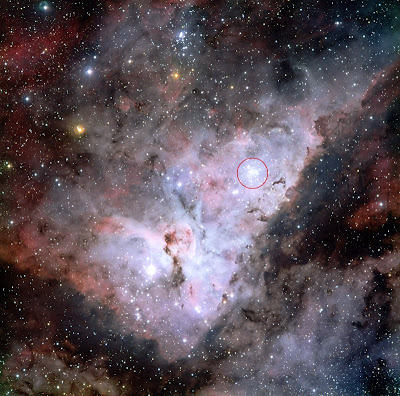
The young star cluster Trumpler 14 is revealed in another stunning ESO image. The amount of exquisite detail seen in this portrait, which beautifully reveals the life of a large family of stars, is due to the Multi-conjugate Adaptive optics Demonstrator (MAD) on ESO’s Very Large Telescope. Never before has such a large patch of sky been imaged using adaptive optics [1], a technique by which astronomers are able to remove most of the atmosphere's blurring effects.

Noted for harbouring Eta Carinae — one of the wildest and most massive stars in our galaxy — the impressive Carina Nebula also houses a handful of massive clusters of young stars. The youngest of these stellar families is the Trumpler 14 star cluster, which is less than one million years old — a blink of an eye in the Universe’s history. This large open cluster is located some 8000 light-years away towards the constellation of Carina (the Keel).

A team of astronomers, led by Hugues Sana, acquired astounding images of the central part of Trumpler 14 using the Multi-conjugate Adaptive optics Demonstrator (MAD, [2]) mounted on ESO’s Very Large Telescope (VLT). Thanks to MAD, astronomers were able to remove most of the blurring effects of the atmosphere and thus obtain very sharp images. MAD performs this correction over a much larger patch of the sky than any other current adaptive optics instrument, allowing astronomers to make wider, crystal-clear images.

Thanks to the high quality of the MAD images, the team of astronomers could obtain a very nice family portrait. They found that Trumpler 14 is not only the youngest — with a refined, newly estimated age of just 500 000 years — but also one of the most populous star clusters within the nebula. The astronomers counted about 2000 stars in their image, spanning the whole range from less than one tenth up to a factor of several tens of times the mass of our own Sun. And this in a region which is only about six light-years across, that is, less than twice the distance between the Sun and its closest stellar neighbour!

The most prominent star is the supergiant HD 93129A, one of the most luminous stars in the Galaxy. This titan has an estimated mass of about 80 times that of the Sun and is approximately two and a half million times brighter! It makes a stellar couple — a binary star — with another bright, massive star. The astronomers found that massive stars tend to pair up more often than less massive stars, and preferably with other more massive stars.

The Trumpler 14 cluster is undoubtedly a remarkable sight to observe: this dazzling patch of sky contains several white-blue, hot, massive stars, whose fierce ultraviolet light and stellar winds are blazing and heating up the surrounding dust and gas. Such massive stars rapidly burn their vast hydrogen supplies — the more massive the star, the shorter its lifespan. These giants will end their brief lives dramatically in convulsive explosions called supernovae, just a few million years from now.

A few orange stars are apparently scattered through Trumpler 14, in charming contrast to their bluish neighbours. These orange stars are in fact stars located behind Trumpler 14. Their reddened colour is due to absorption of blue light in the vast veils of dust and gas in the cloud.

The technology used in MAD to correct for the effect of the Earth’s atmosphere over large areas of sky will play a crucial role in the success of the next generation European Extremely Large Telescope (E-ELT).

Notes

[1] Telescopes on the ground suffer from a blurring effect introduced by atmospheric turbulence. This turbulence causes the stars to twinkle in a way that delights poets but frustrates astronomers, since it smears out the fine details of the images. However, with adaptive optics techniques, this major drawback can be overcome so that the telescope produces images that are as sharp as theoretically possible, i.e. approaching conditions in space. Adaptive optics systems work by means of a computer-controlled deformable mirror that counteracts the image distortion introduced by atmospheric turbulence. It is based on real-time optical corrections computed at very high speed (several hundreds of times each second) from image data obtained by a wavefront sensor (a special camera) that monitors light from a reference star.

[2] Present adaptive optics systems can only correct the effect of atmospheric turbulence in a very small region of the sky — typically 15 arcseconds or less — the correction degrading very quickly when moving away from the reference star. Engineers have therefore developed new techniques to overcome this limitation, one of which is multi-conjugate adaptive optics. MAD uses up to three stars instead of one as references to remove the blur caused by atmospheric turbulence over a field of view thirty times larger than that available to existing techniques.

Date: Thursday, December 03, 2009

Key Terms: Adaptive optics,open cluster,young star cluster,ESO, Trumpler 14,Very Large Telescope,MAD,HD 93129A,Binary Star,Stellar Winds,E-ELT,Arcsecond,Carina Constellation(the keel).

Revised and Edited By: Imran Khan.
year: 2009

A Superbright Supernova That’s the First of Its Kind


picture: In this schematic illustration of the material ejected from SN 2007bi, the radioactive nickel core (white) decays to cobalt, emitting gamma rays and positrons that excite surrounding layers (textured yellow) rich in heavy elements like iron. The outer layers (dark shadow) are lighter elements such as oxygen and carbon, where any helium must reside, which remain unilluminated and do not contribute to the visible spectrum.

But not the last, now that astronomers know where to look

Berkeley, CA – An extraordinarily bright, extraordinarily long-lasting supernova named SN 2007bi, snagged in a search by a robotic telescope, turns out to be the first example of the kind of stars that first populated the Universe. The superbright supernova occurred in a nearby dwarf galaxy, a kind of galaxy that’s common but has been little studied until now, and the unusual supernova could be the first of many such events soon to be discovered.

SN 2007bi was found early in 2007 by the international Nearby Supernova Factory (SNfactory) based at the U.S. Department of Energy’s Lawrence Berkeley National Laboratory. The supernova’s spectrum was unusual, and astronomers at the University of California at Berkeley subsequently obtained a more detailed spectrum. Over the next year and a half the Berkeley scientists participated in a collaboration led by Avishay Gal-Yam of Israel’s Weizmann Institute of Science to collect and analyze much more data as the supernova slowly faded away.

The analysis indicated that the supernova’s precursor star could only have been a giant weighing at least 200 times the mass of our Sun and initially containing few elements besides hydrogen and helium – a star like the very first stars in the early Universe.

“Because the core alone was some 100 solar masses, the long-hypothesized phenomenon called pair instability must have occurred,” says astrophysicist Peter Nugent. A member of the SNfactory, Nugent is the co-leader of the Computational Cosmology Center (C3), a collaboration between Berkeley Lab’s Physics Division and Computational Research Division (CRD), where Nugent is a staff scientist. “In the extreme heat of the star’s interior, energetic gamma rays created pairs of electrons and positrons, which bled off the pressure that sustained the core against collapse.”

“SN 2007bi was the explosion of an exceedingly massive star,” says Alex Filippenko, a professor in the Astronomy Department at UC Berkeley whose team helped obtain, analyze, and interpret the data. “But instead of turning into a black hole like many other heavyweight stars, its core went through a nuclear runaway that blew it to shreds. This type of behavior was predicted several decades ago by theorists, but never convincingly observed until now.”

SN 2007bi is the first confirmed observation of a pair-instability supernova. The researchers describe their results in the 3 December 2009 issue of Nature.

On the trail of a strange beast

SN 2007bi was recorded on images taken as part of the Palomar-QUEST Survey, an automated search with the wide-field Oschin Telescope at the California Institute of Technology’s Palomar Observatory, and was quickly detected and categorized as an unusual supernova by the SNfactory. The SNfactory has so far discovered nearly a thousand supernovae of all types and amassed thousands of spectra, but has focused on those designated Type Ia, the “standard candles” used to study the expansion history of the Universe. SN 2007bi, however, turned out not to be a Type Ia. For one thing, it was at least ten times as bright.

“The thermonuclear runaway experienced by the core of SN 2007bi is reminiscent of that seen in the explosions of white dwarfs as Type Ia supernovae,” says Filippenko, “but on a much larger scale and with a far greater amount of power.”

“The discovery is a great example of how we can get all the science, in addition to cosmology, out of the SNfactory search,” says Greg Aldering, SNfactory project leader, who was not an author of the Nature paper. “Berkeley Lab and Caltech’s Astronomy Department agreed that we would split the work, the Lab handling the Type Ia’s and Caltech all the other types.”

Nugent contacted Gal-Yam, then a Caltech postdoctoral fellow, the lead investigator for the all-other category. “I asked, are you interested? He said, sure!” Nugent then contacted Filippenko, who was about to conduct a night of observation with the 10-meter Keck I telescope on the summit of Mauna Kea in Hawaii. Filippenko immediately set out to obtain an optical spectrum of the unusual supernova.

Caltech researchers subsequently acquired additional spectra with the Keck telescope, as did Paolo Mazzali’s team from the Max Planck Institute for Astrophysics in Garching, Germany, using the Very Large Telescope (VLT) in Chile.

Says Mazzali, “The Keck and VLT spectra clearly indicated that an extremely large amount of material was ejected by the explosion, including a record amount of radioactive nickel, which caused the expanding gases to glow very brightly.”

Rollin Thomas of CRD, a member of C3 and the SNfactory, aided the early analysis, using the Franklin supercomputer at the National Energy Research Scientific Computing Center (NERSC) to run a code he developed to generate numerous synthetic spectra for comparison with the real spectrum.

“The code uses hundreds of cores to systematically test a large number of simplified model supernovae, searching through the candidates by adjusting parameters until it finds a good fit,” says Thomas. “This kind of data-driven approach is key to helping us understand new types of transients for which no reliable theoretical predictions yet exist.” The model fit was unambiguous: SN 2007bi was a pair-instability supernova.

“The central part of the huge star had fused to oxygen near the end of its life, and was very hot,” Filippenko explains. “Then the most energetic photons of light turned into electron-positron pairs, robbing the core of pressure and causing it to collapse. This led to a nuclear runaway explosion that created a large amount of radioactive nickel, whose decay energized the ejected gas and kept the supernova visible for a long time.”

Gal-Yam organized a team of collaborators from many institutions to continue to observe SN 2007bi and obtain data as it slowly faded over a span of 555 days. Says Gal-Yam, “As our follow-up observations started to roll in, I immediately realized this must be something new. And indeed it turned out to be a fantastic example of how we are finding new types of stellar explosions.”

Because it had no hydrogen or helium lines, the usual classification scheme would have labeled the supernova a Type Ic. But it was so much brighter than an ordinary Type Ic that it reminded Nugent of only one prior event, a supernova designated SN 1999as, found by the international Supernova Cosmology Project but unfortunately three weeks after its peak brightness.

Understanding a supernova requires a good record of its rise and fall in brightness, or light curve. Although SN 2007bi was detected more than a week after its peak, Nugent delved into years of data compiled by NERSC from the SNfactory and other surveys. He found that the Catalina Sky Survey had recorded SN 2007bi before its peak brightness and could provide enough data to calculate the duration of the rising curve, an extraordinarily long 70 days – more evidence for the pair-instability identification.

A fossil laboratory of the early Universe

“It’s significant that the first unambiguous example of a pair-instability supernova was found in a dwarf galaxy,” says Nugent. “These are incredibly small, very dim galaxies that contain few elements heavier than hydrogen and helium, so they are models of the early Universe.”
Dwarf galaxies are ubiquitous but so faint and dim – “they take only a few pixels on a camera,” says Nugent, “and until recently, with the development of wide-field projects like the SNfactory, astronomers had wanted to fill the chip with galaxies” – that they’ve rarely been studied. SN 2007bi is expected to focus attention on what Gal-Yam and his collaborators call “fossil laboratories to study the early Universe.”

Says Filippenko, “In the future, we might end up detecting the very first generation of stars, early in the history of the Universe, through explosions such as that of SN 2007bi – long before we have the capability of directly seeing the pre-explosion stars.”

With the advent of the multi-institutional Palomar Transient Factory, a fully automated, wide-field survey to find transients, led by Caltech’s Shri Kulkarni, and with the aid of the Deep Sky Survey established by Nugent at NERSC to compile historical data from Palomar-QUEST, the SNfactory, the Near Earth Asteroid Team, and other surveys, the collaborators expect they will soon find many more ultrabright, ultramassive supernovae, revealing the role of these supernovae in creating the Universe as we know it today.


Edited By : Imran Khan
Key Terms: Pair Instability Supernova,SN 2007bi,light curve
Year:2009
Wednesday, December 02, 2009

Blushing Dusty Nebula


This close-up of an area in the northwest region of the large Iris Nebula seems to be clogged with cosmic dust. With bright light from the nearby star HD 200775 illuminating it from above, the dust resembles thick mounds of billowing cotton. It is actually made up of tiny particles of solid matter, with sizes from ten to a hundred times smaller than those of the dust grains we find at home. Both background and foreground stars are dotted throughout the image. Researchers studying the object are particularly interested in the region to the left and slightly above centre in the image, where dusty filaments appear redder than is expected.

North is down, East is right. The field of view is 3.3 arcminutes. The image is a composite of four images obtained through blue, green, near-infrared and H-alpha filters.Credit: NASA & ESA


Tuesday, December 01, 2009

A recent NASA/ESA Hubble Space Telescope image of part of NGC 7023, or the Iris Nebula, highlights a perfect dust laboratory in the sky.

On Earth, we tend to find dust nothing more than a nuisance that blankets our furniture and causes us to sneeze. Cosmic dust can also be a hindrance to astronomers because cameras using visible light cannot see through it. However, studying cosmic dust in detail helps astronomers to pin down the ingredients of the raw mixture that eventually gives birth to stars.

This close-up of an area in the northwest region of the large Iris Nebula seems to be clogged with cosmic dust. With bright light from the nearby star HD 200775 [1] illuminating it from above, the dust resembles thick mounds of billowing cotton. It is actually made up of tiny particles of solid matter, with sizes from ten to a hundred times smaller than those of the dust grains we find at home [2]. Both background and foreground stars are dotted throughout the image.

NGC 7023 is a reflection nebula, which means it scatters light from a massive nearby star, in this case, HD 200775. Reflection nebulae are different from emission nebulae, which are clouds of gas that are hot enough to emit light themselves. Reflection nebulae tend to appear blue because of the way light scatters, but parts of the Iris Nebula appear unusually red.

Researchers studying the object are particularly interested in the region to the left and slightly above centre in the image, where they find dusty filaments to be redder than expected. An unknown chemical compound, most likely based on hydrocarbons, is responsible for the red tinge. The high resolution and sensitivity of Hubble’s instruments allow astronomers to study the area in detail. Images and spectra are only part of the analysis. On Earth, scientists are performing additional laboratory tests to assess better the exact chemical composition of the nebula.

NGC 7023 was discovered by Sir William Herschel in 1794; the nebula is in the constellation of Cepheus, the King, in the northern sky. NGC 7023 is approximately 1400 light–years from Earth and about six light-years across. This aethereal image was taken by Hubble's Advanced Camera for Surveys. Astronomers also used Hubble’s Near Infrared Camera and Multi-Object Spectrometer (NICMOS) instrument to try to determine which chemical elements are present in the nebula.

Notes for you:

North is down, East is right. The field of view is 3.3 arcminutes. The image is a composite of four images obtained through blue, green, near-infrared and H-alpha filters.

[1] HD 200775 is about ten times the mass of the Sun.

[2] The typical sizes of cosmic dust grains range between a few hundredths of a micron and several microns.

The Hubble Space Telescope is a project of international cooperation between ESA and NASA.

These observations were obtained by a team led by Karl Gordon from the Space Telescope Science Institute in Baltimore, Maryland, USA.