Monday, October 3, 2011

Faster than Light Experiment : OPERA


CERN Neutrinos to Gran Sasso Underground Structures

Credit : CERN


Published : 3rd October, 2011

The Oscillation Project with Emulsion-tRacking Apparatus (OPERA) is an experiment to test the phenomenon of neutrino oscillations. It exploits CERN Neutrinos to Gran Sasso (CNGS), a high-intensity and high-energy beam of muon neutrinos produced at the CERN Super Proton Synchrotron in Geneva and pointing to the Laboratori Nazionali del Gran Sasso (LNGS) underground laboratory, 733 km (455 mi) away at Gran Sasso in central Italy (Abruzzo region). OPERA is located in Hall C of LNGS and is aimed at detecting for the first time the appearance of tau neutrinos from the oscillation of muon neutrinos during their 3 millisecond travel from Geneva to Gran Sasso. Tau particles resulting from the interaction of tau neutrinos will be observed in "bricks" of photographic emulsion films interleaved with lead plates. The apparatus contains about 150,000 bricks, for a total mass of 1300 tons, and is complemented by electronic detectors (trackers and spectrometers) and ancillary infrastructure. Its construction was completed in spring 2008 and the experiment is currently collecting data.

On 31 May 2010, OPERA researchers announced the observation of a first tau neutrino candidate event in a muon neutrino beam. In September 2011, CERN and OPERA announced that time of flight measurements made by their collaboration had indicated muon neutrinos traveling at faster than lightspeed. While acknowledging that such a measurement would be a major discovery if correct, many physicists,and the OPERA team itself, have expressed skepticism that OPERA's measurements are sufficiently free of error. Experimental groups such as the MINOS Experiment at Fermilab and the T2K experiment are planning to attempt to replicate the result, while others in the physics community search for any experimental errors which might account for it.

OPERA needs an intense and energetic beam of muon neutrinos traveling a distance of hundreds of kilometers to detect the appearance of oscillated tau neutrinos. A beam of this type is generated by collisions of accelerated protons with a graphite target after focusing the particles produced (pions and kaons in particular) in the desired direction. The products of their decays, muons and neutrinos, continue to travel in generally the same direction as the parent particle. Muon neutrinos produced in this way at CERN pass through the Earth's crust reaching OPERA after a 730 km journey.

OPERA is located in Hall C of the Gran Sasso underground labs. Construction started in 2003, and the apparatus was completed in summer 2008. The taus resulting from the interaction of tau neutrinos will be observed in "bricks" of photographic films (nuclear emulsion) interleaved with lead sheets. Each brick has an approximate weight of 8.3 kg and the two OPERA supermodules contain about 150,000 bricks arranged into parallel walls and interleaved with plastic scintillator counters. Each supermodule is followed by a magnetic spectrometer for momentum and charge identification of penetrating particles. During the data collection, a neutrino interaction is tagged in real time by the scintillators and the spectrometers, which also provide the location of the bricks where the neutrino interaction occurred. These bricks are extracted from the walls asynchronously with respect to the beam to allow for film development, scanning and for the topological and kinematic search of tau decays.

Saturday, October 1, 2011

NASA Space Telescopes Reveal Secrets of Supermassive Black Hole


This image of the distant active galaxy Markarian 509 was taken in April 2007 with the Hubble Space Telescope's Wide Field Camera 2.

Credit: NASA, ESA, G. Kriss (STScI), and J. de Plaa (SRON Netherlands Institute for Space Research); Acknowledgment: B. Peterson (Ohio State University)


Published: 29th September, 2011


A fleet of spacecraft including NASA's Hubble Space Telescope has uncovered unprecedented details in the surroundings of a supermassive black hole. Observations reveal huge bullets of gas being driven away from the gravitational monster and a corona of very hot gas hovering above the disk of matter that is falling into the black hole.A team led by Jelle Kaastra of SRON Netherlands Institute for Space Research made use of data from ESA's XMM-Newton and INTEGRAL spacecraft (which study X-rays and gamma rays, respectively), the Hubble Space Telescope (for ultraviolet observations with the COS instrument), and NASA's Chandra (X-ray) Observatory and Swift (gamma-ray) satellites.

The black hole that the team chose to study lies at the heart of the galaxy Markarian 509 (Mrk 509), nearly 500 million light-years away. This black hole is colossal, containing 300 million times the mass of the Sun, and is growing more massive every day as it continues to feed on surrounding matter, which glows brightly as it forms a rotating disk around the black hole. Mrk 509 was chosen because it is known to vary in brightness, which indicates that the flow of matter is turbulent.

The above image of Mrk 509 was taken in April 2007 with Hubble's Wide Field Planetary Camera 2. But using a large number of telescopes that are sensitive to different wavelengths of light gave astronomers unprecedented coverage running from the infrared, through the visible, ultraviolet, X-rays, and into the gamma-ray band.The study is presented in a series of seven papers in the journal Astronomy and Astrophysics, with more expected to be published in coming months.

Tuesday, September 27, 2011

A method to detect the collision of stars with an elusive type of black hole


Princeton and New York University researchers have simulated the effect of a primordial black hole passing through a star. Primordial black holes are among the objects hypothesized to make up dark matter — the invisible substance thought to constitute much of the universe — and astronomers could use the researchers' model to finally observe the elusive black holes. This image illustrates the resulting vibration waves as a primordial black hole (white dots) passes through the center of a star. The different colors correspond to the density of the primordial black hole and strength of the vibration.

Credit: Tim Sandstrom

By Princeton University, Princeton, New Jersey

Published: September 22, 2011

Scientists looking to capture evidence of dark matter — the invisible substance thought to constitute much of the universe — may find a helpful tool in the recent work of researchers from Princeton University in New Jersey and New York University (NYU).

The team unveiled a ready-made method for detecting the collision of stars with an elusive type of black hole, which is on the short list of objects believed to make up dark matter. Such a discovery could serve as observable proof of dark matter and provide a much deeper understanding of the universe’s inner workings.

Researchers Shravan Hanasoge from Princeton and Michael Kesden from NYU simulated the visible result of a primordial black hole passing through a star. Theoretical remnants of the Big Bang, primordial black holes possess the properties of dark matter and are one of various cosmic objects thought to be the source of the mysterious substance, but they have yet to be observed.

If primordial black holes are the source of dark matter, the sheer number of stars in the Milky Way galaxy — roughly 100 billion — makes an encounter inevitable. Unlike larger black holes, a primordial black hole would not “swallow” the star, but instead cause noticeable vibrations on the star’s surface as it passes through.

Thus, as the number of telescopes and satellites probing distant stars in the Milky Way increases, so do the chances to observe a primordial black hole as it slides harmlessly through one of the galaxy’s billions of stars, Hanasoge said. The computer model developed by Hanasoge and Kesden can be used with these current solar-observation techniques to offer a more precise method for detecting primordial black holes than existing tools.

“If astronomers were just looking at the Sun, the chances of observing a primordial black hole are not likely, but people are now looking at thousands of stars,” Hanasoge said.

“There’s a larger question of what constitutes dark matter, and, if a primordial black hole were found, it would fit all the parameters — they have mass and force so they directly influence other objects in the universe, and they don’t interact with light. Identifying one would have profound implications for our understanding of the early universe and dark matter.”

Although dark matter has not been observed directly, galaxies are thought to reside in extended dark-matter halos based on documented gravitational effects of these halos on galaxies’ visible stars and gas. Like other proposed dark-matter candidates, primordial black holes are difficult to detect because they neither emit nor absorb light, stealthily traversing the universe with only subtle gravitational effects on nearby objects.

Because primordial black holes are heavier than other dark-matter candidates, however, their interaction with stars would be detectable by existing and future stellar observatories, Kesden said. When crossing paths with a star, a primordial black hole’s gravity would squeeze the star, and then, once the black hole passed through, cause the star’s surface to ripple as it snaps back into place.

“If you imagine poking a water balloon and watching the water ripple inside, that’s similar to how a star’s surface appears,” Kesden said.

“By looking at how a star’s surface moves, you can figure out what’s going on inside. If a black hole goes through, you can see the surface vibrate.”

Eyeing the Sun’s surface for hints of dark matter
Kesden and Hanasoge used the Sun as a model to calculate the effect of a primordial black hole on a star’s surface. Kesden, whose research includes black holes and dark matter, calculated the masses of a primordial black hole as well as the likely trajectory of the object through the Sun. Hanasoge, who studies seismology in the Sun, Earth, and stars, worked out the black hole’s vibrational effect on the Sun’s surface.

NASA’s Tim Sandstrom created video simulations of the researchers’ calculations using the Pleiades supercomputer at the Ames Research Center in California. One clip shows the vibrations of the Sun’s surface as a primordial black hole — represented by a white trail — passing through its interior. A second movie portrays the result of a black hole grazing the Sun’s surface.

Marc Kamionkowski from Johns Hopkins University in Baltimore, Maryland, said that the work serves as a toolkit for detecting primordial black holes, because Hanasoge and Kesden have provided a thorough and accurate method that takes advantage of existing solar observations.

“It’s been known that as a primordial black hole went by a star, it would have an effect, but this is the first time we have calculations that are numerically precise,” Kamionkowski said. “This is a clever idea that takes advantage of observations and measurements already made by solar physics. It’s like someone calling you to say there might be a million dollars under your front doormat. If it turns out to not be true, it cost you nothing to look. In this case, there might be dark matter in the data sets astronomers already have, so why not look?”

One significant aspect of Kesden and Hanasoge’s technique, Kamionkowski said, is that it narrows a significant gap in the mass that can be detected by existing methods of trolling for primordial black holes.

The search for primordial black holes has thus far been limited to masses too small to include a black hole, or so large that “those black holes would have disrupted galaxies in heinous ways we would have noticed,” Kamionkowski said. “Primordial black holes have been somewhat neglected, and I think that’s because there has not been a single, well-motivated idea of how to find them within the range in which they could likely exist.”

The current mass range in which primordial black holes could be observed was set based on previous direct observations of Hawking radiation — the emissions from black holes as they evaporate into gamma rays — as well as the bending of light around large stellar objects, Kesden said. The difference in mass between those phenomena, however, is enormous even in astronomical terms. Hawking radiation can only be observed if the evaporating black hole’s mass is less than 100 quadrillion grams. On the other end, an object must be larger than 100 septillion (24 zeroes) grams for light to visibly bend around it. The search for primordial black holes covered a swath of mass that spans a factor of 1 billion, Kesden said — similar to searching for an unknown object with a weight somewhere between that of a penny and a mining dump truck.

He and Hanasoge suggest a technique to give that range a much-needed trim and established more specific parameters for spotting a primordial black hole. The pair found through their simulations that a primordial black hole larger than 1 sextillion (21 zeroes) grams — roughly the mass of an asteroid — would produce a noticeable effect on a star’s surface.

“Now that we know primordial black holes can produce detectable vibrations in stars, we could try to look at a larger sample of stars than just our own Sun,” Kesden said.

“The Milky Way has 100 billion stars, so about 10,000 detectable events should be happening every year in our galaxy if we just knew where to look.”

A huge doughnut-shaped cloud of water vapor created by Enceladus


Water vapor and ice erupt from Saturn's moon Enceladus, the source of a newly discovered doughnut-shaped cloud around Saturn.

Credit: NASA/JPL/Space Science Institute

Published: September 22, 2011

Chalk up one more feat for Saturn's intriguing moon Enceladus. The small, dynamic moon spews out dramatic plumes of water vapor and ice — first seen by NASA's Cassini spacecraft in 2005. It possesses simple organic particles and may house liquid water beneath its surface. Its geyser-like jets create a gigantic halo of ice, dust, and gas around Enceladus that helps feed Saturn's E ring. Now, thanks again to those icy jets, Enceladus is the only moon in our solar system known to substantially influence the chemical composition of its parent planet.

In June, the European Space Agency (ESA) announced that its Herschel Space Observatory, which has important NASA contributions, had found a huge doughnut-shaped cloud, or torus, of water vapor created by Enceladus encircling Saturn. The torus is more than 373,000 miles (600,000 kilometers) across and about 37,000 miles (60,000 km) thick. It appears to be the source of water in Saturn's upper atmosphere.

Though it is enormous, the cloud had not been seen before because water vapor is transparent at most visible wavelengths of light, but Herschel could see the cloud with its infrared detectors. "Herschel is providing dramatic new information about everything from planets in our own solar system to galaxies billions of light-years away," said Paul Goldsmith from NASA's Jet Propulsion Laboratory in Pasadena, California.

The discovery of the torus around Saturn did not come as a complete surprise. NASA's Voyager and Hubble missions had given scientists hints of the existence of water-bearing clouds around Saturn. Then in 1997, ESA’s Infrared Space Observatory confirmed the presence of water in Saturn's upper atmosphere. NASA's Submillimeter Wave Astronomy Satellite also observed water emission from Saturn at far-infrared wavelengths in 1999.

While a small amount of gaseous water is locked in the warm, lower layers of Saturn's atmosphere, it can't rise to the colder, higher levels. To get to the upper atmosphere, water molecules must be entering Saturn's atmosphere from somewhere in space. But from where and how? Those were mysteries until now.

Build the model, and the data will come
The answer came by combining Herschel's observations of the giant cloud of water vapor created by Enceladus' plumes with computer models that researchers had already been developing to describe the behavior of water molecules in clouds around Saturn.

One of these researchers is Tim Cassidy from the University of Colorado, Boulder. "What's amazing is that the model, which is one iteration in a long line of cloud models, was built without knowledge of the observation,” said Cassidy. “Those of us in this small modeling community were using data from Cassini, Voyager, and the Hubble telescope, along with established physics. We weren't expecting such detailed 'images' of the torus, and the match between model and data was a wonderful surprise."

The results show that, though most of the water in the torus is lost to space, some of the water molecules fall and freeze on Saturn's rings, while a small amount — about 3 to 5 percent — gets through the rings to Saturn's atmosphere. This is just enough to account for the water that has been observed there.

Herschel's measurements combined with the cloud models also provided new information about the rate at which water vapor is erupting out of the dark fractures known as "tiger stripes" on Enceladus' southern polar region. Previous measurements by the Ultraviolet Imaging Spectrograph (UVIS) instrument aboard the Cassini spacecraft showed that the moon is ejecting about 440 pounds (200 kilograms) of water vapor every second.

"With the Herschel measurements of the torus from 2009 and 2010 and our cloud model, we were able to calculate a source rate for water vapor coming from Enceladus," said Cassidy. "It agrees very closely with the UVIS finding, which used a completely different method."

"We can see the water leaving Enceladus, and we can detect the end product — atomic oxygen — in the Saturn system," said Cassini UVIS science team member Candy Hansen from the Planetary Science Institute in Tucson, Arizona. "It's very nice with Herschel to track where it goes in the meantime."

While a small fraction of the water molecules inside the torus end up in Saturn's atmosphere, most are broken down into separate atoms of hydrogen and oxygen. "When water hangs out in the torus, it is subject to the processes that dissociate water molecules, first to hydrogen and hydroxide, and then the hydroxide dissociates into hydrogen and atomic oxygen," said Hansen. “This oxygen is dispersed through the Saturn system. Cassini discovered atomic oxygen on its approach to Saturn before it went into orbit insertion. At the time, no one knew where it was coming from. Now we do."

"The profound effect this little moon Enceladus has on Saturn and its environment is astonishing," said Hansen.

Thursday, June 16, 2011

Total Eclipse: Dark of the Moon


The December 21, 2010, lunar eclipse dazzled viewers across North America. This image is a two-exposure combination taken in Mead, Colorado, by attaching a digital camera to a 4-inch telescope.
Photo by Richard McCoy

by Michael E. Bakich
Published: June 6, 2011

Don't get scared. This title is not from Hollywood Movies. The first lunar eclipse of 2011 occurs June 15. The timing and the placement of the Moon in its orbit does not favor the Western Hemisphere, however.

Skywatchers can see the entire event from the eastern half of Africa, the Middle East, central Asia, and western Australia. At mid-eclipse, the Moon will lie near the zenith for observers situated in Réunion or Mauritius in the Indian Ocean.

Observers throughout Europe will miss the early stages of the eclipse because they occur before moonrise. But except for northern Scotland and northern Scandinavia, Europeans with clear skies will see totality (when the Moon lies completely within Earth’s umbra).

Likewise, eastern Asia, eastern Australia, and New Zealand will miss the last stages of eclipse because they occur after moonset, but, like those in Europe, most inhabitants will see the total phase. Observers in eastern Brazil, Uruguay, and Argentina also will witness totality. Unfortunately, none of the eclipse will be visible from North America.

A lunar eclipse occurs when the Moon in its orbit passes into Earth’s shadow. Because the Sun isn’t a point of light, the shadow has two parts — the inner, darker umbra and the outer, lighter penumbra. If the entire Moon enters the umbra, the eclipse is total. If the umbra hides only part of our satellite, the eclipse is partial.

This eclipse’s umbral phase begins at 18h22m56s UT (2:22:56 p.m. EDT). As the Moon dips deeper into our planet’s shadow during the next hour or so, darkness gradually overtakes the brilliant orb.

Earth’s shadow takes almost exactly 1 hour to envelop the Moon. Totality begins at 19h22m30s UT (3:22:30 p.m. EDT).

The Moon won’t disappear from view, however. Some sunlight passing through Earth’s atmosphere falls on the lunar surface. The cleaner our atmosphere is, the “lighter” the eclipse will be. “Dark” eclipses generally occur after large volcanic eruptions when the atmosphere contains more dust.

What color will the Moon turn at mideclipse? During previous total eclipses, the Moon has appeared brown, orange, crimson, and brick red. Lunar eclipses exhibit a range of shades because sunlight passing through Earth’s atmosphere during totality becomes scattered and reddened. It’s this dim glow that fills Earth’s shadow and lights the eclipsed Moon. The sky certainly will grow darker, allowing the bright summer stars surrounding our nearest celestial neighbor to spring back to prominence.

Totality lasts 100 minutes, which is rather long. The last eclipse to exceed this duration was in July 2000. During totality, the Moon’s southern edge may appear slightly darker than its northern side. This disparity occurs because the Moon’s southern limb lies a bit closer to the center of Earth’s shadow. After totality ends at 21h02m42s UT (5:02:42 p.m. EDT), it takes the Moon another 60 minutes to leave Earth’s umbra.

Astronomy magazine Contributing Editor Ray Shubinski describes the upcoming eclipse as a missed opportunity: “It’s too bad that nobody in North America will see the eclipse. Luckily, we don’t have all that long to wait until the next one.”

The eclipse to which Shubinski refers will occur December 10. But it won’t be perfect, either. For North Americans, that eclipse will still be in progress as the Moon sets. The farther west you live, however, the larger fraction of the eclipse you will see before moonset. The entire event will be visible for inhabitants of Asia and Australia under clear skies.

Sunday, June 12, 2011

NASA probes suggest magnetic bubbles reside at edge of solar system


Old and new views of the heliosheath. Red and blue spirals are the gracefully curving magnetic field lines of orthodox models. New data from Voyager add a magnetic froth (inset) to the mix.
Photo by NASA

By NASA Headquarters, Washington, D.C.
Published: June 9, 2011

While using a new computer model to analyze Voyager data, scientists found the Sun’s distant magnetic field is made up of bubbles approximately 100 million miles wide. The bubbles are created when magnetic field lines reorganize. The new model suggests the field lines are broken up into self-contained structures disconnected from the solar magnetic field. The findings are described in the June 9 edition of the Astrophysical Journal.

Like Earth, the Sun has a magnetic field with a north pole and a south pole. The field lines are stretched outward by the solar wind or a stream of charged particles emanating from the star that interacts with material expelled from others in our corner of the Milky Way galaxy.

The Voyager spacecraft, more than nine billion miles away from Earth, are traveling in a boundary region. In that area, the solar wind and magnetic field are affected by material expelled from other stars in our corner of the Milky Way galaxy.

“The Sun’s magnetic field extends all the way to the edge of the solar system,” said astronomer Merav Opher of Boston University. “Because the Sun spins, its magnetic field becomes twisted and wrinkled, a bit like a ballerina’s skirt. Far, far away from the Sun, where the Voyagers are, the folds of the skirt bunch up.”

Understanding the structure of the Sun’s magnetic field will allow scientists to explain how galactic cosmic rays enter our solar system and help define how our star interacts with the rest of the galaxy.

So far, much of the evidence for the existence of the bubbles originates from an instrument aboard the spacecraft that measures energetic particles. Investigators are studying more information and hoping to find signatures of the bubbles in the Voyager magnetic field data.

“We are still trying to wrap our minds around the implications of the findings,” said University of Maryland physicist Jim Drake, one of Opher’s colleagues.

A new class of stellar explosions


The four supernovae discovered by the Palomar Transient Factory, (from top to bottom) PTF09atu, PTF09cnd, PTF09cwl, and PTF10cwr, are shown both before (left) and after (right) explosion.
Photo by Caltech/Robert Quimby/Nature

By California Institute of Technology, Pasadena
Published: June 10, 2011

They’re bright and blue — and a bit strange. They’re a new type of stellar explosion that was recently discovered by a team of astronomers led by the California Institute of Technology (Caltech). Among the most luminous in the cosmos, these new kinds of supernovae could help researchers better understand star formation, distant galaxies, and what the early universe might have been like.

“We’re learning about a whole new class of supernovae that wasn’t known before,” said Robert Quimby, a Caltech postdoctoral scholar and lead author on the paper. In addition to finding four explosions of this type, the team also discovered that two previously known supernovae, whose identities had baffled astronomers, also belong to this new class.

Quimby first made headlines in 2007 when — as a graduate student at the University of Texas at Austin — he discovered what was then the brightest supernova ever found: 100 billion times brighter than the Sun and 10 times brighter than most other supernovae. Dubbed 2005ap, it was also a little odd. For one thing, its spectrum — the chemical fingerprint that tells astronomers what the supernova is made of, how far away it is, and what happened when it blew up — was unlike any seen before. It also showed no signs of hydrogen, which is commonly found in most supernovae.

At around the same time, astronomers using the Hubble Space Telescope discovered a mysterious supernova called SCP 06F6. This supernova also had an odd spectrum, though there was nothing that indicated this cosmic blast was similar to 2005ap.

Caltech's Shri Kulkarni, a co-author on the paper, recruited Quimby to become a founding member of the Palomar Transient Factory (PTF). The PTF is a project that scans the skies for flashes of light that weren’t there before — flashes that signal objects called transients, many of which are supernovae. As part of the PTF, Quimby and his colleagues used the 1.2-meter Samuel Oschin Telescope at Palomar Observatory to discover four new supernovae. After taking spectra with the 10-meter Keck telescopes in Hawaii, the 5.1-meter telescope at Palomar, and the 4.2-meter William Herschel Telescope in the Canary Islands, the astronomers discovered that all four objects had an unusual spectral signature.

Quimby then realized that if you slightly shifted the spectrum of 2005ap — the supernova he had found a couple of years earlier — it looked a lot like these four new objects. The team then plotted all the spectra together. “Boom — it was a perfect match,” he recalled.

The astronomers soon determined that shifting the spectrum of SCP 06F6 similarly aligned it with the others. In the end, it turned out that all six supernovae are siblings, and that they all have spectra that are very blue — with the brightest wavelengths shining in the ultraviolet.

According to Quimby, the two mysterious supernovae — 2005ap and SCP 06F6 — had looked different from one another because 2005ap was 3 billion light-years away while SCP 06F6 was 8 billion light-years away. More-distant supernovae have a stronger cosmological redshift, a phenomenon in which the expanding universe stretches the wavelength of the emitted light, shifting supernovae spectra toward the red end.

The four new discoveries, which had features similar to 2005ap and SCP 06F6, were at an intermediate distance, providing the missing link that connected the two previously unexplained supernovae. “That’s what was most striking about this — that this was all one unified class,” said Mansi Kasliwal, a Caltech graduate student and co-author on the paper.

Although astronomers now know these supernovae are related, no one knows much else. “We have a whole new class of objects that can’t be explained by any of the models we’ve seen before,” Quimby says. What the researchers do know about them is that they are bright and hot — 10,000 to 20,000 kelvins; that they are expanding rapidly at 6,000 miles per second (10,000 km/s); that they lack hydrogen; and that they take about 50 days to fade away — much longer than most supernovae, whose luminosity is often powered by radioactive decay. So there must be some other mechanism that’s making them so bright.

One possible model that would create an explosion with these properties involves a pulsating star about 90 to 130 times the mass of the Sun. The pulsations blow off hydrogen-free shells, and when the star exhausts its fuel and explodes as a supernova, the blast heats up those shells to the observed temperatures and luminosities.

A second model requires a star that explodes as a supernova but leaves behind what’s called a magnetar, a rapidly spinning dense object with a strong magnetic field. The rotating magnetic field slows the magnetar down as it interacts with the sea of charged particles that fills space, releasing energy. The energy heats the material that was previously blown off during the supernova explosion and can naturally explain the brightness of these events.

The newly discovered supernovae live in dim, small collections of a few billion stars called dwarf galaxies. (Our own Milky Way has 200 to 400 billion stars.) The supernovae, which are almost a hundred times brighter than their host galaxies, illuminate their environments like distant street lamps lighting up dark roads. They work as a kind of backlight, enabling astronomers to measure the spectrum of the interstellar gas that fills the dwarf galaxies in which the supernovae reside, and revealing each galaxy’s composition. Once an observed supernova fades a couple of months later, astronomers can directly study the dwarf galaxy — which would have remained undetected if it weren’t for the supernova.

These supernovae could also reveal what ancient stars might have been like because they most likely originate from stars around a hundred times more massive than the Sun — stars that would have been very similar to the first stars in the universe.

“It is really amazing how rich the night sky continues to be,” Kulkarni said. “In addition to supernovae, the Palomar Transient Factory is making great advances in stellar astronomy as well.”

Sunday, May 29, 2011

NASA's Hubble Finds Rare 'Blue Straggler' Stars in Milky Way's Hub


The Hubble Telescope captures blue straggler stars in the Milky Way bulge Credit: NASA, ESA, W. Clarkson (Indiana University and UCLA), and K. Sahu (STScl)

By: STScl
Published: 05.25.11

NASA's Hubble Space Telescope has found a rare class of oddball stars called blue stragglers in the hub of our Milky Way, the first detected within our galaxy's bulge.

Blue stragglers are so named because they seemingly lag behind in the aging process, appearing younger than the population from which they formed. While they have been detected in many distant star clusters, and among nearby stars, they never have been seen inside the core of our galaxy.

It is not clear how blue stragglers form. A common theory is that they emerge from binary pairs. As the more massive star evolves and expands, the smaller star gains material from its companion. This stirs up hydrogen fuel and causes the growing star to undergo nuclear fusion at a faster rate. It burns hotter and bluer, like a massive young star.

The findings support the idea that the Milky Way's central bulge stopped making stars billions of years ago. It now is home to aging sun-like stars and cooler red dwarfs. Giant blue stars that once lived there have long since exploded as supernovae.

The results have been accepted for publication in an upcoming issue of The Astrophysical Journal. Lead author Will Clarkson of Indiana University in Bloomington, will discuss them today at the American Astronomical Society meeting in Boston.

"Although the Milky Way bulge is by far the closest galaxy bulge, several key aspects of its formation and subsequent evolution remain poorly understood," Clarkson said. "Many details of its star-formation history remain controversial. The extent of the blue straggler population detected provides two new constraints for models of the star-formation history of the bulge."

The discovery followed a seven-day survey in 2006 called the Sagittarius Window Eclipsing Extrasolar Planet Search (SWEEPS). Hubble peered at 180,000 stars in the crowded central bulge of our galaxy, 26,000 light-years away. The survey was intended to find hot Jupiter-class planets that orbit very close to their stars. In doing so, the SWEEPS team also uncovered 42 oddball blue stars with brightness and temperatures typical for stars much younger than ordinary bulge stars.

The observations clearly indicate that if there is a young star population in the bulge, it is very small. It was not detected in the SWEEPS program. Blue stragglers long have been suspected to be living in the bulge, but had not been observed because younger stars in the disk of our galaxy lie along the line-of-sight to the core, confusing and contaminating the view.

Astronomers used Hubble to distinguish the motion of the core population from foreground stars in the Milky Way. Bulge stars orbit the galactic center at a different speed than foreground stars. Plotting their motion required returning to the SWEEPS target region with Hubble two years after the first observations were made. The blue stragglers were identified as moving along with the other stars in the bulge.

"The size of the field of view on the sky is roughly that of the thickness of a human fingernail held at arm's length, and within this region, Hubble sees about a quarter million stars toward the bulge," Clarkson said. "Only the superb image quality and stability of Hubble allowed us to make this measurement in such a crowded field."

From the 42 candidate blue stragglers, the investigators estimate 18 to 37 are likely genuine. The remainder could be a mix of foreground objects and, at most, a small population of genuinely young bulge stars.

"The SWEEPS program was designed to detect transiting planets through small light variations" said Kailash Sahu, the principal investigator of the SWEEPS program. "Therefore the program could easily detect the variability of binary pairs, which was crucial in confirming these are indeed blue stragglers."

Black holes spin faster and faster


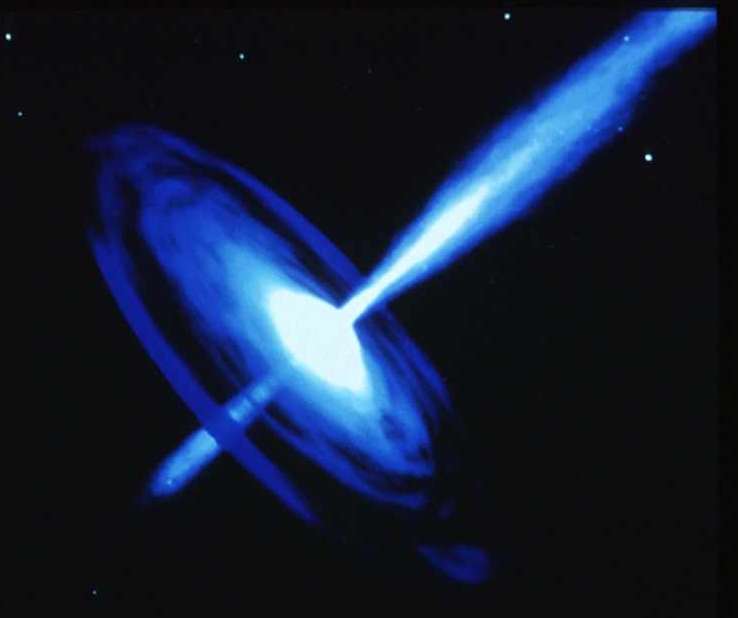
An artist’s impression of the jets emerging from a supermassive black hole at the center of the galaxy PKS 0521-36. Dana Berry/STScI

By Royal Astronomical Society, United Kingdom
Published: May 24, 2011

Two United Kingdom astronomers have found that the giant black holes in the center of galaxies are on average spinning faster than at any time in the history of the universe. Alejo Martinez-Sansigre from the University of Portsmouth and Steve Rawlings from the University of Oxford made the new discovery by using radio, optical, and X-ray data.

There is strong evidence that every galaxy has a black hole in its center. These black holes have masses between a million and a billion Suns and so are referred to as “supermassive.” They are not visible directly, but material swirls around the black hole in an accretion disk before its final demise. That material can become hot and emit radiation, including X-rays that can be detected by space-based telescopes while associated radio emission can be detected by telescopes on the ground.

As well as radiation, twin jets are often associated with black holes and their accretion disks. There are many factors that can cause these jets to form, but scientists believe the spin of the supermassive black hole is important. However, there are conflicting predictions about how the spins of the black holes should be evolving, and until now this evolution was not well understood.

Martinez-Sansigre and Rawlings compared theoretical models of spinning black holes with radio, optical, and X-ray observations made using a variety of instruments and found that the theories can explain very well the population of supermassive black holes with jets.

Using the radio observations, the two astronomers were able to sample the population of black holes, deducing the spread of the jets’ power. By estimating how they acquire material (the accretion process), the two scientists could then infer how quickly these objects are spinning.

The observations also give information on how the spins of supermassive black holes have evolved. In the past, when the universe was half its present size, practically all of the supermassive black holes had low spins, whereas today a fraction of them have high spins. So on average, supermassive black holes are spinning faster than ever before.

This is the first time that the evolution of the spin of the supermassive black holes has been constrained, and it suggests that those supermassive black holes that grow by swallowing matter will barely spin, while those that merge with other black holes will be left spinning rapidly.

“The spin of black holes can tell you a lot about how they formed,” said Martinez-Sansigre. “Our results suggest that in recent times a large fraction of the most massive black holes have somehow spun up. A likely explanation is that they have merged with other black holes of similar mass, which is a truly spectacular event, and the end product of this merger is a faster spinning black hole.”

“Later this decade, we hope to test our idea that these supermassive black holes have been set spinning relatively recently,” said Rawlings. “Black hole mergers cause predictable distortions in space and time — called gravitational waves. With so many collisions, we expect there to be a cosmic background of gravitational waves, something that will change the timing of the pulses of radio waves that we detect from the remnants of massive stars known as pulsars.

“If we are right, this timing change should be picked up by the Square Kilometer Array, the giant radio observatory due to start operating in 2019.”

Promising new method to measure star age


Artist's conception of a hypothetical exoplanet. Gyrochronology is a promising new method to learn the ages of isolated stars, including all stars known to have planets. David A. Aguilar (CfA)

By Harvard-Smithsonian Center for Astrophysics, Cambridge, Massachusetts
Published: May 23, 2011

How can we tell if a star is 1 billion or 10 billion years old? Astronomers may have found a solution — measuring the star's spin. "A star's rotation slows down steadily with time, like a top spinning on a table, and can be used as a clock to determine its age," said astronomer Soren Meibom from the Harvard-Smithsonian Center for Astrophysics in Cambridge, Massachusetts.

Knowing a star's age is important for many astronomical studies and, in particular, for planet hunters. With the bountiful harvest from NASA's Kepler spacecraft (launched in 2009) adding to previous discoveries, astronomers have found nearly 2,000 planets orbiting distant stars. Now, they want to use this new zoo of planets to understand how planetary systems form and evolve and why they are so different from each other.

"Ultimately, we need to know the ages of the stars and their planets to assess whether alien life might have evolved on these distant worlds," said Meibom. "The older the planet, the more time life has had to get started. Since stars and planets form together at the same time, if we know a star's age, we know the age of its planets, too."

Learning a star's age is relatively easy when it's in a cluster of hundreds of stars that all formed at the same time. Astronomers have known for decades that if they plot the colors and brightnesses of the stars in a cluster, the pattern they see can be used to tell the cluster's age. But this technique only works on clusters. For stars not in clusters (including all stars known to have planets), determining the age is more difficult.

Using the unique capabilities of the Kepler space telescope, Meibom and his collaborators measured the rotation rates for stars in a 1-billion-year-old cluster called NGC 6811. This new work nearly doubles the age covered by previous studies of younger clusters. It also significantly adds to our knowledge of how a star's spin rate and age are related.

If a relationship between stellar rotation and age can be established by studying stars in clusters, then measuring the rotation period of any star can be used to derive its age — a technique called gyrochronology. For gyrochronology to work, astronomers first must calibrate their new "clock."

They begin with stars in clusters with known ages. By measuring the spins of cluster stars, they can learn what spin rate to expect for that age. Measuring the rotation of stars in clusters with different ages tells them exactly how spin and age are related. Then by extension, they can measure the spin of a single isolated star and calculate its age.

To measure a star's spin, astronomers look for changes in its brightness caused by dark spots on its surface — the stellar equivalent of sunspots. Any time a spot crosses the star's face, it dims slightly. Once the spot rotates out of view, the star's light brightens again. By watching how long it takes for a spot to rotate into view, travel across the star, and then disappear out of view again, scientists learn how fast the star is spinning.

The changes in a star's brightness due to spots are very small, typically a few percent or less, and become smaller the older the star. Therefore, the rotation periods of stars older than about half a billion years can't be measured from the ground where Earth's atmosphere interferes. Fortunately, this is not a problem for the Kepler spacecraft. Kepler was designed specifically to measure stellar brightnesses very precisely in order to detect planets, which block a star's light ever so slightly if they cross the star's face from our point of view.

To extend the age-rotation relationship to NGC 6811, Meibom and his colleagues faced a herculean task. They spent 4 years painstakingly sorting out stars in the cluster from unrelated stars that just happened to be seen in the same direction. This preparatory work was done using a specially designed instrument, called the Hectochelle, mounted on the MMT telescope on Mt. Hopkins in southern Arizona. Hectochelle can observe 240 stars at the same time, allowing the researcher to observe nearly 7,000 stars over 4 years. Once they knew which stars were the real cluster stars, they used Kepler data to determine how fast those stars were spinning.

They found rotation periods ranging from 1 to 11 days (with hotter, more-massive stars spinning faster), compared to the 30-day spin rate of our Sun. More importantly, they found a strong relationship between stellar mass and rotation rate, with little scatter. This result confirms that gyrochronology is a promising new method to learn the ages of isolated stars.

The team now plans to study other, older star clusters to continue calibrating their stellar "clocks." Those measurements will be more challenging because older stars spin slower and have fewer and smaller spots, meaning that the brightness changes will be even smaller and more drawn out. Nevertheless, they feel up to the challenge.

"This work is a leap in our understanding of how stars like our Sun work. It also may have an important impact on our understanding of planets found outside our solar system," said Meibom.