Saturday, February 18, 2012

New tools reveal astronomical mysteries


Artist's conception of dusty disk around young star TW Hydrae.
Credit: Bill Saxton, NRAO/AUI/NSF

By NRAO, Socorro, New Mexico

Date: February 17, 2012

Two new and powerful research tools are helping astronomers gain key insights needed to transform our understanding of important processes across the breadth of astrophysics. The Atacama Large Millimeter/submillimeter Array (ALMA), and the newly expanded Karl G. Jansky Very Large Array (VLA) offer scientists vastly improved and unprecedented capabilities for frontier research.

The cutting-edge research enabled by these powerful telescope systems extends from unlocking the mysteries of star- and planet-formation processes in the Milky Way and nearby galaxies to probing the emergence of the first stars and galaxies at the universe’s “cosmic dawn,” and along the way helping scientists figure out where Earth’s water came from.

A trio of scientists outlined recent accomplishments of ALMA and the Jansky VLA, both of which are in the “early science” phase of their development, as construction progresses toward their completion.

One exciting area where the two facilities are expected to unlock long-standing mysteries is the study of how new stars and planets form in our Milky Way Galaxy and in its nearby neighbors.

“These new ‘eyes’ will allow us to study, at unprecedented scales, the motion of gas and dust in the disks surrounding young stars, and put our theories of planet formation to the test,” said David Wilner from the Harvard-Smithsonian Center for Astrophysics in Cambridge, Massachusetts. In addition, he added, the new telescopes will help show the first stages of planet formation — the growth of dust grains and pebbles in the disks — as well as show the gravitational interactions between the disks and new planets embedded within them.

“The power of ALMA and the expanded VLA also will allow us to study many more young stars and solar systems — probably thousands — than we could before. This will help us understand the processes that produce the huge diversity we already see in extrasolar planetary systems,” Wilner said.

One set of early ALMA observations of a disk around a young star nearly 170 light-years from Earth promises to shed light on a much closer question — the origin of Earth’s oceans. Scientists think much of our planet’s water came from comets bombarding the young Earth, but aren’t sure just how much.

The key clue has been the fact that our seawater contains a higher percentage of deuterium — a heavy isotope of hydrogen — than is found in the gas between stars in our galaxy. Scientists think this enrichment of deuterium is caused by low-temperature chemical reactions in the cold outer regions of the disk surrounding the young Sun — the region from which comets arise. The new ALMA observations, however, show that in a disk surrounding the young star TW Hydrae deuterium also is found in the warmer region closer to the star.

“With further studies like this, we are on the path to more precisely measuring the percentage of Earth’s ocean water that might have come from comets,” Wilner said.

Looking beyond the Milky Way, Christine Wilson from McMaster University in Ontario, Canada, points out that ALMA and the expanded VLA will give astronomers the ability to carefully study star formation in widely different types of galaxies, from the very faint to the extremely luminous and active ones.

“This will help us understand what regulates the rate at which stars form in galaxies,” Wilson said. One result from the VLA, however, seems to add to the mystery about this. John Cannon of Macalester College in St. Paul, Minnesota, and his colleagues studied a small star-forming galaxy and found that its mass is largely dark matter rather than the gas usually thought of as the fuel for star formation. “Their sample of small, but star-forming, galaxies has low amounts of gas, and this is puzzling,” Wilson said.

The two new telescopes also will help extend the study of galaxy evolution and star formation back to the universe’s youth, 10 or 12 billion years ago.

“The Jansky VLA and ALMA are ideally suited to reveal important new facts about very distant galaxies, which we see as they were when the universe was a fraction of its current age,” said Kartik Sheth of the National Radio Astronomy Observatory (NRAO) in Charlottesville, Virginia. “The new capabilities of these two facilities will show us the details of dust and gas in galaxies of this early epoch, thus helping us learn how such galaxies evolved into the types we see in the current universe.”

Already, Sheth said, both instruments have provided tantalizing glimpses of both atomic and molecular gas in galaxies as distant as 12 billion light-years.

“The huge range of ages in galaxies that we will be able to observe with these facilities represents a big step in piecing together the full history of how galaxies formed, evolved, and made stars over the vast span of cosmic time,” Sheth said.

“The early research results from ALMA and the Jansky VLA show the tremendous potential of these facilities for studies of galaxies and their history,” said Fred K. Y. Lo from the NRAO. “However, this is just one area of research in which these telescopes will make landmark contributions to our understanding of astronomical processes. ALMA and the Jansky VLA are leading tools for answering the most important questions of 21st-century astrophysics.”

Giant Eruption from Eta Carinae


These images reveal light from a massive stellar outburst in the Carina Nebula reflecting off dust clouds surrounding a behemoth double-star system. The color image at left shows the Carina Nebula, a star-forming region located 7,500 light-years from Earth. The massive double-star system Eta Carinae resides near the top of the image. The star system, about 120 times more massive than the Sun, produced a spectacular outburst that was seen on Earth from 1837 to 1858. The three black-and-white images at right show light from the eruption illuminating dust clouds near the doomed star system as it moves through them. The effect is like shining a flashlight on different regions of a vast cavern. The images were taken over an eight-year span by the U.S. National Optical Astronomy Observatory's Blanco 4-meter telescope at the CTIO.

By Carnegie Institution for Science, Washington, D.C.

Date: February 15, 2012

Eta Carinae, one of the most massive stars in our Milky Way Galaxy, unexpectedly increased in brightness in the 19th century. For 10 years in the mid-1800s, it was the second-brightest star in the sky — now it is not even in the top 100. The increase in luminosity was so great that it earned the rare title of Great Eruption. New research from a team, including Carnegie’s Jose Prieto, now at Princeton University in New Jersey, has used a “light echo” technique to demonstrate that this eruption was much different than previously thought.

Eta Carinae is a Luminous Blue Variable (LBV), meaning it has periods of dimness followed by periods of brightness. The variations in brightness of an LBV are caused by increased instability and loss of mass. The Great Eruption was an extreme and unique event in which the star, which is more than 100 times the mass of the Sun, lost several times the mass of our star. Scientists have believed that this rare type of eruption was caused by a stellar wind.

The team of scientists, led by Armin Rest of the Space Telescope Science Institute in Baltimore, Maryland, used images of Eta Carinae over eight years to study light echoes of the Great Eruption. For the first time, they observed light from the eruption that bounced, or echoed, off interstellar dust tens of light-years from the star. Those extra light-years mean that the light is reaching Earth now rather than in the 1800s when people on Earth observed the light that traveled here directly.

They then used the Magellan and du Pont telescopes at Las Campanas Observatories in Chile to obtain spectra of the echoes of light. The spectra allow them to precisely separate the light into its constituents, much like a drop of rain naturally acts as a prism and separates sunlight into the colors of the rainbow. These observations give important information about the chemical composition, temperature, and velocity of the material ejected during the 19th century Great Eruption.

Most surprisingly, their observations show that the Great Eruption is different from “supernova impostors,” events in nearby galaxies that are thought to be eruptions from LBVs. For example, the Great Eruption was significantly cooler than allowed by simple stellar-wind models used to explain supernova impostors.

“This star’s Giant Eruption has been considered a prototype for all supernova imposters in external galaxies,” Prieto said. “But this research indicates that it is actually a rather unique event.”

Scientists still don’t know what phenomenon caused Eta Carinae to erupt and lose such a quantity of mass without being destroyed. Further research is necessary to determine whether other proposed models could have triggered this activity instead.

Saturday, February 11, 2012

Venus is spinning slower than before


Figure : Venus Express
Research done By ESA, Noordwijk, Netherlands

Published: February 10, 2012

The European Space Agency’s (ESA) Venus Express spacecraft has discovered that our cloud-covered neighbor spins a little slower than previously measured. Peering through the dense atmosphere in the infrared, the orbiter found surface features were not quite where they should be.

Using the VIRTIS instrument at infrared wavelengths to penetrate the thick cloud cover, scientists studied surface features and discovered that some were displaced by up to 12 miles (20 kilometers) from where they should be given the accepted rotation rate as measured by NASA’s Magellan orbiter in the early 1990s.

These detailed measurements from orbit are helping scientists determine whether Venus has a solid or liquid core, which will help our understanding of the planet’s creation and how it evolved.

If Venus has a solid core, its mass must be more concentrated towards the center. In this case, the planet’s rotation would react less to external forces.

The most important of those forces is due to the dense atmosphere — more than 90 times the pressure of Earth’s, and high-speed weather systems, which are believed to change the planet’s rotation rate through friction with the surface.

Earth experiences a similar effect, where it is largely caused by wind and tides. The length of an Earth day can change by roughly a millisecond, and it depends seasonally upon wind patterns and temperatures over the course of a year.

In the 1980s and 1990s, the Venera and Magellan orbiters made radar maps of the surface of Venus, long shrouded in mystery as well as a dense, crushing, and poisonous atmosphere. These maps gave us our first detailed global view of this unique and hostile world.

Over its four-year mission, Magellan was able to watch features rotate under the spacecraft, allowing scientists to determine the length of the day on Venus as being equal to 243.0185 Earth days.

However, surface features seen by Venus Express some 16 years later could only be lined up with those observed by Magellan if the length of the Venus day is on average 6.5 minutes longer than Magellan measured.

This also agrees with the most recent long-duration radar measurements from Earth.

“When the two maps did not align, I first thought there was a mistake in my calculations as Magellan measured the value very accurately, but we have checked every possible error we could think of,” said Nils Müller from the DLR German Aerospace Center.

Scientists, including Özgur Karatekin from the Royal Observatory of Belgium, looked at the possibility of short-term random variations in the length of a Venus day, but concluded these should average themselves out over longer timescales.

On the other hand, other recent atmospheric models have shown that the planet could have weather cycles stretching over decades, which could lead to equally long-term changes in the rotation period. Other effects could also be at work, including exchanges of angular momentum between Venus and Earth when the two planets are relatively close to each other.

“An accurate value for Venus’ rotation rate will help in planning future missions because precise information will be needed to select potential landing sites,” said Håkan Svedhem from ESA.

While further study is needed, it’s clear that Venus Express is penetrating far deeper into the mysteries of this enigmatic planet then anyone dreamed.

Sunday, January 15, 2012

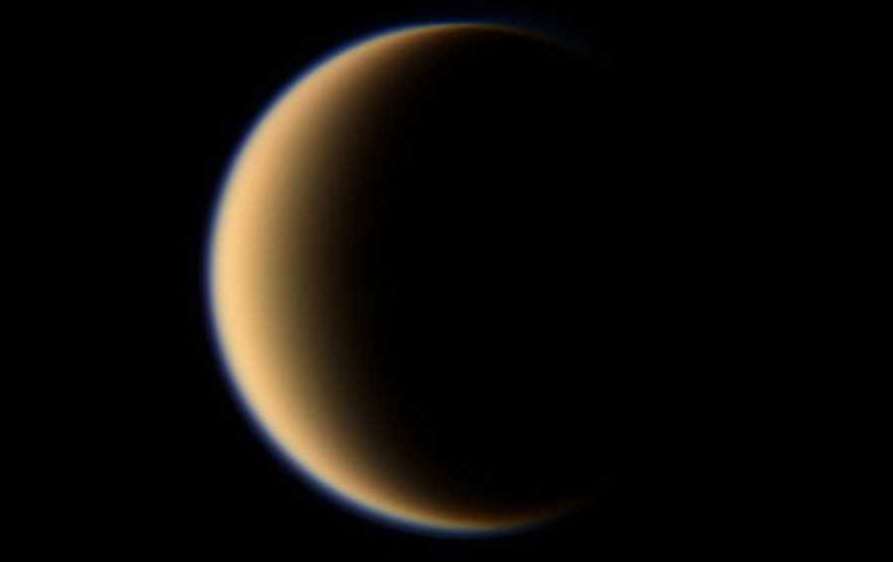
Latest computer model explains lakes and storms on Titan


Figure: Titan is covered in a thick atmosphere with abundant methane. Credit: NASA/JPL/Space Science Institute

By California Institute of Technology, Pasadena

Published: January 5, 2012

Saturn’s largest moon, Titan, is an intriguing alien world that’s covered in a thick atmosphere abundant with methane. With an average surface temperature of a brisk –300° Fahrenheit (–185° Celsius) and a diameter just less than half of Earth’s, Titan boasts methane clouds and fog as well as rainstorms and plentiful lakes of liquid methane. It’s the only place in the solar system, other than Earth, that has large bodies of liquid on its surface.

The origins of many of these features, however, remain puzzling to scientists. Now, researchers at the California Institute of Technology (Caltech) have developed a computer model of Titan’s atmosphere and methane cycle that, for the first time, explains many of these phenomena in a relatively simple and coherent way.

In particular, the new model explains three baffling observations of Titan. One oddity was discovered in 2009 when researchers found that Titan’s methane lakes tend to cluster around its poles, and noted that there are more lakes in the northern hemisphere than in the south.

Secondly, the areas at low latitudes near Titan’s equator are known to be dry, lacking lakes and regular precipitation. But when the Huygens probe landed on Titan in 2005, it saw channels carved out by flowing liquid, possibly runoff from rain. And in 2009, Caltech researchers discovered raging storms that may have brought rain to this supposedly dry region.

Finally, scientists uncovered a third mystery when they noticed that clouds observed over the past decade — during summer in Titan’s southern hemisphere — cluster around southern middle and high latitudes.

Scientists have proposed various ideas to explain these features, but their models either can’t account for all of the observations, or do so by requiring exotic processes such as cryogenic volcanoes that spew methane vapor to form clouds. The Caltech researchers say their new computer model, on the other hand, can explain all these observations and does so using relatively straightforward and fundamental principles of atmospheric circulation.

“We have a unified explanation for many of the observed features,” said Tapio Schneider from Caltech. “It doesn’t require cryovolcanoes or anything esoteric.”

Schneider said the team’s simulations were able to reproduce the distribution of clouds that’s been observed, which was not the case with previous models. The new model also produces the right distribution of lakes. Methane tends to collect in lakes around the poles because the sunlight there is weaker on average, he said. Energy from the Sun normally evaporates liquid methane on the surface, but since there’s generally less sunlight at the poles, it’s easier for liquid methane there to accumulate into lakes.

But then why are there more lakes in the northern hemisphere? Schneider points out that Saturn’s slightly elongated orbit means that Titan is farther from the Sun when it’s summer in the northern hemisphere. Kepler’s second law says that a planet orbits more slowly the farther it is from the Sun, which means that Titan spends more time at the far end of its elliptical orbit, when it’s summer in the north. As a result, the northern summer is longer than the southern summer. And since summer is the rainy season in Titan’s polar regions, the rainy season is longer in the north. Although the summer rains in the southern hemisphere are more intense — triggered by stronger sunlight because Titan is closer to the Sun during southern summer — there’s more rain over the course of a year in the north, filling more lakes.

In general, however, Titan’s weather is bland, and the regions near the equator are particularly dull, the researchers say. Years can go by without a drop of rain, leaving the lower latitudes of Titan parched. It was a surprise, then, when the Huygens probe saw evidence of rain runoff in the terrain. That surprise only increased in 2009 when Schaller, Brown, Schneider, and Henry Roe discovered storms in this same, supposedly rainless, area.

No one really understood how those storms arose, and previous models failed to generate anything more than a drizzle. But the new model was able to produce intense downpours during Titan’s vernal and autumnal equinoxes — enough liquid to carve out the type of channels that Huygens found. With the model, the researchers can now explain the storms. “It rains very rarely at low latitudes,” Schneider said. “But when it rains, it pours.”

The new model differs from previous ones in that it’s 3-D and simulates Titan’s atmosphere for 135 Titan years — equivalent to 3,000 years on Earth — so that it reaches a steady state. The model also couples the atmosphere to a methane reservoir on the surface, simulating how methane is transported throughout the moon.

The model successfully reproduces what scientists have already seen on Titan, but perhaps what’s most exciting, Schneider said, is that it also can predict what scientists will see in the next few years. For instance, based on the simulations, the researchers predict that the changing seasons will cause the lake levels in the north to rise over the next 15 years. They also predict that clouds will form around the north pole in the next two years. Making testable predictions is “a rare and beautiful opportunity in the planetary sciences,” Schneider said. “In a few years, we’ll know how right or wrong they are.”

“This is just the beginning,” he adds. “We now have a tool to do new science with, and there’s a lot we can do and will do.”

El Gordo : largest galaxy cluster in early universe


Figure: Composite image of the El Gordo galaxy cluster. An exceptional galaxy cluster, the largest seen in the distant universe, has been found using NASA’s Chandra X-ray Observatory and the Atacama Cosmology Telescope (ACT) in Chile. Credit: X-ray: NASA/CXC/Rutgers/J. Hughes et al; Optical: ESO/VLT & SOAR/Rutgers/F. Menanteau; IR: NASA/JPL/Rutgers/F. Menanteau

By Chandra X-ray Center, Cambridge, Massachusetts

Published: January 10, 2012

Officially known as ACT-CL J0102-4915, the galaxy cluster has been nicknamed “El Gordo” (“the big one” or “the fat one” in Spanish) by the researchers who discovered it. The name, in a nod to the Chilean connection, describes just one of the remarkable qualities of the cluster, which is located more than 7 billion light-years from Earth. This large distance means that it is being observed at a young age.

“This cluster is the most massive, the hottest, and gives off the most X-rays of any known cluster at this distance or beyond,” said Felipe Menanteau from Rutgers University in New Brunswick, New Jersey.

Galaxy clusters, the largest objects in the universe that are held together by gravity, form through the merger of smaller groups or sub-clusters of galaxies. Because the formation process depends on the amount of dark matter and dark energy in the universe, clusters can be used to study these mysterious phenomena.

Dark matter is material that can be inferred to exist through its gravitational effects, but it does not emit and absorb detectable amounts of light. Dark energy is a hypothetical form of energy that permeates all space and exerts a negative pressure that causes the universe to expand at an ever-increasing rate.

“Gigantic galaxy clusters like this are just what we were aiming to find,” said Jack Hughes, also from Rutgers. “We want to see if we understand how these extreme objects form using the best models of cosmology that are currently available.”

Although a cluster of El Gordo’s size and distance is extremely rare, it is likely that its formation can be understood in terms of the standard Big Bang model of cosmology. In this model, the universe is composed predominantly of dark matter and dark energy and began with the Big Bang about 13.7 billion years ago.

The team of scientists found El Gordo using ACT thanks to the Sunyaev-Zel’dovich effect. In this phenomenon, photons in the cosmic microwave background interact with electrons in the hot gas that pervades these enormous galaxy clusters. The photons acquire energy from this interaction, which distorts the signal from the microwave background in the direction of the clusters. The magnitude of this distortion depends on the density and temperature of the hot electrons and the physical size of the cluster.

X-ray data from Chandra and the European Southern Observatory’s Very Large Telescope, an 8-meter optical observatory in Chile, show that El Gordo is, in fact, the site of two galaxy clusters running into one another at several million miles per hour. This and other characteristics make El Gordo akin to the well-known object called the Bullet Cluster, which is located almost 4 billion light-years closer to Earth.

As with the Bullet Cluster, there is evidence that normal matter, mainly composed of hot, X-ray bright gas, has been wrenched apart from the dark matter in El Gordo. The hot gas in each cluster was slowed down by the collision, but the dark matter was not.

According to 'Felipe Menanteau' of Rutgers University who led the study says, "This cluster is the most massive, the hottest, and gives off the most X-rays of any known cluster at this distance or beyond."

Based on European Southern Observatory's Very Large Telescope and Chandra X-ray Observatory findings, El Gordo is composed of two separate galaxy subclusters , colliding at several million kilometers per hour. Their observation based on X-ray data and other characteristics suggests that, 'El Gordo' most probably formed like Bullet Cluster and make akin to the Bullet Cluster, located 4 billion light years to Earth. According to 'Cristobal Sifon' from Pontifical Catholic University of Chile says, "This is the first time we've found a system like the Bullet Cluster at such a large distance."

“This is the first time we’ve found a system like the Bullet Cluster at such a large distance,” said Cristobal Sifon from Pontificia Universidad de Catolica de Chile (PUC) in Santiago. “It’s like the expression says: If you want to understand where you’re going, you have to know where you’ve been.”

The Astrophysical Journal has accepted the results for publication and will announce its findings and results on 'El Gordo' at its 219th meeting in Austin of Texas.

Friday, December 30, 2011

Fermi shows that Tycho's star shines in gamma rays


Fig: Gamma rays detected by Fermi's LAT show that the remnant of Tycho's supernova shines in the highest-energy form of light. This portrait of the shattered star includes gamma rays (magenta), X-rays (yellow, green, and blue), infrared (red) and optical data. Gamma ray, NASA/DOE/Fermi LAT Collaboration; X-ray, NASA/CXC/SAO; Infrared, NASA/JPL-Caltech; Optical, MPIA, Calar Alto, O. Krause et al. and DSS

By NASA's Goddard Space Flight Center, Greenbelt, Maryland

Published: December 16, 2011

In early November 1572, observers on Earth witnessed the appearance of a “new star” in the constellation Cassiopeia, an event now recognized as the brightest naked-eye supernova in more than 400 years. It’s often called “Tycho’s supernova” after the great Danish astronomer Tycho Brahe, who gained renown for his extensive study of the object. Now, years of data collected by NASA’s Fermi Gamma-Ray Space Telescope reveal that the shattered star’s remains shine in high-energy gamma rays.

The detection gives astronomers another clue in understanding the origin of cosmic rays, subatomic particles — mainly protons — that move through space at nearly the speed of light. Exactly where and how these particles attain such incredible energies has been a long-standing mystery because charged particles speeding through the galaxy are easily deflected by interstellar magnetic fields. This makes it impossible to track cosmic rays back to their sources.

“Fortunately, high-energy gamma rays are produced when cosmic rays strike interstellar gas and starlight,” said Francesco Giordano from the University of Bari and the National Institute of Nuclear Physics in Italy. “These gamma rays come to Fermi straight from their sources.”

Better understanding the origins of cosmic rays is one of Fermi’s key goals. Its Large Area Telescope (LAT) scans the entire sky every three hours, gradually building up an ever-deeper view of the gamma-ray sky. Because gamma rays are the most energetic and penetrating form of light, they serve as signposts for the particle acceleration that gives rise to cosmic rays.

“This detection gives us another piece of evidence supporting the notion that supernova remnants can accelerate cosmic rays,” said Stefan Funk from the Kavli Institute for Particle Astrophysics and Cosmology (KIPAC) in Stanford, California.

In 1949, physicist Enrico Fermi — the satellite’s namesake — suggested that the highest-energy cosmic rays were accelerated in the magnetic fields of interstellar gas clouds. In the decades that followed, astronomers showed that supernova remnants might be the galaxy’s best candidate sites for this process.

When a star explodes, it is transformed into a supernova remnant, a rapidly expanding shell of hot gas bounded by the blast’s shock wave. Scientists expect that magnetic fields on either side of the shock front can trap particles between them in what amounts to a subatomic Pingpong game.

“A supernova remnant’s magnetic fields are very weak relative to Earth’s, but they extend across a vast region, ultimately spanning thousands of light-years,” said Melitta Naumann-Godo from Paris Diderot University and the Atomic Energy Commission in Saclay, France. “They have a major influence on the course of charged particles.”

As they shuttle back and forth across the supernova shock, the charged particles gain energy with each traverse. Eventually, they break out of their magnetic confinement, escaping the supernova remnant and freely roaming the galaxy.

The LAT’s ongoing sky survey provides additional evidence favoring this scenario. Many younger remnants, like Tycho’s, tend to produce more high-energy gamma rays than older remnants. “The gamma-ray energies reflect the energies of the accelerated particles that produce them, and we expect more cosmic rays to be accelerated to higher energies in younger objects because the shock waves and their tangled magnetic fields are stronger,” Funk said. By contrast, older remnants with weaker shock waves cannot retain the highest-energy particles, and the LAT does not detect gamma rays with corresponding energies.

The supernova of 1572 was one of the great watersheds in the history of astronomy. The star blazed forth at a time when the starry sky was regarded as a fixed and unchanging part of the universe. Tycho’s candid account of his own discovery of the strange star gives a sense of how radical an event it was.

The supernova first appeared around November 6, but poor weather kept it from Tycho until November 11, when he noticed it during a walk before dinner. “When I had satisfied myself that no star of that kind had ever shone forth before, I was led into such perplexity by the unbelievability of the thing that I began to doubt the faith of my own eyes, and so, turning to the servants who were accompanying me, I asked them whether they too could see a certain extremely bright star. ... They immediately replied with one voice that they saw it completely and that it was extremely bright,” he said.

The supernova remained visible for 15 months and exhibited no movement in the heavens, indicating that it was located far beyond the Sun, Moon, and planets. Modern astronomers estimate that the remnant lies between 9,000 and 11,000 light-years away.

After more than 2.5 years of scanning the sky, LAT data clearly show that an unresolved region of GeV (billion electron volt) gamma-ray emission is associated with the remnant of Tycho’s supernova. (For comparison, the energy of visible light is between about 2 and 3 electron volts.)

“We knew that Tycho’s supernova remnant could be an important find for Fermi because this object has been so extensively studied in other parts of the electromagnetic spectrum,” said Keith Bechtol from SLAC. “We thought it might be one of our best opportunities to identify a spectral signature indicating the presence of cosmic-ray protons.” he said.

The science team’s model of the emission is based on LAT observations along with higher-energy TeV (trillion electron volt) gamma rays mapped by ground-based facilities and radio and X-ray data. The researchers conclude that a process called pion production best explains the emission. First, a proton traveling close to the speed of light strikes a slower-moving proton. This interaction creates an unstable particle — a pion — with only 14 percent of the proton’s mass. In just 10 millionths of a billionth of a second, the pion decays into a pair of gamma rays.

If this interpretation is correct, then somewhere within the remnant protons are being accelerated to near the speed of light, and then interacting with slower particles to produce gamma rays, the most extreme form of light. With such unbelievable goings-on in what’s left of his “unbelievable” star, it’s easy to imagine that Tycho Brahe himself might be pleased.

Astronomers discover two planets that survived their star's expansion


Fig: Two planets that survived the red-giant expansion of their host star. Illustration by Stéphane Charpinet/Institut de Recherche en Astrophysique et Planétologie in Toulouse, France

By Iowa State University, Ames

Published: December 22, 2011

Astronomers have discovered two Earth-sized planets that survived getting caught in the red-giant expansion of their host star.

Steve Kawaler from Iowa State University helped the research team study data from the Kepler space telescope to confirm that tiny variations of light from a star were actually caused by two planets orbiting it. Stéphane Charpinet from the Institut de Recherche en Astrophysique et Planétologie in Toulouse, France, is the leader of the research team.

“This is a snapshot of what our solar system might look like after several billion more years of evolution,” Kawaler said. “This can help us learn about the future of planetary systems and of our own Sun.”

Kawaler said the researchers have studied pulsations of the planets’ host star, KIC 05807616 — an old star just past its red-giant stage — for about two years. While analyzing the data, Charpinet noticed two tiny variations repeated in 5.76- and 8.23-hour intervals.

He asked other astronomers, including Kawaler, to analyze the original Kepler data and a subsequent set of data to see if they also could see the variations.

“We saw them in the same place and the same periodicity,” Kawaler said. “So we knew they were real.”

That led to the next question: “So what are they?”

Kawaler has studied the fastest and slowest rates that stars could pulsate. Using that result, the team could conclude the variations seen by Kepler were too slow to be from the star itself. So the astronomers started testing the idea that the variations were from two planets orbiting the star.

Astronomers believe the variations from the two planets, KOI 55.01 and KOI 55.02, are caused by reflection of the star’s light on the planets and by temperature differences between the hot day-sides and cooler night-sides of the planets.

The astronomers also report the planets are 76 percent and 87 percent the size of Earth. That makes them among the smallest planets detected around a star other than our Sun.

They further report the planets are close to their host star, only 0.6 percent and 0.76 percent the distance between the Sun and Earth. That means conditions on the planets are harsh with temperatures up to 16,000° Fahrenheit (9,000° Celsius).

That’s so close that the host star’s expansion to a red giant would have engulfed the planets, possibly stripping gas giant planets similar to Jupiter down to their dense cores. The planets also could have contributed to the host star’s unusual loss of mass.

The research team said the discovery of the two planets raises many questions about their ability to survive such harsh conditions. It also raises questions about how planets can affect the evolution of their host stars.

A galaxy cluster gets sloshed


Fig: The hot gas in the galaxy cluster Abell 2052 is being sloshed back and forth. The sloshing was set in motion when a small cluster smashed into the larger central one. The large spiral structure on the outside of the image was also caused by that off-center collision. Sloshing of hot gas like this can affect how the giant elliptical galaxy and its supermassive black hole at the center grow.

X-ray: NASA/CXC/BU/L.Blanton; Optical: ESO/VLT

By Chandra X-ray Center, Cambridge, Massachusetts

Published: December 14, 2011

Like wine in a glass, vast clouds of hot gas are sloshing back and forth in Abell 2052, a galaxy cluster located about 480 million light-years from Earth. X-ray data (blue) from NASA’s Chandra X-ray Observatory shows the hot gas in this dynamic system, and optical data (gold) from the Very Large Telescope shows the galaxies. The hot X-ray-bright gas has an average temperature of about 30 million degrees.

A huge spiral structure in the hot gas — spanning almost a million light-years across — is seen around the outside of the image, surrounding a giant elliptical galaxy at the center. This spiral was created when a small cluster of galaxies smashed into a larger one that surrounds the central elliptical galaxy.

As the smaller cluster approached, the dense hot gas of the central cluster was attracted to it by gravity. After the smaller cluster passed the cluster core, the direction of motion of the cluster gas reversed, and it traveled back toward the cluster center. The cluster gas moved through the center again and “sloshed” back and forth. The sides of the glass push the wine back to the center, whereas in the cluster the gravitational force of the matter in the clusters pulls it back. The sloshing gas ended up in a spiral pattern because the collision between the two clusters was off-center.

This type of sloshing in Abell 2052 has important physical implications. First, it helps push some of the more dense, cooler gas located in the center of the cluster — where temperatures are only about 10 million degrees — farther away from the core. This helps prevent further cooling of this gas in the core and could limit the amount of new stars being formed in the central galaxy. Sloshing motions like those seen in Abell 2052 also redistribute heavy elements, like iron and oxygen, which are forged in supernova explosions. These elements are used in the future generations of stars and planets and are necessary for life, as we know it.

Chandra’s observation of Abell 2052 was particularly long, lasting more than a week. Such a deep observation was necessary to detect all of the details in this image. Even then, processing to emphasize more-subtle features was necessary to reveal the outer spiral structure.

In addition to the large-scale spiral feature, the deep Chandra observation reveals exquisite detail in the cluster center related to outbursts from the central supermassive black hole. The Chandra data show clear bubbles evacuated by material blasted away from the black hole, which are surrounded by dense, bright, cool rims. As with the sloshing, this activity helps prevent cooling of the gas in the cluster’s core, setting limits on the growth of the giant elliptical galaxy and its supermassive black hole.

Coronal mass ejections (CMEs) could "sandblast" the Moon


Fig: Coronal mass ejection as viewed by the Solar Dynamics Observatory
(June 7, 2011. NASA/SDO)

By NASA's Goddard Space Flight Center, Greenbelt, Maryland

Published: December 12, 2011

Solar storms and associated coronal mass ejections (CMEs) can significantly erode the lunar surface, according to a new set of computer simulations by NASA scientists. In addition to removing a surprisingly large amount of material from the lunar surface, this could be a major method of atmospheric loss for planets like Mars that are unprotected by a global magnetic field.

Rosemary Killen is leading the research from NASA’s Goddard Space Flight Center in Greenbelt, Maryland, as part of the Dynamic Response of the Environment At the Moon (DREAM) team within the NASA Lunar Science Institute.

CMEs are basically an intense gust of the normal solar wind, a diffuse stream of electrically conductive gas called plasma that’s blown outward from the surface of the Sun into space. A strong CME may contain around a billion tons of plasma moving at up to 1 million mph (1.6 million km/h) in a cloud many times the size of Earth.

The Moon has just the barest wisp of an atmosphere, technically called an exosphere because it is so tenuous, which leaves it vulnerable to CME effects. The plasma from CMEs impacts the lunar surface, and atoms from the surface are ejected in a process called “sputtering.”

“We found that when this massive cloud of plasma strikes the Moon, it acts like a sandblaster and easily removes volatile material from the surface,” said William Farrell from NASA’s Goddard Space Flight Center. “The model predicts 100 to 200 tons of lunar material — the equivalent of 10 dump-truck loads — could be stripped off the lunar surface during the typical two-day passage of a CME.”

This is the first time researchers have attempted to predict the effects of a CME on the Moon. “Connecting various models together to mimic conditions during solar storms is a major goal of the DREAM project,” said Farrell.

Plasma is created when energetic events, like intense heat or radiation, remove electrons from the atoms in a gas, turning the atoms into electrically charged particles called ions. The Sun is so hot that the gas is emitted in the form of free ions and electrons called the solar wind plasma. Ejection of atoms from a surface or an atmosphere by plasma ions is called sputtering.

“Sputtering is among the top five processes that create the Moon’s exosphere under normal solar conditions, but our model predicts that during a CME, it becomes the dominant method by far, with up to 50 times the yield of the other methods,” said Killen.

CMEs are effective at removing lunar material not only because they are denser and faster than the normal solar wind, but also because they are enriched in highly charged, heavy ions, according to the team. The typical solar wind is dominated by lightweight hydrogen ions (protons). However, a heavier helium ion with more electrons removed, and hence a greater electric charge, can sputter tens of times more atoms from the lunar surface than a hydrogen ion.

The team used data from satellite observations that revealed this enrichment as input to their model. For example, helium ions make up about 4 percent of the normal solar wind, but observations reveal that during a CME they can increase to over 20 percent. When this enrichment is combined with the increased density and velocity of a CME, the highly charged, heavy ions in CMEs can sputter 50 times more material than protons in the normal solar wind.

“The computer models isolate the contributions from sputtering and other processes,” said Dana Hurley from the Johns Hopkins University Applied Physics Laboratory in Laurel, Maryland. “Comparing model predictions through a range of solar wind conditions allows us to predict the conditions when sputtering should dominate over the other processes. Those predictions can later be compared to data during a solar storm.”

The researchers believe that NASA’s Lunar Atmosphere And Dust Environment Explorer (LADEE) — a lunar orbiter mission scheduled to launch in 2013 — will be able to test their predictions. The strong sputtering effect should kick lunar surface atoms to LADEE’s orbital altitude, about 12 to 31 miles (19 to 50 kilometers), so the spacecraft will see them increase in abundance.

“This huge CME sputtering effect will make LADEE almost like a surface mineralogy explorer, not because LADEE is on the surface, but because during solar storms surface atoms are blasted up to LADEE,” said Farrell.

The Moon is not the only heavenly body affected by the dense CME driver gas. Space scientists have long been aware that these solar storms dramatically affect Earth’s magnetic field and are responsible for intense aurorae (the northern and southern lights).

While certain areas of the martian surface are magnetized, Mars does not have a magnetic field that surrounds the entire planet. Therefore, CME gases have a direct path to sputter and erode that planet’s upper atmosphere. In late 2013, NASA will launch the Mars Atmosphere and Volatile Evolution (MAVEN) mission that will orbit the Red Planet to investigate exactly how solar activity, including CMEs, removes the atmosphere.

On exposed small bodies like asteroids, the dense, fast-streaming CME gas should create a sputtered-enhanced exosphere about the object, similar to that expected at the Moon.

Tuesday, December 6, 2011

Kepler's First Planet Inside Habitable (Outside Solar System)


This diagram compares our own solar system to Kepler-22, a star system containing the first "habitable zone" planet discovered by NASA's Kepler mission. NASA/Ames/JPL-Caltech

By NASA Headquarters, Washington, D.C.

Published: December 5, 2011

NASA’s Kepler mission has confirmed its first planet in the “habitable zone,” the region where liquid water could exist on a planet’s surface. Kepler also has discovered more than 1,000 new planet candidates, nearly doubling its previously known count. Ten of these candidates are near Earth’s size and orbit in the habitable zone of their host star. Candidates require follow-up observations to verify they are actual planets.

The newly confirmed planet, Kepler-22b, is the smallest yet found to orbit in the middle of the habitable zone of a star similar to our Sun. The planet is about 2.4 times the radius of Earth. Scientists don’t yet know if Kepler-22b has a predominantly rocky, gaseous, or liquid composition, but its discovery is a step closer to finding Earth-like planets.

Previous research hinted at the existence of near-Earth-sized planets in habitable zones, but clear confirmation proved elusive. Two other small planets orbiting stars smaller and cooler than our Sun recently were confirmed on the edges of the habitable zone, with orbits more closely resembling those of Venus and Mars.

“This is a major milestone on the road to finding Earth’s twin,” said Douglas Hudgins from NASA Headquarters in Washington, D.C. “Kepler’s results continue to demonstrate the importance of NASA’s science missions, which aim to answer some of the biggest questions about our place in the universe.”

Kepler discovers planets and planet candidates by measuring dips in the brightness of more than 150,000 stars to search for planets that cross in front, or “transit,” the stars. Kepler requires at least three transits to verify a signal as a planet.

“Fortune smiled upon us with the detection of this planet,” said William Borucki from NASA Ames Research Center at Moffett Field, California. “The first transit was captured just three days after we declared the spacecraft operationally ready. We witnessed the defining third transit over the 2010 holiday season.”

The Kepler science team uses ground-based telescopes and the Spitzer Space Telescope to review observations on planet candidates the spacecraft finds. The star field that Kepler observes in the constellations Cygnus and Lyra are only visible from ground-based observatories in spring through early fall. The data from these other observations help determine which candidates can be validated as planets.

Kepler-22b is located 600 light-years away. While the planet is larger than Earth, its orbit of 290 days around a Sun-like star resembles that of our world. The planet’s host star belongs to the same class as our Sun, called G-type, although it is slightly smaller and cooler.

Of the 54 habitable zone planet candidates reported in February 2011, Kepler-22b is the first to be confirmed.

The Kepler team is hosting its inaugural science conference at Ames December 5–9, announcing 1,094 new planet candidate discoveries. Since the last catalog was released in February, the number of planet candidates identified by Kepler has increased by 89 percent, and now totals 2,326. Of these, 207 are approximately Earth-sized, 680 are super-Earth-sized, 1,181 are Neptune-sized, 203 are Jupiter-sized, and 55 are larger than Jupiter.

The findings, based on observations conducted May 2009 to September 2010, show a dramatic increase in the numbers of smaller-sized planet candidates.


Kepler observed many large planets in small orbits early in its mission, which were reflected in the February data release. Having had more time to observe three transits of planets with longer orbital periods, the new data suggest that planets one to four times the size of Earth may be abundant in the galaxy.

The number of Earth-sized and super-Earth-sized candidates has increased by more than 200 and 140 percent since February, respectively.

There are 48 planet candidates in their stars’ habitable zones. While this is a decrease from the 54 reported in February, the Kepler team has applied a stricter definition of what constitutes a habitable zone in the new catalog to account for the warming effect of atmospheres, which would move the zone away from the star out to longer orbital periods.

“The tremendous growth in the number of Earth-size candidates tells us that we’re honing in on the planets that Kepler was designed to detect: those that are not only Earth-size, but also are potentially habitable,” said Natalie Batalha from San Jose State University in California. “The more data we collect, the keener our eye for finding the smallest planets out at longer orbital periods.”